
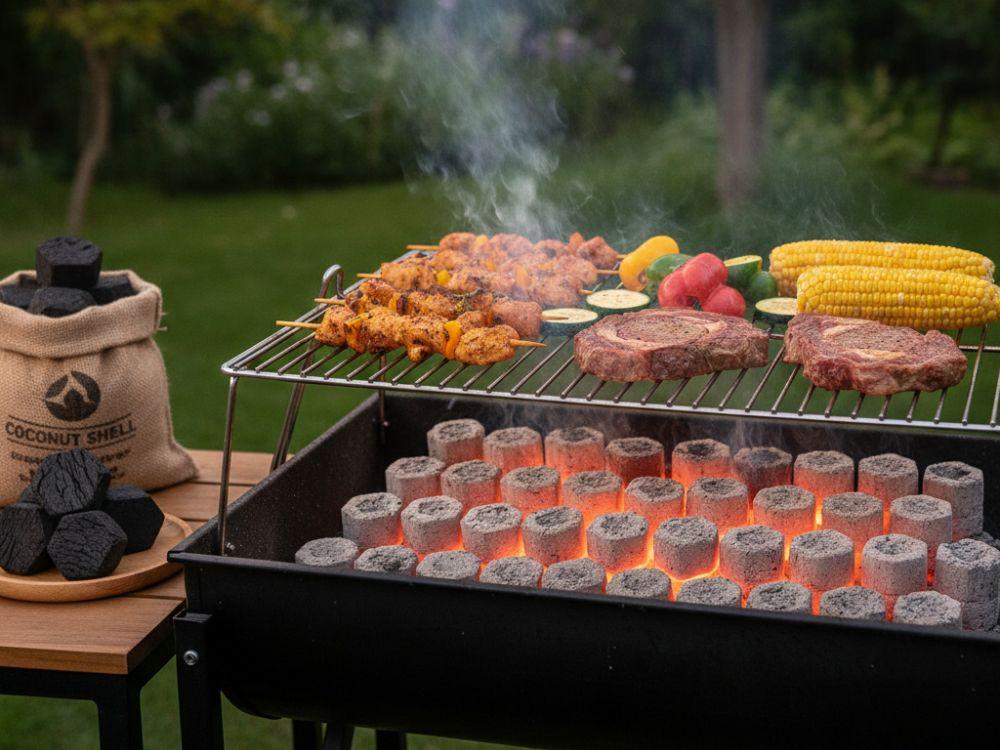
Professional chefs, restaurant owners, and serious grill masters understand that charcoal choice determines grilling success. When you’re running a high-volume kitchen or serving customers who demand perfectly cooked food every time, your fuel source needs to deliver consistent results.
Coconut shell charcoal briquettes have emerged as the superior BBQ fuel—not through marketing hype, but through measurable performance advantages that directly impact cooking quality, operational efficiency, and bottom-line costs.
The Superior Performance Numbers
Coconut charcoal delivers performance metrics that traditional options cannot match:
Heat Output: 7,000-7,500 kcal/kg compared to traditional wood charcoal at 4,000-5,000 kcal/kg. This represents 30-50% higher energy efficiency per kilogram.
Burn Time: 3-4 hours continuous heat from a single loading, compared to 1.5 hours for regular charcoal briquettes and just 1 hour for lump charcoal at equivalent quantities.
Temperature Range: 650-800°F sustained temperature with the ability to reach searing temperatures above 800°F when needed, outperforming standard briquettes (715°F) and matching premium lump charcoal (735°F).
Ash Production: Less than 5% ash residue, compared to 10% or more from wood-based alternatives. This translates directly to less cleanup time and fewer service interruptions.
These aren’t marketing claims. These are measured specifications from independent laboratory testing and field performance data collected across thousands of commercial grilling operations.
What Makes Coconut Charcoal Different
Coconut shell charcoal starts with a fundamentally superior raw material. The dense structure of carbonized coconut shells creates briquettes with higher fixed carbon content (75-85%) compared to compressed wood charcoal (60-70%).
The production process matters significantly. Premium coconut charcoal undergoes carbonization at controlled temperatures between 400-600°C in oxygen-deprived environments. This process creates pure carbon without the impurities and inconsistencies that plague wood-based alternatives.
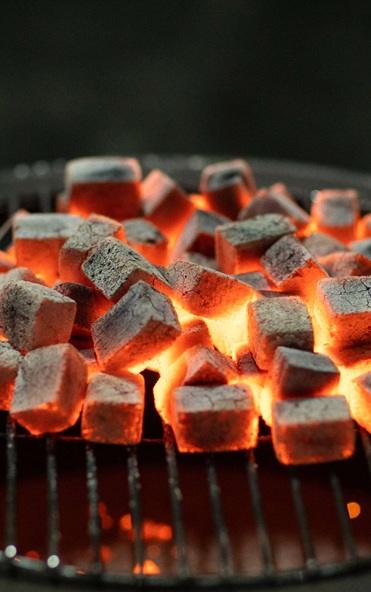
The result is uniform briquettes—whether cube, hexagonal, or finger shapes—that burn predictably and consistently. Restaurant kitchens operating multiple grills simultaneously need this reliability. When you’re managing dinner service for 200 customers, you cannot afford temperature fluctuations or premature charcoal burnout.
Consistent Temperature Control Advantage
Temperature consistency separates amateur grilling from professional results. Coconut charcoal’s dense composition and high calorific value create steady heat output throughout the entire burn cycle.
Traditional lump charcoal burns hot initially but temperature drops rapidly as the charcoal consumes. Standard briquettes provide moderate consistency but lack the heat intensity needed for proper searing. Coconut charcoal maintains both high temperature and consistency across 3-4 hour periods.
For professional kitchens, this consistency means:
- Predictable cooking times across all stations
- Reduced food waste from undercooked or overcooked items
- Consistent quality regardless of which grill chef is working
- Ability to maintain service during peak hours without temperature management issues
The high fixed carbon content creates this stability. Carbon burns slowly and evenly, releasing heat in controlled fashion rather than the rapid, inconsistent combustion that characterizes lower-quality fuels.
Extended Burn Time Creates Operational Efficiency
A 7-pound package of coconut charcoal equals 14 pounds of regular charcoal in burn time. This 2:1 ratio fundamentally changes operational economics for high-volume operations.
Consider a busy steakhouse operating five grills during dinner service: Traditional charcoal requires reloading every 90 minutes. Staff members must interrupt food preparation to manage charcoal replenishment, creating service slowdowns and safety risks from hot charcoal handling.
Coconut charcoal’s 3-4 hour burn time typically covers an entire service period with a single loading. This eliminates mid-service reloading, reduces staff labor hours, and improves kitchen safety by minimizing hot charcoal exposure.
The extended burn time comes from density. Coconut shell briquettes compress to 1.0-1.2 g/cm³, significantly denser than wood-based alternatives. This density stores more energy per unit volume, extending service life without requiring larger fuel loads.
Minimal Ash Production Reduces Labor
Ash management represents hidden costs in commercial grilling operations. Wood charcoal generating 10% ash content creates substantial cleanup burdens, particularly in operations running multiple services daily.
Coconut charcoal’s sub-5% ash content cuts cleanup time by roughly 50%. More importantly, the ash produced is finer and lighter, making removal faster and reducing the dusty mess that contaminates food preparation areas.
The white ash color indicates complete combustion. This visual cue tells experienced grill operators that the charcoal has burned efficiently, extracting maximum heat value. Dark or black ash signals incomplete combustion and wasted fuel—a problem virtually eliminated with properly carbonized coconut charcoal.
Less ash also means less airflow restriction. Heavy ash buildup blocks oxygen flow through grill vents, reducing temperature control capability. Coconut charcoal maintains clear air passages throughout the burn cycle, preserving precise temperature adjustment ability.
Neutral Flavor Profile Benefits
Traditional charcoal imparts varying degrees of smoky flavor depending on wood species and carbonization quality. For many grilling applications, this adds desirable character. However, the neutral flavor profile of coconut charcoal offers distinct advantages for specific culinary approaches.
High-end restaurants using carefully developed rubs, marinades, and seasoning profiles need the charcoal to provide heat without competing flavors. Coconut charcoal burns virtually odorless and tasteless, allowing the chef’s intended flavor profile to shine through without interference.
This neutral base makes coconut charcoal particularly valuable for:
- Seafood grilling where delicate flavors require clean heat
- Poultry preparations with herb and spice complexities
- Vegetable grilling where natural sweetness should dominate
- Asian cuisine applications where specific flavor profiles must remain uncontaminated
Professional kitchens can add desired smoke flavors through wood chips or chunks while maintaining the clean-burning, consistent heat that coconut charcoal provides. This separation of heat source and flavor source gives chefs precise control over final taste profiles.
Superior Heat Management Capability
Coconut charcoal responds effectively to airflow adjustments, allowing precise temperature control through vent manipulation. The high heat capacity combined with controllable combustion enables both high-temperature searing and low-temperature smoking from the same fuel source.
High-heat applications: The 800°F capability enables proper Maillard reaction development for steakhouse-quality crusts. Many restaurants struggle to achieve authentic char marks and caramelized exteriors—coconut charcoal’s heat output solves this problem consistently.
Low-and-slow cooking: The same fuel that sears steaks also maintains stable 225-275°F temperatures for hours-long smoking sessions. This versatility reduces inventory complexity, as kitchens need only stock one high-quality charcoal type rather than multiple products for different applications.
The uniform briquette size and shape facilitate predictable heat zone creation. Chefs can arrange charcoal to create direct and indirect heat zones with confidence that temperature differentials will remain stable throughout service.
Environmental and Sustainability Advantages
Coconut charcoal production utilizes agricultural waste—coconut shells from the coconut processing industry—that would otherwise be discarded or burned without energy recovery. This waste-to-product approach represents genuine circular economy principles.
Zero deforestation impact. Unlike wood charcoal requiring tree harvesting, coconut charcoal comes exclusively from shells remaining after coconut meat and water extraction. Indonesia, the Philippines, and other major coconut-producing regions generate millions of tons of shell waste annually—converting this to premium charcoal creates value from waste streams.
The renewable nature of coconut farming ensures continued raw material availability without environmental degradation. Coconut palms produce shells continuously for decades, creating sustainable feedstock supplies that don’t deplete forest resources or require dedicated agricultural land.
For restaurants emphasizing environmental responsibility, coconut charcoal provides substantive sustainability credentials that resonate with increasingly eco-conscious customers. This isn’t greenwashing—it’s measurable environmental impact reduction through agricultural waste utilization.
Cost Analysis: Initial Price vs. Total Value
Coconut charcoal typically costs more per kilogram than standard charcoal briquettes. This higher unit price creates initial sticker shock for procurement managers comparing prices on paper.
However, total cost analysis reveals coconut charcoal’s economic advantage:
Consider a restaurant using 20 kg of standard charcoal per day at $2/kg = $40 daily fuel cost. The same operation using coconut charcoal consumes approximately 10 kg per day (due to 2:1 efficiency ratio) at $3.50/kg = $35 daily fuel cost.
The 12.5% cost reduction comes purely from superior burn efficiency. Additional savings accumulate from reduced labor (fewer charcoal changes), less ash disposal, and improved food consistency reducing waste from cooking errors.
Monthly impact for a single restaurant: $150 direct fuel savings, plus approximately $200 in labor reduction from fewer charcoal management tasks, plus approximately $100 in reduced food waste from more consistent cooking temperatures. Total monthly advantage: $450.
For restaurant groups operating multiple locations, these savings scale proportionally, creating substantial annual cost reductions while simultaneously improving product quality.
Practical Considerations for Professional Use
Lighting requirements: Coconut charcoal requires electric burners or charcoal chimneys for ignition, typically taking 10-15 minutes to reach cooking temperature. Quick-light options with chemical accelerants are available but compromise the clean-burning advantages that make coconut charcoal superior.
Most professional kitchens already use chimney starters or electric ignition systems, so this requirement creates no additional infrastructure needs. The 10-15 minute ignition time actually works advantageously—staff can light charcoal at the start of prep periods, ensuring optimal temperature by service start.
Storage requirements: Coconut charcoal must remain dry to maintain performance characteristics. The highly porous structure absorbs moisture readily, and damp charcoal ignites poorly and burns inconsistently. Proper storage in sealed containers or climate-controlled areas preserves quality indefinitely.
This storage requirement matches standard food safety practices already in place at professional operations. No special storage systems are needed—simply keep charcoal dry as you would keep flour or sugar dry.
Sourcing considerations: Quality varies significantly between suppliers. Premium coconut charcoal from certified producers (ISO, SGS certifications) delivers the performance characteristics described here. Lower-grade products may contain fillers, incomplete carbonization, or inconsistent sizing that undermines performance.
Working with established Indonesian or Filipino exporters who provide laboratory test results and maintain consistent quality standards ensures reliable performance. Request sample batches before committing to large orders, and verify specifications match your operational needs.
Comparison with Traditional Alternatives
Coconut Charcoal vs. Lump Hardwood Charcoal:
Lump charcoal offers authentic wood-smoke flavor and reaches high temperatures quickly. However, irregular shapes create inconsistent heat distribution, pieces vary dramatically in size causing unpredictable burn rates, and the relatively short burn time (1 hour typical) requires frequent reloading during service.
Coconut charcoal trades the distinctive wood flavor for superior consistency, extended burn time, and predictable performance. For operations where flavor control matters more than traditional wood-smoke character, coconut wins decisively.
Coconut Charcoal vs. Standard Briquettes:
Traditional briquettes made from compressed sawdust and wood scraps provide reasonable consistency and moderate burn times (1.5 hours typical). However, heat output remains lower than coconut charcoal, ash production runs higher, and many contain chemical binders that can affect flavor.
Coconut charcoal delivers everything standard briquettes promise—uniform size, predictable burning, reasonable cost—while significantly exceeding performance in heat output, burn duration, and ash minimization.
Coconut Charcoal vs. Gas Grills:
Gas provides ultimate convenience through instant temperature adjustment and elimination of ash handling. However, gas grills cannot achieve the high heat that charcoal delivers, food lacks the subtle smoke character that even coconut charcoal provides, and many customers specifically prefer charcoal-grilled flavor profiles.
Coconut charcoal bridges the gap—delivering near-gas-level consistency and predictability while maintaining authentic charcoal grilling characteristics that customers value.
Implementation Strategy for Commercial Operations
Transitioning to coconut charcoal requires systematic planning rather than abrupt changeover:
Phase 1: Pilot Testing (2-4 weeks)
Select one grill station for coconut charcoal evaluation. Train grill operators on ignition procedures and temperature management techniques specific to coconut charcoal’s characteristics. Document fuel consumption, cooking consistency, and staff feedback.
Compare results against traditional charcoal baseline—measure burn time per load, ash volume per service period, and consistency of cooking temperatures across service.
Phase 2: Operational Refinement (4-6 weeks)
Based on pilot results, adjust loading quantities and lighting procedures to optimize performance for your specific menu and service patterns. Different foods require different temperature profiles—fine-tune coconut charcoal management to match your actual needs.
Calculate accurate cost comparisons using real consumption data rather than theoretical estimates. This reveals true economic impact based on your operational patterns.
Phase 3: Full Implementation (Ongoing)
Roll out coconut charcoal across all grill stations. Update staff training materials to incorporate learned best practices. Establish relationships with reliable suppliers to ensure consistent sourcing.
Monitor performance metrics continuously—fuel costs, cooking consistency, customer feedback, and staff satisfaction all provide data points for ongoing optimization.
Quality Indicators When Sourcing
Premium coconut shell charcoal exhibits specific characteristics:
- Fixed carbon content above 75%: This ensures high heat output and extended burn times. Lower carbon content indicates incomplete carbonization or filler materials.
- Ash content below 5%: Quality carbonization minimizes mineral residue. Higher ash content suggests impurities in raw materials or poor production processes.
- Moisture content below 8%: Dry charcoal ignites reliably and burns cleanly. Excess moisture creates ignition difficulties and inconsistent burning.
- Uniform briquette dimensions: Consistent sizing enables predictable heat distribution and simplifies quantity calculations for loading.
- Clean black color without discoloration: Even coloring indicates thorough, complete carbonization. Brown or tan patches suggest inadequate processing.
- No chemical odor: Premium coconut charcoal smells neutral or slightly earthy. Chemical smells indicate contamination or processing issues.
Request laboratory test results from suppliers showing these specifications. Reputable producers provide third-party certification documenting product quality.
Regional Considerations and Market Dynamics
Indonesia dominates global coconut charcoal production, benefiting from vast coconut cultivation and established carbonization expertise. Filipino producers also supply premium products, particularly for Asian markets. These Southeast Asian origins create reliable supply chains for North American, European, and Middle Eastern buyers.
Import logistics require attention: Container shipping from Indonesia to North America takes 4-6 weeks, requiring advance planning for inventory management. However, coconut charcoal’s extended shelf life (indefinite when stored properly) accommodates bulk ordering without quality degradation concerns.
Minimum order quantities typically start at container loads (10-20 tons), making direct importation most practical for restaurant groups, distributors, or large single-location operations. Smaller operators can source through established importers who break down container loads into accessible quantities.
Market pricing fluctuates based on coconut shell availability, shipping costs, and demand patterns. Establishing long-term supplier relationships provides pricing stability and supply security, particularly important for high-volume operations where charcoal shortages directly impact service capability.
The Professional Verdict
Coconut shell charcoal briquettes deliver measurable performance advantages that translate directly into improved operational efficiency and better customer outcomes. The combination of high heat output, extended burn time, minimal ash production, and clean burning creates value that justifies premium pricing.
For professional operations prioritizing consistency, efficiency, and quality, coconut charcoal represents the optimal BBQ fuel choice. The transition from traditional charcoal to coconut requires minimal operational changes while delivering substantial performance improvements.
Key Takeaways
Coconut charcoal produces 30-50% more heat energy per kilogram than wood charcoal, burns 2-3 times longer than traditional alternatives, generates less than half the ash of wood-based options, and provides neutral flavor profiles that let food quality shine through.
These performance characteristics reduce fuel costs, minimize labor requirements, improve cooking consistency, and create genuine environmental benefits through agricultural waste utilization.
For restaurants, caterers, and foodservice operations committed to grilling excellence, coconut charcoal delivers the reliable, high-performance fuel source that professional cooking demands.
See out product: Premium Barbecue Coconut Charcoal
Ready to experience the coconut charcoal advantage in your operation? Our team supplies premium Indonesian coconut shell briquettes to professional kitchens across 15 countries. We provide product specifications, competitive bulk pricing, and samples for evaluation.
Contact us today to discuss your specific needs and discover why leading restaurants and hotels have made coconut charcoal their standard BBQ fuel.
Quality specifications available:
- Fixed carbon: 75-85%
- Ash content: <5%
- Moisture: <8%
- Calorific value: 7,000-7,500 kcal/kg
- Burn time: 3-4 hours continuous
- Shapes: Cube, hexagonal, finger formats
- Certifications: ISO, SGS
Note: Performance metrics cited represent premium-grade coconut shell charcoal from certified producers. Lower-grade products may not achieve these specifications.