
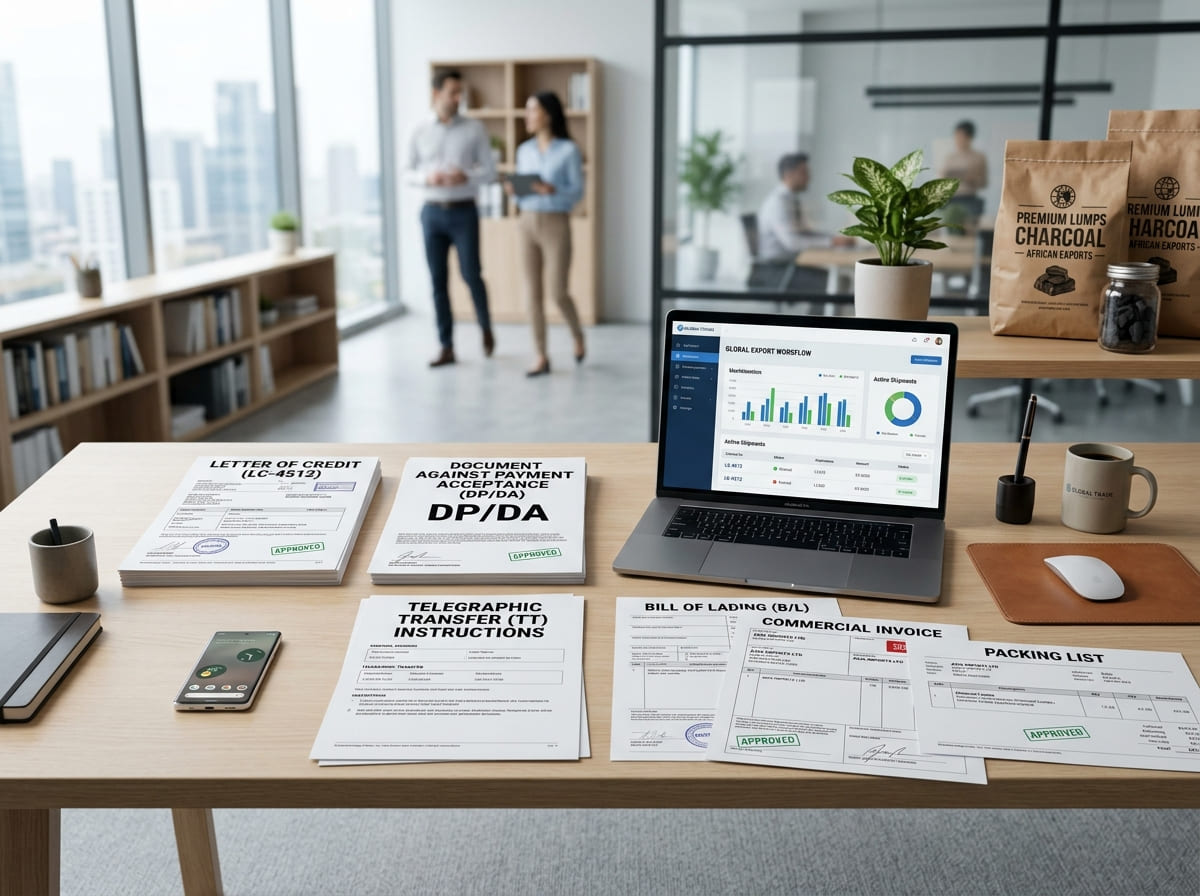
Importing coconut charcoal briquettes from Indonesia involves more than just finding the right supplier and negotiating prices. One of the most critical decisions you’ll make is choosing the right payment method. The wrong choice can expose your business to unnecessary risk or tie up working capital for months.
We’ve worked with hundreds of international buyers over the past 15 years, and payment terms often determine whether a new import relationship succeeds or fails. Understanding the three main trade finance options, Letter of Credit (LC), Documentary Payment (DP/DA), and Telegraphic Transfer (TT), helps you balance risk, cost, and cash flow based on your specific situation.
Understanding Trade Finance Basics
Trade finance instruments exist to solve a fundamental problem in international commerce: buyers and suppliers don’t fully trust each other yet. You want to receive your charcoal before paying. Your supplier wants payment before shipping. Trade finance mechanisms bridge this gap by involving banks and structured payment terms that protect both parties.
The right payment method depends on several factors: your relationship with the supplier, order size, working capital availability, and risk tolerance. A first-time order of 50 tons requires different protection than your twentieth container from a proven partner.
Letter of Credit: Maximum Security for Both Parties
A Letter of Credit is a bank guarantee that ensures payment to the supplier once they meet specific shipping and documentation requirements. Your bank issues the LC and commits to paying the supplier’s bank when they present correct documents proving shipment occurred as agreed.
How LC Works in Practice
When you open an LC, your bank sets aside funds or extends credit to cover the purchase amount. The supplier ships your charcoal and submits shipping documents to their bank. These documents typically include the commercial invoice, packing list, bill of lading, certificate of origin, and any required quality certifications like SGS inspection reports.
The supplier’s bank checks the documents against LC requirements. If everything matches exactly, they forward the documents to your bank. Your bank performs the same verification. Once approved, your bank releases payment to the supplier’s bank, which pays the supplier. You receive the shipping documents and can claim your cargo when it arrives.
This process typically takes 7-10 business days from document submission to payment, though complex LCs with multiple inspection requirements can take longer.
LC Costs and Requirements
Opening an LC costs approximately 0.5-2% of the transaction value, depending on your bank relationship and the importing country. You’ll also pay for amendments if terms change, typically USD 50-150 per amendment. Many buyers underestimate amendment costs, a single specification change or deadline extension generates fees from both banks.
Your bank may require collateral or proof of creditworthiness before issuing an LC, especially for first-time importers or large transactions. Some banks hold 100% cash collateral, while others accept a percentage based on your credit history.
When to Use LC
LCs make sense for first-time orders with new suppliers, especially for large transactions above USD 50,000. The structured process and document verification provide strong protection against fraud and shipping errors. We recommend LCs when importing from suppliers you haven’t worked with before or when buying high-value specialty products like certified organic charcoal.
One restaurant chain we work with in Germany uses LCs for their initial order with any new supplier, then switches to simpler payment terms once trust is established. This approach balances security with operational efficiency.
Documentary Payment: DP and DA Terms
Documentary Payment comes in two forms: Documents against Payment (DP) and Documents against Acceptance (DA). Both involve banks handling shipping documents but work differently than LCs.
DP Terms Explained
Under DP terms, the supplier ships your charcoal and sends documents through their bank to your bank. Your bank holds the documents until you pay. Only after payment does your bank release the bill of lading and other documents needed to claim your cargo at the port.
DP provides moderate protection for suppliers because payment happens before you take possession. For buyers, it’s less secure than LC because banks don’t verify document accuracy or match them against pre-agreed requirements. You’re paying based on the documents presented, not guaranteed compliance with your specifications.
DA Terms Explained
DA terms give you more time. The supplier’s bank sends documents to your bank along with a draft (essentially a post-dated check) that you accept. By accepting the draft, you commit to paying by a specific future date, typically 30, 60, or 90 days after acceptance. Your bank releases the shipping documents immediately after acceptance, allowing you to clear customs and take delivery before payment is due.
This structure helps your cash flow significantly. You can receive the charcoal, verify quality, possibly even resell it, before payment is required. For suppliers, DA carries more risk because you have physical possession before paying.
Cost Comparison with LC
DP and DA are significantly cheaper than LC. Bank fees typically run 0.1-0.5% of the transaction value, roughly one-third to one-quarter of LC costs. For a USD 30,000 charcoal shipment, you might pay USD 30-150 for DP/DA versus USD 150-600 for an LC.
Processing is also faster, documents usually move through the banking system in 3-5 business days compared to 7-10 days for LC verification.
When to Use DP or DA
DP works well for established supplier relationships where trust exists but you want banking channels to handle document exchange professionally. Many of our European clients use DP for their third or fourth order after LC-based initial purchases.
DA suits buyers with strong credit standing who need extended payment terms to manage cash flow. Suppliers typically require financial statements or bank references before offering DA terms. We’ve found DA most common in the Middle East hookah charcoal market, where 60-90 day payment cycles align with distributor cash flow patterns.
Telegraphic Transfer: Speed and Simplicity
Telegraphic Transfer is direct bank-to-bank payment without document handling or verification. You send money, the supplier receives it, usually within 1-2 business days. TT is the fastest and cheapest payment method but offers the least protection.
How TT Works
You instruct your bank to transfer funds to the supplier’s bank account. Your bank sends the payment electronically through the SWIFT network. The supplier’s bank credits their account. No documents are exchanged through banking channels, you handle shipping documents directly with the supplier, usually by courier or email.
TT Payment Timing Options
TT can happen at different stages: 100% advance payment before production starts, 30% deposit with 70% before shipment, or 100% after receiving copies of shipping documents. Each option shifts risk between buyer and supplier.
Full advance payment gives suppliers maximum security and working capital to purchase raw materials and arrange production. For buyers, it’s the riskiest option, you’ve paid everything before seeing product or proof of shipment.
Split payments (typically 30/70 or 50/50) balance interests. The deposit demonstrates commitment and funds initial production costs. The balance payment before shipment gives you some leverage to ensure production happens as agreed, though you still pay before receiving goods.
TT after document copies provides the most buyer protection within the TT framework. The supplier sends scanned shipping documents proving shipment occurred. You verify and send payment. The supplier then couriers original documents so you can clear customs. This approach works when you trust the supplier won’t fabricate documents, which is a serious crime but theoretically possible.
Cost and Speed Advantages
TT costs are minimal, typically USD 15-50 per transfer regardless of amount. There are no percentage-based fees, no document checking charges, no amendment costs. For a USD 30,000 order, you might pay USD 25 total in bank fees.
Processing is fast. Funds typically arrive within 24-48 hours, occasionally same day for transfers between major banking hubs. This speed helps suppliers manage production schedules and ensures your order doesn’t face delays waiting for payment confirmation.
When to Use TT
TT makes sense for established supplier relationships built over multiple successful transactions. After working with the same supplier for six months or a year, the additional cost and complexity of LC or DP often isn’t justified.
Many of our long-term clients start new supplier relationships with LC for the first 1-2 orders, switch to DP for orders 3-5, then move to TT payment terms once both parties have proven reliability. This progression balances caution with efficiency.
TT also works well for smaller orders where LC fees become prohibitively expensive on a percentage basis. For a USD 5,000 trial order, paying USD 100-200 in LC fees represents 2-4% of the transaction value. At that point, the security might not justify the cost if you’ve done proper supplier vetting.
Read: Self-Heating Treatment (SHT) Certified vs Non-Certified Charcoal
Choosing the Right Payment Method
Your decision should account for supplier relationship stage, order value, working capital position, and risk tolerance.
For first-time suppliers, LC provides the strongest protection despite higher costs. The document verification process catches many potential issues before they become expensive problems. We’ve seen LCs prevent fraud, ensure compliance with import regulations, and resolve disputes about product specifications.
After 2-3 successful LC transactions, consider moving to DP if the supplier relationship is solid. You’ll reduce costs while maintaining professional document handling through banking channels. DP works particularly well when importing into countries with strong legal systems where document fraud carries serious consequences.
TT becomes viable after 5-6 successful orders or 6-12 months of regular business. By this point, you understand the supplier’s reliability, product quality is proven, and administrative efficiency matters more than transactional security.
Order size also influences the decision. For shipments above USD 50,000, LC security often justifies the cost. Between USD 20,000-50,000, DP offers a good middle ground. Below USD 20,000, especially with established suppliers, TT makes economic sense.
Your working capital situation matters too. If cash flow is tight, DA terms with 60-90 day payment windows might be worth the slightly higher risk and cost compared to standard DP. The ability to receive goods, verify quality, and potentially resell before payment comes due can significantly improve your business cash flow.
Read: FSC vs PEFC Certification for Charcoal Export: The European Market Access Key
Common Challenges and How to Avoid Them
LC discrepancies cause the most problems we see. When documents don’t match LC requirements exactly, banks refuse payment until corrections happen. This delays shipment and generates amendment fees. Common discrepancies include minor spelling differences in company names, incorrect product descriptions, or missing certifications.
To avoid discrepancies, review draft LC terms carefully with your supplier before your bank issues the LC. Many banks offer pre-issuance review where an experienced trade finance specialist checks terms for practical viability. This service costs USD 100-200 but prevents expensive amendments later.
DP and DA expose you to quality issues because payment happens before you physically inspect goods. Mitigate this risk by requiring independent inspection certificates from SGS or similar firms before shipment. The inspection cost (typically USD 200-400 per container) is modest insurance against receiving substandard product.
TT fraud, while rare with legitimate suppliers, does happen. Verify supplier credentials thoroughly before sending advance payments. Check business registration documents, visit the factory if possible, start with small test orders, and use escrow services for first-time high-value transactions with suppliers you haven’t met in person.
Currency fluctuation can affect all payment methods but impacts TT most directly since there’s no bank verification delay. If you’re importing from Indonesia (where suppliers typically price in USD but have rupiah expenses), significant dollar movements between order and payment can affect supplier willingness to fulfill. Consider forward contracts or currency hedging for large orders when exchange rates are volatile.
Industry-Specific Considerations for Charcoal Imports
Charcoal imports face specific challenges that affect payment method selection. Product quality varies significantly based on carbonization process, raw material quality, and production expertise. This variability makes pre-shipment inspection valuable regardless of payment method chosen.
Many countries require specific certifications for imported charcoal, certificates of origin, phytosanitary certificates, or product safety certifications. LC terms should explicitly list every required document. Missing certifications cause customs delays even if payment completed smoothly.
Moisture content and ash percentage are critical quality metrics that affect charcoal value and usability. These characteristics can only be verified through laboratory testing after production. If you’re using LC or DP, consider adding independent lab testing requirements to protect against specification violations.
Container fumigation is mandatory for most charcoal exports from Indonesia due to pest control regulations. Ensure your payment terms account for fumigation certificates and costs. Some buyers have faced customs rejection because their LC didn’t specify fumigation documentation requirements.
Read: How to Buy – Term of Payments
Practical Next Steps
Start by assessing where you are in the supplier relationship lifecycle. First order with a new supplier? Use LC despite the cost. Third or fourth order going smoothly? Transition to DP. Working together for over a year with consistent quality? Discuss TT terms.
Talk with your bank about their specific requirements and costs for each payment method. Banks vary significantly in their trade finance fees, processing speed, and willingness to work with importers new to international trade. Some banks specialize in certain regions and offer better terms for Indonesian transactions.
Discuss payment preferences with your supplier early in negotiations. Many suppliers have strong preferences based on their working capital needs and previous buyer experiences. A supplier who needs cash to purchase raw materials might require advance TT. Another supplier with strong finances might prefer LC to minimize transaction friction.
Consider mixing payment methods based on order characteristics. Your regular monthly 20-ton container shipment might work perfectly with TT, while a special 100-ton order of a new product grade might justify LC protection.
Read: Charcoal Cargo Insurance 101: Clauses, Risks, and Claims
Working with Omnico
We offer flexible payment terms based on your specific situation and relationship stage. New clients typically start with LC or DP for security and professional document handling. As we build trust through successful transactions, we’re happy to discuss TT arrangements that reduce costs and administrative complexity for both parties.
Our export team has worked with buyers using all three payment methods across 15 countries. We can help you understand the specific documentation your country requires, recommend the most efficient payment structure for your order size, and work with your bank to ensure smooth transaction processing.
For first-time importers, we provide detailed documentation packages that meet LC requirements and help your bank process transactions without discrepancies. Our quality control process includes independent inspection before shipment, giving you confidence whether you choose LC verification or simpler payment methods.
Ready to discuss payment terms for your next charcoal order? Our team can walk you through the options and recommend the approach that best balances security, cost, and cash flow for your specific needs. Contact us to start the conversation.