
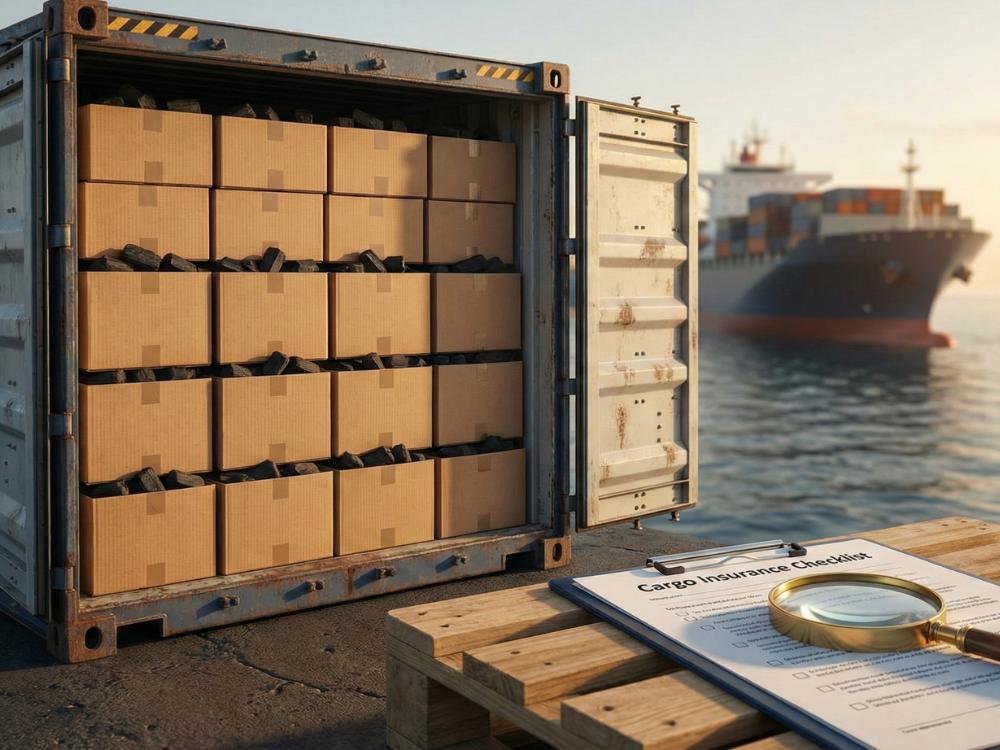
Cargo insurance for coconut charcoal briquette shipments protects exporters and importers against transit losses from container damage, moisture contamination, fire incidents, and shipping delays across 15-30 day ocean voyages. Comprehensive marine cargo policies cost 0.3-0.8% of shipment value while covering risks that can destroy entire container loads worth $25,000-45,000.
Understanding Marine Cargo Insurance for Charcoal
Marine cargo insurance transfers financial risk from charcoal shipment damage or loss to insurance carriers who compensate for covered incidents during international transport. Unlike general liability insurance covering business operations, cargo insurance specifically protects goods in transit from origin warehouse to final destination.
Why Charcoal Requires Specialized Coverage:
Coconut charcoal briquettes face unique transit risks requiring insurance consideration:
- Moisture Sensitivity: Exposure to rain, seawater, or container condensation degrades product quality and violates moisture content specifications (below 6-8% required)
- Breakage Susceptibility: Physical impacts during container loading, vessel movement, or unloading create dust and broken pieces reducing commercial value
- Fire Risk: Although counterintuitive, packaged charcoal can ignite from friction, improper storage near heat sources, or spontaneous combustion in rare cases
- Container Contamination: Previous cargo residues or improper container cleaning can contaminate charcoal affecting food-safety certification
- Documentation Disputes: Missing certificates, incorrect labeling, or customs complications can result in cargo rejection or confiscation
A single 20-foot container holds 18-22 tons of briquettes worth $27,000-44,000 at wholesale prices. Total loss from container water damage or fire eliminates this value entirely without insurance protection.
Standard Coverage Periods:
Marine cargo insurance typically covers goods from warehouse departure at origin to final delivery at destination, spanning:
- Inland transport from production facility to departure port (truck or rail)
- Port storage and container loading operations
- Ocean transit (15-30 days depending on route)
- Destination port unloading and customs clearance
- Inland delivery to buyer’s warehouse or specified location
Total coverage period extends 25-60 days from initial shipment to final delivery, protecting against all transit-related risks during this window.
Three Standard Coverage Levels (Institute Cargo Clauses)
International cargo insurance follows standardized coverage frameworks established by the Institute of London Underwriters, offering three distinct protection levels with different risk coverage scopes.
Institute Cargo Clauses (A) – All Risk Coverage
ICC(A) provides the most comprehensive protection, covering all physical loss or damage except specifically excluded perils. This “all risk” approach shifts burden of proof to insurers who must demonstrate exclusion applicability rather than buyers proving covered cause.
ICC(A) Coverage Includes:
- Physical damage from container handling, loading, or unloading operations
- Seawater damage from vessel incidents, container leaks, or storm water intrusion
- Fire, explosion, or lightning damage during transit or storage
- Vessel collision, grounding, sinking, or capsizing
- Theft, pilferage, or non-delivery of entire packages
- General average contributions (shared vessel emergency costs)
- Jettison (deliberate cargo disposal to save vessel)
- Earthquake, volcanic eruption, or lightning strikes
ICC(A) Standard Exclusions:
- Willful misconduct by insured party
- Ordinary leakage, weight loss, or wear and tear
- Inadequate packaging or preparation
- Inherent vice (product defects causing self-damage)
- Delay-related losses (even if delay results from covered peril)
- Insolvency of vessel owners or operators
- War, strikes, riots, civil commotion (unless additional coverage purchased)
ICC(A) costs 0.5-0.8% of shipment value for charcoal cargo, making it the preferred choice for high-value shipments or routes with elevated risk profiles (monsoon seasons, developing country ports, long-distance routes).
Institute Cargo Clauses (B) – Named Perils Coverage
ICC(B) covers specific listed perils rather than all-risk protection, reducing premium costs while maintaining coverage for major loss scenarios.
ICC(B) Covered Perils:
- Fire or explosion
- Vessel stranding, grounding, sinking, or capsizing
- Overturning or derailment of land transport
- Collision with external objects
- Discharge of cargo at distress port
- General average sacrifice
- Jettison or washing overboard
- Entry of seawater, lake water, or river water into container, hold, or storage location
ICC(B) Does NOT Cover:
- Theft (unless entire package stolen during covered incident)
- Rain or freshwater damage (only seawater, lake, or river water covered)
- Breakage or crushing (unless from covered peril like vessel collision)
- Contamination from container conditions
- Sweat or condensation damage
ICC(B) premiums cost 0.3-0.5% of shipment value, offering 40-50% savings versus ICC(A) coverage. This option suits established routes with reliable carriers, stable weather patterns, and proper container preparation minimizing non-covered risks.
Institute Cargo Clauses (C) – Minimum Coverage
ICC(C) provides the narrowest coverage, protecting only against major maritime casualties while excluding most damage scenarios. This minimal insurance rarely suits charcoal shipments given moisture and handling sensitivity.
ICC(C) Coverage Limited To:
- Fire or explosion only
- Vessel stranding, grounding, sinking, or capsizing
- Overturning or derailment of land conveyance
- Collision with external objects
- Discharge at distress port only
- General average sacrifice
ICC(C) excludes theft, water damage (except from vessel sinking), breakage, contamination, and most handling damage. Premium costs reach 0.2-0.3% of shipment value but leave substantial exposure to common charcoal damage scenarios.
Coverage Recommendation for Charcoal:
ICC(A) all-risk coverage provides optimal protection for coconut charcoal shipments given moisture sensitivity and handling requirements. The 0.3-0.5% premium difference versus ICC(C) is negligible compared to potential total loss risk from water damage or container handling incidents not covered under restricted policies.
Additional Coverage Extensions and Endorsements
Standard cargo clauses exclude certain risks that supplemental coverage options address for comprehensive protection.
War and Strikes Coverage
Standard ICC clauses exclude war, strikes, riots, and civil commotion. Separate war risk and strikes, riots, and civil commotion (SRCC) endorsements provide protection for:
War Risk Coverage:
- War, civil war, revolution, rebellion, insurrection
- Capture, seizure, arrest, or detention by military forces
- Derelict mines, torpedoes, or other weapons of war
- Confiscation or expropriation by governments
SRCC Coverage:
- Strikes, lockouts, or labor disturbances
- Riots or civil commotion
- Terrorist acts or malicious damage
- Vandalism or sabotage
War and SRCC coverage adds 0.05-0.15% to premium costs. Essential for shipments through conflict zones (Red Sea routes, politically unstable regions) or during labor dispute seasons at major ports.
Theft, Pilferage, and Non-Delivery (TPND)
Enhanced theft coverage beyond standard ICC(A) provisions protects against:
- Pilferage of individual cartons from containers
- Partial shipment theft during port storage
- Non-delivery of entire containers
- Mysterious disappearance without documented cause
TPND endorsements cost 0.1-0.2% additional premium. Valuable for routes through high-theft ports or countries with elevated cargo crime rates.
Rejection Coverage
Protects against commercial loss when cargo arrives in satisfactory physical condition but buyers reject shipments due to:
- Quality specifications not met (moisture content exceeds limits)
- Documentation errors preventing customs clearance
- Certification gaps (missing HALAL, phytosanitary, or origin certificates)
- Contamination making product unsuitable for intended use
Rejection coverage requires pre-shipment survey and documentation of cargo condition at origin. Premium costs reach 0.2-0.4% depending on product specifications and buyer reputation.
Delay Coverage (Refrigerated/Time-Sensitive Only)
Standard policies exclude delay losses. Special delay coverage compensates for depreciation or obsolescence from extended transit times. Rarely applicable to charcoal but relevant for time-sensitive shipments with expiring certifications or seasonal market windows.
Container Inspection and Survey Costs
Covers professional surveyor fees for damage assessment, sampling, and claims documentation. Typically included in comprehensive policies or available as 0.05% premium endorsement.
Read: Preventive Maintenance for Briquette Plants: Minimizing Downtime
Common Charcoal Transit Risks and Coverage Scenarios
Understanding how insurance responds to specific damage scenarios helps buyers select appropriate coverage levels and prepare proper documentation for claims.
Water Damage from Container Leaks
Scenario: Container develops leak during ocean transit, allowing seawater intrusion that wets 30% of charcoal cargo. Affected briquettes exceed 8% moisture specification, making them unsalable.
ICC(A) Response: Covered – water damage from container leak during ocean transit qualifies as covered peril. Insurer compensates for affected portion value plus survey costs.
ICC(B) Response: Covered – seawater entry into container specifically listed under ICC(B) coverage.
ICC(C) Response: Not Covered – water entry alone insufficient; requires vessel sinking or stranding for ICC(C) coverage.
Prevention: Pre-shipment container inspection for structural integrity, proper gasket sealing, and absence of previous damage. Request photos of container interior before loading.
Rain Damage During Port Operations
Scenario: Heavy rain during container loading at departure port wets cartons before container doors close. Moisture content increases from 5% to 9%, violating buyer specifications.
ICC(A) Response: Covered – physical damage during loading operation falls under all-risk protection.
ICC(B) Response: Not Covered – rainwater damage specifically excluded; only seawater, lake, or river water covered.
ICC(C) Response: Not Covered – rain damage excluded.
Prevention: Specify covered loading area requirements in shipping contracts. Schedule container stuffing during dry weather periods when possible. Use moisture-barrier packaging for tropical port operations.
Breakage from Rough Handling
Scenario: Forklift operator drops pallet during container unloading, shattering bottom layer cartons and creating 15-20% broken briquettes and dust.
ICC(A) Response: Covered – physical damage from handling during covered transit period qualifies for compensation.
ICC(B) Response: Not Covered – breakage from handling excluded unless from major incident like vessel collision.
ICC(C) Response: Not Covered – handling damage excluded.
Prevention: Palletize cargo with heavy-duty wrapping. Specify handling requirements in bills of lading. Document pre-shipment condition with photographs showing intact packaging.
Container Fire During Vessel Transit
Scenario: Container fire during ocean crossing destroys entire 20-ton charcoal shipment. Fire originated in adjacent container holding chemical products.
ICC(A) Response: Covered – fire damage during transit fully compensated regardless of fire source.
ICC(B) Response: Covered – fire explicitly listed under ICC(B) named perils.
ICC(C) Response: Covered – fire included in ICC(C) minimum coverage.
Prevention: Request proper stowage away from hazardous cargo. Verify vessel fire suppression systems. Some carriers offer enhanced container placement for sensitive cargo at additional cost.
Theft of Partial Container Contents
Scenario: Container arrives at destination with broken seal and 5 cartons missing (approximately 150kg total value $225-270).
ICC(A) Response: Covered – theft of packaged goods included in all-risk coverage.
ICC(B) Response: Not Covered – partial theft excluded unless occurring during covered major incident.
ICC(C) Response: Not Covered – theft excluded entirely.
Prevention: Use high-security container seals with unique serial numbers. Photograph seal placement at origin. Verify seal integrity at each transfer point. Report seal tampering immediately upon discovery.
Moisture Contamination from Container Conditions
Scenario: Container with improper ventilation creates condensation during transit. Moisture accumulates despite no external water entry, affecting product quality.
ICC(A) Response: Coverage Disputed – insurers may argue inherent vice or inadequate packaging rather than external peril. Successful claims require proving container defect rather than normal condensation.
ICC(B) Response: Not Covered – condensation damage excluded.
ICC(C) Response: Not Covered – condensation damage excluded.
Prevention: Specify ventilated container requirements for charcoal shipments. Use moisture-absorbing desiccants (silica gel packets) inside containers. Select appropriate shipping seasons avoiding extreme temperature/humidity transitions.
Filing Insurance Claims: Process and Documentation
Successful cargo insurance claims require immediate action, comprehensive documentation, and adherence to policy notification requirements.
Immediate Actions Upon Discovering Damage
Step 1: Notify All Parties (Within 24 Hours)
Contact immediately upon damage discovery:
- Insurance company or broker (reference policy number, vessel name, container number)
- Shipping carrier or freight forwarder (document notice of claim)
- Surveyor or inspection company (request immediate inspection appointment)
- Buyer or seller (depending on ownership transfer point per Incoterms)
Many policies require 24-48 hour notification or risk claim denial for late reporting.
Step 2: Preserve Evidence
- Photograph damaged cargo from multiple angles showing extent and nature of damage
- Preserve damaged samples for laboratory testing if quality disputes arise
- Maintain damaged packaging materials showing water stains, crush marks, or contamination
- Seal container if possible to prevent additional damage or tampering
- Separate damaged goods from undamaged portions for accurate loss assessment
Step 3: Arrange Independent Survey
Professional marine surveyors provide critical third-party documentation supporting claims:
- Document damage extent and probable cause
- Estimate repair or replacement costs
- Verify cargo specifications against shipping documents
- Photograph evidence and container conditions
- Provide written survey report for insurer submission
Survey costs typically range $500-1,500 per inspection. Comprehensive policies include survey fee coverage; otherwise, costs deducted from claim settlement.
Required Claims Documentation
Insurers evaluate claims based on documentary evidence proving loss occurrence, amount, and coverage applicability.
Mandatory Documents:
Commercial Documents:
- Original commercial invoice showing shipment value
- Packing list detailing cargo contents and quantities
- Bill of Lading (B/L) evidencing cargo shipment and carrier responsibility
- Certificate of Origin verifying product source
- Insurance certificate or policy proving coverage existence
Loss Documentation:
- Surveyor report with photographs and damage assessment
- Carrier exception reports noting damage at delivery
- Notice of claim to carrier documenting damage notification
- Laboratory analysis (if moisture, contamination, or quality issues)
- Repair or replacement cost estimates
Supporting Evidence:
- Container inspection report from pre-shipment
- Photographs of cargo loading showing initial condition
- Temperature/humidity logs during transit (if available)
- Correspondence with carrier regarding damage circumstances
Claims Submission Timeline:
Most policies require claim submission within 30-90 days after cargo delivery or loss discovery. Missing deadlines can result in claim denial regardless of validity.
Claims Evaluation and Settlement Process
Initial Assessment (1-2 Weeks): Insurer reviews submitted documentation, verifying policy validity, coverage applicability, and documentation completeness. Additional information requests at this stage.
Investigation (2-4 Weeks): For significant claims, insurers may appoint independent adjusters to verify surveyor findings, interview involved parties, and assess probable cause. Cooperation during investigation essential for settlement.
Settlement Determination (4-8 Weeks): Insurers calculate settlement amount based on:
- Total Loss: Full insured value paid if cargo completely destroyed or commercially worthless
- Partial Loss: Proportional payment based on damaged percentage of total shipment
- Particular Average: Loss affecting only insured cargo (not general average shared loss)
- Salvage Value: Deduction for damaged goods still having some commercial value
Payment Processing (1-2 Weeks After Acceptance): Once settlement agreed, insurers issue payment to policy beneficiary (typically shipment owner at time of loss based on Incoterms).
Total claims process duration: 6-12 weeks for straightforward cases; 3-6 months for complex disputes requiring extensive investigation.
Common Claim Denial Reasons
Inadequate Packaging: Insurers deny claims when damage results from insufficient packaging rather than covered transit perils. Charcoal packed in lightweight cartons without moisture barriers may face denial for rain damage if proper packaging could have prevented loss.
Delayed Notification: Late claim reporting beyond policy deadlines results in automatic denial regardless of merit. Calendar claims notification immediately upon damage discovery.
Excluded Perils: Attempting to claim losses from excluded causes (delay, inherent vice, wear and tear) results in denial. Review policy exclusions carefully before shipment.
Policy Limits Exceeded: Claims exceeding declared cargo value or policy limits receive payment only up to maximum coverage amounts. Always insure for full replacement value plus freight costs.
Documentation Gaps: Missing required documents (surveyor reports, bills of lading, commercial invoices) delay or prevent claim settlement. Maintain complete shipping file organization.
Read: Export Packaging Engineering: Cartons, Inner Bags, Pallets, Straps
Calculating Appropriate Insurance Value
Underinsuring cargo saves premium costs but leaves exposure to significant out-of-pocket losses when claims occur. Overinsuring wastes money on unnecessary premium without additional recovery benefit.
Insurable Interest Components
Cargo FOB Value: Wholesale product value at departure port based on commercial invoice amount. For charcoal, typically $1,500-2,000 per ton.
Freight Costs: Ocean shipping charges from origin to destination port. Container freight ranges $2,000-5,000 depending on route, season, and carrier.
Insurance Premium: Include insurance cost in insured value (typically 110% of FOB value covers freight, insurance, and 10% profit margin).
Expected Profit: Many buyers insure for FOB value plus freight plus expected profit margin (10-20% typical). This ensures business interruption compensation if replacement cargo must be sourced at higher spot prices.
Example Insurance Calculation:
20-foot container shipment: 20 tons coconut charcoal briquettes
- FOB Value: 20 tons × $1,800/ton = $36,000
- Ocean Freight: $3,500
- Expected Profit: 15% = $5,400
- Total Insured Value: $44,900
- Insurance Premium (0.6% for ICC(A)): $269
Insuring for $44,900 rather than just $36,000 FOB value ensures complete compensation including freight costs and profit loss if total cargo loss occurs.
CIF (Cost, Insurance, Freight) Considerations
Under CIF Incoterms, sellers arrange and pay for insurance to destination port. However, sellers typically purchase minimum ICC(C) coverage meeting contractual obligations while leaving buyers exposed to many damage scenarios.
CIF Buyer Protection:
Buyers receiving CIF shipments should:
- Request copy of seller’s insurance certificate verifying coverage adequacy
- Purchase supplemental “buyer’s interest” insurance upgrading from ICC(C) to ICC(A)
- Verify insurance beneficiary allows claim assignment to buyer upon cargo ownership transfer
Buyer’s interest insurance costs 0.3-0.5% of cargo value and provides gap coverage for CIF terms that typically include only minimal insurance.
Selecting Insurance Providers and Policies
Marine Insurance Company Evaluation
Financial Strength Ratings: Choose insurers with A.M. Best ratings of A- or higher, indicating strong claims-paying ability. Avoid low-rated carriers that may dispute claims aggressively or face solvency problems.
Claims Settlement Reputation: Research insurer track record for prompt, fair claims handling. Industry forums, freight forwarders, and customs brokers provide insights into insurer reliability.
Geographic Coverage: Verify insurer operates in both origin and destination countries. Claims settlement complications increase when insurers lack local presence in destination markets.
Policy Flexibility: Evaluate ability to adjust coverage for different shipments, add endorsements for specific risks, and modify terms as business needs evolve.
Working with Insurance Brokers
Specialized marine insurance brokers provide access to multiple carriers, competitive premium quotes, and claims advocacy services that direct insurer relationships often lack.
Broker Value Services:
- Premium comparison across 5-10 insurance carriers
- Policy language review identifying coverage gaps
- Claims documentation assistance and settlement negotiation
- Risk management advice for packaging, routing, and handling
- Annual policy renewals with competitive re-bidding
Broker commissions (typically 10-15% of premium) are included in quoted rates, making broker services cost-neutral while providing expertise and advocacy.
Annual vs Shipment-Specific Policies
Open Marine Cargo Policies: Cover all shipments during policy period (typically annual) up to declared limits per shipment. Simplifies administration for regular exporters shipping monthly or more frequently.
Benefits:
- No separate insurance arrangement needed for each shipment
- Lower administrative costs through blanket coverage
- Predictable annual insurance budgeting
- Automatic coverage for unplanned shipments
Requirements:
- Monthly shipment declarations to insurer
- Minimum annual premium commitments (typically $1,000-2,500)
- Suitable for businesses shipping 6+ containers annually
Single Shipment Policies: Cover individual shipments only, purchased separately for each export transaction.
Benefits:
- No minimum premium commitments
- Flexibility to adjust coverage for each shipment
- Suitable for occasional exporters (1-5 shipments yearly)
- No ongoing administrative requirements
Most regular charcoal exporters find open policies more economical and administratively efficient once shipping volume exceeds 6-8 containers annually.
Read: Binder Science for Briquettes: Tapioca and Alternatives
Risk Management Beyond Insurance
Insurance provides financial protection but prevention strategies reduce claim frequency, maintain customer relationships, and protect business reputation.
Container Selection and Inspection
Pre-Shipment Container Inspection: Inspect containers before loading for:
- Structural integrity without holes, cracks, or rust-through
- Door seals and gaskets in functional condition
- Interior cleanliness without chemical residues or contamination
- Ventilation mechanisms (if ventilated container specified)
- Locking mechanisms and security seal compatibility
Reject containers showing damage or cleanliness issues. Photographs documenting acceptable condition strengthen insurance claims if issues develop during transit.
Packaging and Moisture Protection
Moisture Barrier Strategies:
- Shrink-wrap individual cartons with polyethylene film
- Line container walls with moisture-barrier sheets
- Place desiccant packets (silica gel, clay) throughout cargo load
- Use pallets elevating bottom layer above potential water accumulation
- Seal all carton openings with moisture-resistant tape
Proper Palletization:
- Heavy-duty stretch wrap securing cartons to pallets
- Corner protection preventing edge damage
- Weight distribution preventing bottom-layer crushing
- Pallet quality adequate for forklift handling
Packaging investment of $0.30-0.50 per carton significantly reduces damage claims while improving product presentation.
Carrier and Route Selection
Carrier Reputation Assessment:
- Review carrier safety records and cargo claim histories
- Verify vessel age and maintenance standards (newer vessels preferred)
- Confirm container tracking and monitoring capabilities
- Evaluate carrier responsiveness to damage claims
Route Optimization:
- Direct routes reduce handling and transfer damage risks
- Avoid transshipment when possible (increases handling exposure)
- Consider seasonal weather patterns affecting specific routes
- Evaluate port infrastructure and handling equipment quality
Premium carriers charging 10-15% higher freight rates often deliver superior cargo care reducing damage incidents by 40-60% versus budget carriers.
Documentation Best Practices
Comprehensive Shipping Files: Maintain organized documentation for every shipment:
- Commercial invoice and packing list
- Bill of lading with carrier notations
- Container inspection photos (exterior and interior)
- Loading process photos showing cargo condition
- All certificates (origin, analysis, phytosanitary)
- Insurance certificate and policy documentation
- Correspondence with all parties
Digital copies stored in cloud systems ensure documentation access during claims processes even if physical documents are lost.
Cargo Insurance Delivers Peace of Mind
Marine cargo insurance protects coconut charcoal exporters and importers against transit losses that can eliminate entire shipment values during 25-60 day international journeys. Comprehensive ICC(A) all-risk coverage costs 0.5-0.8% of shipment value while covering water damage, breakage, theft, and handling incidents that commonly affect moisture-sensitive cargo.
Successful insurance programs require appropriate coverage selection matching cargo risk profiles, immediate damage notification with comprehensive documentation, and preventive strategies reducing claim frequency through proper packaging and carrier selection. Working with experienced marine insurance brokers and maintaining organized shipping documentation streamlines claims processes when losses occur.
Our export operations maintain comprehensive cargo insurance on all international shipments, protecting customer interests through proven risk management. We provide insurance requirement guidance, documentation support, and claims assistance for buyers establishing import programs. Contact us to discuss your cargo insurance needs and verify coverage adequacy for your charcoal procurement.
Related Resources: