
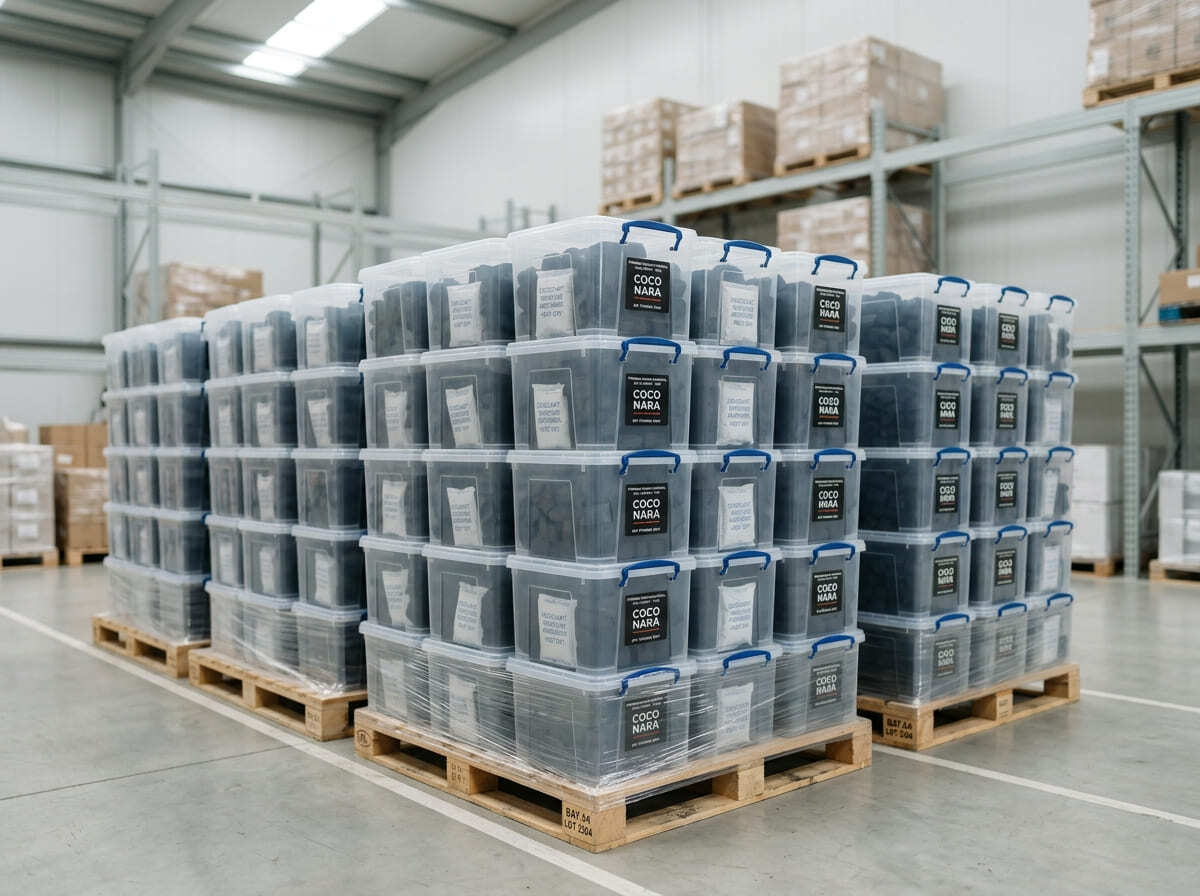
Moisture is the most damaging variable in bulk charcoal storage. A shipment that arrives at 7% moisture content and passes incoming quality inspection can reach 14% within six weeks if stored incorrectly.
That same product then sparks during lighting, produces inconsistent heat, and generates customer complaints that trace back to the warehouse, not the factory.
For distributors and lounge operators managing bulk inventory, storage is not a logistics afterthought. It is the final stage of quality control.
Why Coconut Charcoal Absorbs Moisture So Readily
Coconut shell charcoal is a porous carbonized material. Its internal structure contains millions of microscopic pores that give it superior heat retention and burn efficiency. Those same pores make it hygroscopic — it pulls water vapor from surrounding air continuously and passively.
This is not a defect. It is a physical property of the material. Premium coconut shell charcoal with fixed carbon content of 75-85% and low ash content is inherently more porous than lower-grade alternatives, which means it absorbs ambient moisture faster under identical storage conditions.
The absorption rate depends on two variables: the relative humidity of the storage environment and how much of the charcoal surface is exposed to that environment. Managing both variables is the foundation of effective bulk storage.
What Happens When Stored Charcoal Absorbs Moisture
Moisture reabsorption degrades charcoal performance in four measurable ways.
Sparking increases. Water absorbed into the briquette converts to steam during lighting. When steam pressure builds faster than it can escape through the pore structure, it ejects fragments from the surface. Sparking during lighting is the most immediate customer-facing symptom of moisture reabsorption.
Ignition time extends. A briquette at 7% moisture ignites in 7-9 minutes on an electric coil. The same briquette at 14% moisture requires 12-15 minutes. In a high-turnover lounge environment, this slows table preparation and increases staff workload.
Burn time decreases. Moisture displaces carbon in the effective fuel content of the briquette. A cube that burns for 85 minutes at 7% moisture may deliver only 65-70 minutes at 14% moisture. Customers experience shorter sessions or require charcoal replacement mid-session.
Ash color darkens. High moisture interferes with complete combustion. The residue contains more unburned carbon, which darkens the ash. Customers familiar with white ash performance standards notice this change and associate it with product quality decline.
Understanding Your Storage Environment
Before addressing storage solutions, measure the conditions in your actual warehouse or storage space. Two numbers matter:
Relative humidity (RH). Charcoal stored below 60% RH reabsorbs moisture slowly enough that sealed inner packaging provides adequate protection for standard inventory turnover periods of 30-60 days. Between 60% and 75% RH, sealed packaging remains necessary but inventory rotation must be tighter. Above 75% RH, sealed packaging alone is insufficient for extended storage — additional environmental controls are required.
Temperature. Temperature affects moisture absorption indirectly. Warm air holds more moisture than cool air. A warehouse that reaches 35°C during the day in a tropical or coastal location creates higher effective humidity stress on stored charcoal than the same space at 25°C, even if the relative humidity reading stays constant.
Buyers importing to humid regions — Southeast Asia, West Africa, coastal Middle East, the Caribbean — should measure their storage RH before assuming their facilities meet standard requirements. A cheap digital hygrometer placed at the storage level where charcoal sits costs under USD 20 and eliminates guesswork.
Post-arrival quality checks should include an RH reading of the storage space alongside the moisture content measurement of the charcoal itself.
Packaging Integrity: The First Line of Defense
The charcoal’s packaging is the most important moisture barrier, and it begins with what the supplier ships.
Inner packaging. Premium shisha charcoal ships in sealed inner bags. The material specification matters: standard polyethylene bags provide limited moisture barrier properties. Foil-laminated bags or moisture-barrier poly bags — typically BOPP or PE with an aluminum foil layer — provide meaningful protection against humidity ingress during shipping and storage.
When evaluating a new supplier, request their inner packaging specification. A supplier who ships product in unsealed or standard poly inner bags cannot guarantee moisture content on arrival, regardless of what the factory proximate analysis shows. The export packaging engineering that quality suppliers invest in exists precisely because the 30-35 day ocean voyage passes through multiple humidity environments.
Outer carton integrity. Damaged outer cartons compromise inner packaging. A carton that absorbs moisture during transit softens, which allows the inner bags to shift and potentially puncture against briquette corners. On arrival, inspect outer cartons before moving product to storage. Cartons with moisture damage, soft spots, or compromised seals need immediate attention — the inner packaging may still be intact, but the risk is elevated.
Seal integrity on opening. Once an inner bag is opened, the charcoal inside is exposed to ambient humidity. Distributors who open bags to fill retail orders or supply lounges in smaller quantities need a resealing protocol. Resealable bags, clip seals, or transfer to airtight containers prevent moisture ingress on partially used stock.
Warehouse Storage: Practical Requirements
Beyond packaging, the physical storage environment determines how long bulk charcoal maintains its arrival moisture content.
Elevation off the floor. Store all charcoal on pallets, never directly on concrete floors. Concrete is porous and wicks ground moisture upward. A carton sitting on a concrete warehouse floor absorbs moisture through its base regardless of ambient RH. Standard pallet height — 12-15cm off the floor — provides adequate separation.
Distance from exterior walls. Exterior walls in warehouses experience temperature differentials between inside and outside that cause condensation on the wall surface. Charcoal stored within 50cm of an exterior wall absorbs moisture from that condensation zone. Maintain at least 50cm clearance between charcoal stacks and all exterior walls.
Separation from moisture-generating sources. Do not store charcoal near water sources, drainage channels, refrigeration units, or areas where cleaning involves water. Charcoal stored adjacent to a floor drain used for regular washing absorbs airborne moisture from every cleaning cycle.
Stack height and airflow. Stacking cartons too high compresses lower cartons and restricts airflow between stacks. Restricted airflow allows humidity to concentrate in the lower portions of the stack. Leave 30-40cm between stacks and maintain a clear path for air circulation throughout the storage area.
Roof and ceiling condition. Roof leaks and condensation dripping from uninsulated metal ceilings are common causes of localized moisture damage in warehouse storage. Inspect ceiling condition during wet season or after rain before relying on an existing facility for charcoal storage.
Climate Control: When It Is Necessary
Passive storage management — pallets, sealed packaging, clearance from walls — works adequately in temperate climates with moderate humidity. In tropical or coastal environments, passive management alone does not maintain charcoal quality across inventory holding periods longer than 30-45 days.
In high-humidity environments, active climate control becomes a cost-benefit decision rather than an optional upgrade.
Dehumidifiers. Industrial dehumidifiers capable of maintaining storage space below 60% RH represent a practical investment for distributors holding more than 20 tons of inventory at any time. The operating cost of a dehumidifier is a fraction of the commercial cost of a spoiled shipment — both in replacement product value and in the customer relationships that deteriorate when consistent performance fails.
Air conditioning. Air conditioning lowers both temperature and humidity simultaneously. Facilities that air-condition for staff comfort often inadvertently maintain charcoal storage conditions within acceptable ranges. If air conditioning is already present, verify that the charcoal storage zone sits within the conditioned area and not in an adjacent uncooled annex.
Sealed storage rooms. Some distributors dedicate a single sealed room within a larger warehouse to charcoal storage. A smaller sealed space is easier and cheaper to dehumidify than an entire warehouse. This approach works well for operations holding 10-30 tons of rotating stock.
The investment calculation is straightforward. A 20-ton container of premium shisha charcoal has a landed cost that typically exceeds USD 30,000-50,000 depending on origin, specification, and destination. Preventing moisture damage that renders that shipment unsaleable or significantly discounted requires storage infrastructure that costs a fraction of that value.
Inventory Rotation: First In, First Out
Storage environment management and packaging integrity slow moisture absorption. They do not stop it entirely. Inventory rotation discipline determines how long charcoal remains within acceptable moisture limits regardless of storage conditions.
FIFO (First In, First Out) protocol. Older stock moves before newer stock in every fulfillment operation. This sounds obvious but requires physical warehouse organization that supports it. Charcoal stacked in a way that forces staff to access the newest pallet first to reach the oldest produces LIFO (Last In, First Out) rotation by default.
Maximum holding periods by environment. As a practical guideline:
- Below 55% RH in sealed packaging: up to 12 months without significant moisture reabsorption
- 55-65% RH in sealed packaging: 3-6 months before testing is advisable
- Above 65% RH in sealed packaging: test moisture content at 30-60 day intervals
- Any RH after inner packaging is opened: use within 2-4 weeks
Lot tracking. Record arrival date and proximate analysis moisture content for every incoming shipment. Tag pallets with arrival date. This creates the data needed to identify whether a quality problem originates at the supplier or in your own storage operation — a distinction that matters for claims and guarantee processes.
Testing Moisture Content in Storage
Visual inspection does not reliably detect moisture reabsorption in charcoal. A briquette at 14% moisture looks identical to one at 7% moisture. Testing is the only reliable method.
Moisture meters. Pin-type moisture meters calibrated for dense biomass materials provide field readings in seconds. They are not laboratory-grade instruments, but they detect elevated moisture reliably enough to flag a problem. A reading above 10% on a field meter warrants sending a sample to a laboratory for proximate analysis confirmation.
Weight comparison. A simpler field check: weigh a fixed number of briquettes from the shipment on arrival and record the figure. Weigh the same number of pieces from the same batch 30 days later under the same conditions. Weight gain indicates moisture absorption. This method requires no equipment beyond a basic gram scale.
Laboratory proximate analysis. For any shipment showing field test anomalies, send a 500-gram sample to an accredited laboratory for full proximate analysis. The cost is low relative to the value of the shipment, and the results provide documentation for supplier communications if a claim is warranted.
Seasonal and Regional Considerations
Humidity levels are not constant throughout the year in most markets. Distributors who establish storage protocols during dry season conditions may find those protocols insufficient during monsoon or high-humidity seasons.
Markets with pronounced wet seasons — Indonesia, India, West Africa, Southeast Asia — require tighter storage controls during the 3-4 month peak humidity period. Distributors in these markets should plan import timing to minimize inventory held during peak humidity months, or invest in climate control sufficient to maintain storage conditions year-round.
Gulf markets experience lower ambient humidity during summer months but high humidity in coastal cities during certain periods. Saudi Arabia, Kuwait, and the UAE have relatively dry ambient conditions that suit passive storage management for most of the year — but coastal facilities in these markets still experience localized humidity that warrants attention.
European markets present lower moisture risk overall, but unheated warehouse storage during winter creates condensation risk as temperature fluctuates. Charcoal stored in facilities that drop below 5°C overnight and warm to 15°C during the day cycles through condensation conditions repeatedly. Insulated storage or climate control during winter months addresses this.
A Note for Lounge Operators
Lounge operators storing smaller quantities — one to five cartons at a time — face the same moisture risks as distributors but on a smaller scale. A few practical steps apply at this level:
Keep charcoal in its sealed inner bags until the session preparation moment. Do not pre-open bags in bulk to fill a storage bin or drawer. Store sealed bags in a closed cabinet away from the kitchen, dishwashing area, or any other moisture source in the venue. In humid climates, a small desiccant packet placed in the storage cabinet extends shelf life of opened stock meaningfully.
First-time buyers working through their initial shipment often encounter moisture problems that trace directly to storage practices rather than product quality. We include storage guidance with every first order to prevent this.
Summary: The Storage Protocol
Effective bulk shisha charcoal storage requires four things working together:
Sealed moisture-barrier inner packaging from the supplier, maintained intact until point of use. Warehouse storage on pallets with clearance from floors, walls, and moisture sources. Climate control or dehumidification in environments above 65% RH. Inventory rotation discipline that moves oldest stock first and tracks lot dates.
Suppliers who invest in proper packaging and buyers who invest in proper storage produce a supply chain where charcoal performs as specified from factory to session. The proximate analysis your supplier provides at origin should match what your customers experience at the bowl.
Contact us to discuss packaging specifications for your destination climate or to request our storage guidelines document for distribution to your lounge customers.