
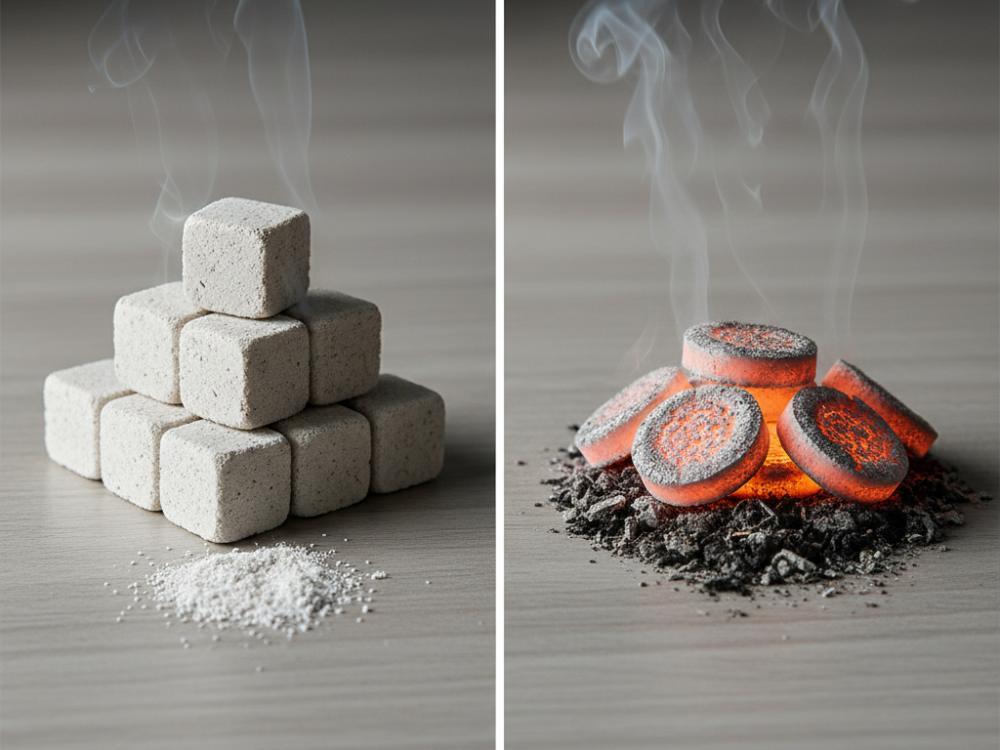
When you’re running a shisha lounge or hookah business, your choice of charcoal affects more than just the flavor of your tobacco. It directly impacts the health and safety of your customers and staff. This guide examines the documented health differences between natural coconut shell charcoal and quick-light charcoal, based on peer-reviewed research and clinical studies.
The Critical Difference: Chemical Composition
Natural coconut shell charcoal consists of 100% carbonized coconut shells with no chemical additives. Quick-light charcoal contains compressed charcoal dust coated with chemical accelerants—typically sulfur, benzene, or potassium nitrate—that allow instant ignition with a lighter.
This fundamental composition difference creates measurably different health outcomes.
Carbon Monoxide Production: The Primary Health Concern
Research published in peer-reviewed medical journals demonstrates that charcoal type significantly influences carbon monoxide (CO) exposure during shisha sessions.
A study examining CO production from different charcoal types found that quick-light charcoals generate substantially higher carbon monoxide levels compared to natural alternatives. One case study documented a shisha smoker who required hyperbaric oxygen treatment for severe CO poisoning after using quick-light charcoal—this incident prompted systematic research into charcoal-specific CO production.
Carbon monoxide poisoning symptoms include:
- Headaches and dizziness
- Nausea and confusion
- Loss of consciousness at high concentrations
- Potential long-term neurological effects
The Centers for Disease Control (CDC) reports that hookah charcoal produces high levels of carbon monoxide, metals, and cancer-causing chemicals. Studies measuring CO generation rates from burning charcoal in enclosed spaces found that 800 grams of glowing charcoal can produce CO concentrations exceeding 3,000 parts per million within two hours—levels fatal to humans within minutes.
For shisha lounges, this matters significantly. Poor ventilation combined with quick-light charcoals increases staff exposure to elevated CO levels throughout their shifts.
Chemical Accelerants and Toxic Fume Release
Quick-light charcoal’s convenience comes from chemical accelerants that create immediate health concerns.
Common accelerants in quick-light charcoal include:
- Sulfur compounds
- Benzene
- Potassium nitrate
- Petroleum-based additives
When these chemicals burn, they release toxic fumes that users and nearby staff inhale. Research on waterpipe tobacco smoking confirms that the charcoal used to heat tobacco significantly contributes to toxic exposure. Multiple studies note that the additives in quick-lighting charcoals and their harmlessness remain largely unknown—a concerning gap given widespread use.
Benzene, commonly used in quick-light formulations, is classified as a known carcinogen. Long-term exposure to benzene fumes can trigger serious health problems including blood disorders and increased cancer risk.
Natural coconut shell charcoal produces no chemical fumes because it contains no synthetic additives. The carbonization process creates pure carbon that burns cleanly without releasing toxic accelerant byproducts.
Flavor Interference and Respiratory Irritation
Beyond direct toxicity, quick-light charcoal creates secondary health and quality issues.
The chemical accelerants produce distinctive odors and tastes that experienced hookah smokers immediately recognize. More importantly, these chemicals can irritate the respiratory tract, causing coughing, wheezing, and shortness of breath—particularly problematic for individuals with pre-existing respiratory conditions or allergies.
Clinical observations note that quick-light charcoals cause a choking effect that natural charcoal users rarely experience. The burnt smoke or ash-laden texture common with quick-light options increases respiratory discomfort.
Natural coconut charcoal burns odorless and tasteless. This isn’t just about flavor preservation—it indicates cleaner combustion with fewer respiratory irritants.

Indoor Air Quality and Secondhand Exposure
Shisha lounges face unique ventilation challenges. The CDC emphasizes that secondhand smoke from hookahs contains smoke from both the tobacco and the heat source (charcoal). Staff working full shifts in hookah lounges experience cumulative exposure to whatever chemicals the charcoal releases.
Research in indoor environments shows that even with windows and fans running, carbon monoxide from charcoal can reach dangerous levels quickly. One study in hookah lounges measured particularly high CO concentrations, creating occupational health concerns for employees.
Natural coconut charcoal reduces this risk measurably. Without chemical accelerants, coconut charcoal produces lower carbon monoxide levels and zero chemical fume release, improving indoor air quality for both customers and staff.
Burn Characteristics and Safety Considerations
Natural coconut shell charcoal burns at lower, more stable temperatures compared to quick-light alternatives. This temperature difference has safety implications:
Quick-light charcoal characteristics:
- Burns very hot and very fast
- Requires frequent replacement (30-45 minutes per piece)
- Sparks during ignition
- Creates more ash
Coconut charcoal characteristics:
- Burns consistently for 3-4 hours
- Maintains steady heat without temperature spikes
- Produces minimal sparking
- Generates less than 5% ash
The sparking behavior of quick-light charcoal during ignition creates fire hazards. Natural coconut charcoal’s minimal sparking results from the coconut shell’s natural heat absorption properties, creating a safer environment.
Long-Term Health Implications
While any form of smoking carries health risks, charcoal choice affects the magnitude of exposure to specific toxicants.
Hookah smoke contains many of the same harmful components as cigarette smoke—nicotine, tar, heavy metals. Research confirms that hookah users face risks of infections, cancers, lung disease, and cardiovascular conditions. However, the charcoal component adds an additional layer of chemical exposure that varies dramatically based on charcoal type.
Studies show that in one hour of hookah smoking, users inhale 100-200 times more smoke than from a cigarette. When that smoke includes fumes from chemical accelerants, the toxic exposure multiplies.
Natural coconut charcoal doesn’t eliminate smoking-related health risks—but it removes one major source of additional chemical toxicity.
Regulatory and Safety Perspective
The U.S. Consumer Product Safety Commission has documented 83 deaths from carbon monoxide poisoning related to charcoal burning over a seven-year period. While these cases primarily involved misuse in enclosed spaces, they underscore charcoal’s capacity to produce lethal CO levels.
Current regulations require warning labels on charcoal products identifying carbon monoxide hazards. However, distinctions between natural and chemical-laden charcoals remain poorly communicated to end users.
Business and Operational Considerations
For hookah lounge operators and restaurant managers, charcoal choice represents a risk management decision.
Natural coconut charcoal advantages:
- Reduced staff exposure to toxic fumes
- Lower carbon monoxide generation
- Improved customer satisfaction through better flavor
- Extended burn time reduces service interruptions
- Professional positioning as health-conscious business
The initial cost difference is minimal when calculated per session. Natural coconut charcoal’s 3-4 hour burn time versus quick-light’s 30-45 minutes means you use fewer pieces overall. The investment in staff safety and customer experience justifies any marginal cost increase.
What the Research Shows
Multiple peer-reviewed studies and clinical observations consistently demonstrate:
- Quick-light charcoal produces measurably higher carbon monoxide levels
- Chemical accelerants in quick-light formulations release toxic fumes
- Natural coconut charcoal burns cleaner with fewer respiratory irritants
- Indoor air quality improves when using natural charcoal alternatives
- Long-term health outcomes favor reduced chemical exposure
Professional Recommendations
Based on the documented research, these guidelines apply:
For new hookah businesses: Start with natural coconut charcoal. The slight learning curve for lighting (requires electric burner, 10-15 minutes) is offset by superior customer experience and reduced health risks.
For established operations using quick-light: Transition gradually. Train staff on natural charcoal lighting procedures. Communicate the change to customers as a health-focused improvement.
For all operations: Ensure adequate ventilation regardless of charcoal type. Install carbon monoxide detectors. Monitor indoor air quality regularly.
For procurement managers: Source coconut charcoal from verified suppliers who provide certifications (ISO, SGS) confirming no chemical additives. Request lab testing results showing ash content below 5%, moisture content below 8%, and fixed carbon content above 75%.
Making the Informed Choice
The research evidence clearly demonstrates that natural coconut shell charcoal provides measurable health advantages over quick-light alternatives. The absence of chemical accelerants means no benzene fumes, no sulfur odors, and significantly reduced toxic exposure.
For businesses focused on customer and employee wellbeing, natural coconut charcoal isn’t just a premium option—it’s a practical investment in health and safety.
We’ve worked with dozens of hookah lounges across multiple countries who made this transition. The consistent feedback: customers notice the cleaner taste immediately, staff report fewer headaches and respiratory discomfort, and businesses position themselves as health-conscious operators in an increasingly aware market.
Key Takeaways
Natural coconut shell charcoal produces lower carbon monoxide levels, contains zero chemical accelerants, and burns cleaner than quick-light alternatives. While no form of smoking is without health risks, choosing coconut charcoal removes one significant source of chemical toxicity from the shisha experience.
For professional hookah operations, this choice matters. Your charcoal affects your customers’ experience, your staff’s working conditions, and your business’s reputation as a responsible operator.
Ready to make the switch to cleaner-burning coconut charcoal? Our team can help you source premium Indonesian coconut shell charcoal that meets international safety standards. Contact us today for samples and specifications.
Research Sources:
- U.S. Centers for Disease Control (CDC) – Hookahs and Tobacco Use
- PubMed: “Charcoal type used for hookah smoking influences CO production” (2015)
- Environmental Health and Preventive Medicine: “The effects of hookah/waterpipe smoking on general health and the cardiovascular system” (2019)
- U.S. Consumer Product Safety Commission – Carbon Monoxide from Charcoal Burning
- Federal Institute for Risk Assessment (Germany) – Carbon Monoxide Releasing Curves from Indoor Charcoal Burning
Note: This article provides educational information about charcoal health impacts. It does not address tobacco-related health risks, which remain significant regardless of charcoal type. Consult healthcare professionals for medical advice.
Read More About Shisha:
- Why Choose Coconut Charcoal for Shisha? Best Benefits Explained
- How to Choose the Right Size and Shape of Shisha Charcoal
- What is Shisha Coconut Charcoal and Why is it Preferred?
- How to Choose the Right Size and Shape of Shisha Charcoal
- How a Saudi Shisha Distributor Built Market Leadership Through 10 Years of Consistent Quality – Case Studies