
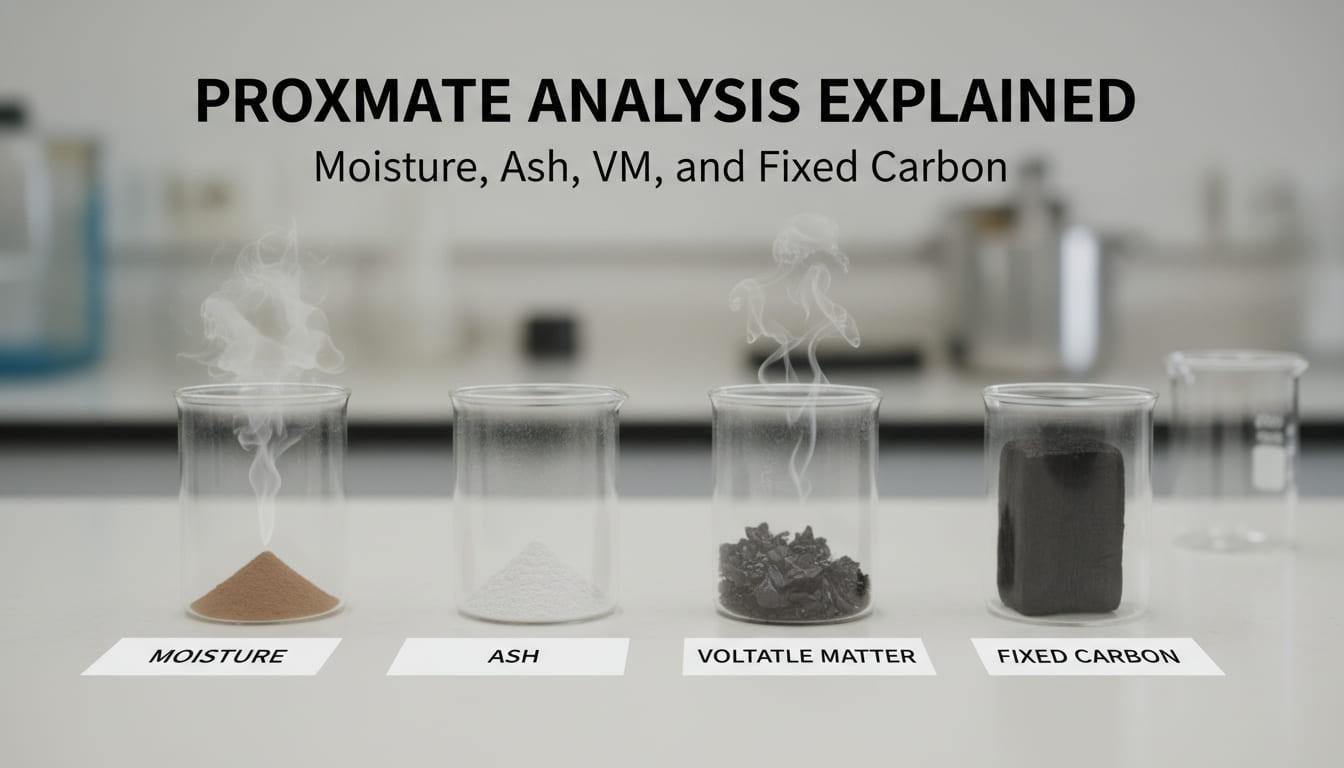
Proximate analysis determines four fundamental charcoal quality parameters through standardized laboratory testing: moisture content (2-8%), ash content (1.5-3.5%), volatile matter (12-20%), and fixed carbon (70-85%). These measurements predict burn performance, heat generation, and commercial value with 95%+ accuracy when conducted according to ASTM D1762 or ISO 17225 testing standards.
Understanding Proximate Analysis Testing
Proximate analysis provides the most widely used quality assessment framework for charcoal briquettes, offering quantitative measurements that correlate directly with combustion performance and customer satisfaction. Unlike subjective visual inspection or unreliable field testing, standardized proximate analysis delivers reproducible data enabling quality comparison across suppliers, batches, and production facilities.
Four Core Measurements:
Each proximate analysis component reveals specific quality characteristics:
- Moisture Content: Water percentage affecting ignition speed, smoke production, and storage stability
- Ash Content: Non-combustible mineral residue remaining after complete burning
- Volatile Matter: Gaseous compounds released during initial combustion affecting ignition and flame characteristics
- Fixed Carbon: Pure carbon content driving sustained heat generation and burn duration
The four measurements total 100% of charcoal composition, with fixed carbon calculated by difference: Fixed Carbon = 100% – (Moisture + Ash + Volatile Matter). This mathematical relationship ensures internal consistency across all four parameters.
Why Proximate Analysis Matters:
Quality disputes between buyers and sellers typically center on performance expectations versus actual product characteristics. Proximate analysis provides objective evidence eliminating subjective interpretation:
- Export contracts specify proximate analysis requirements with acceptance tolerances
- Customer complaints reference specific parameter deviations from specifications
- Quality certification programs (ISO, HALAL, export licensing) require documented proximate analysis
- Price negotiations reflect proximate analysis results with premium pricing for superior specifications
A certificate of analysis (COA) documenting proximate results accompanies every professional charcoal shipment, serving as quality assurance proof and contractual compliance verification.
Moisture Content: Water Percentage in Charcoal
Moisture content represents the percentage of water present in charcoal samples, affecting multiple performance characteristics and commercial considerations.
Testing Methodology (ASTM D1762 Section 7)
Standard Moisture Determination Procedure:
- Weigh 1-2 gram charcoal sample in pre-dried crucible with lid (initial weight W1)
- Place uncovered crucible in laboratory oven at 105-110°C for 60 minutes
- Cool crucible in desiccator for 15-20 minutes preventing moisture reabsorption
- Weigh dried sample and crucible (final weight W2)
- Calculate moisture percentage: Moisture % = [(W1 – W2) / W1] × 100
Equipment Requirements:
- Analytical balance accurate to 0.001 gram (0.1% precision)
- Laboratory oven with temperature control ±2°C
- Desiccator containing silica gel or calcium chloride
- Ceramic or porcelain crucibles with tight-fitting lids
Testing Precision: Duplicate samples should agree within ±0.3% absolute moisture content. Results showing greater variation indicate inadequate sample homogeneity or equipment calibration problems requiring retest.
Moisture Content Impact on Performance
Ignition Speed: Higher moisture content extends ignition time as water must evaporate before charcoal reaches combustion temperature (300-400°C). Charcoal at 4% moisture ignites 2-3 minutes faster than 8% moisture samples under identical conditions.
Smoke Production: Water vaporization during initial heating creates steam that buyers often perceive as excessive smoke. Moisture levels above 8% generate noticeable steam clouds during ignition, particularly problematic for hookah applications requiring minimal smoke.
Heat Output: Water content contributes zero calorific value while requiring energy for evaporation (2,260 kJ per kg water). Each 1% moisture content increase reduces effective heat output by approximately 100 kcal/kg, lowering total calorific value from 7,800 to 7,700 kcal/kg.
Storage Stability: Charcoal stored at moisture levels above 8% faces increased risk of:
- Mold growth on organic binder materials in briquettes
- Dimensional changes from moisture expansion creating packaging stress
- Quality degradation during extended storage (6+ months)
- Weight variation affecting commercial transactions based on mass
Shipping Considerations: Container shipments with high-moisture charcoal (8-10%) experience condensation problems during ocean transit. Temperature cycling between day and night creates moisture migration to container walls, potentially causing localized wetting and quality degradation.
Optimal Moisture Content by Application
Shisha/Hookah Applications: 4-6% moisture content
- Quick ignition on electric burners (8-12 minutes)
- Minimal steam production preserving tobacco flavor
- Stable performance across 90-120 minute sessions
BBQ/Grilling Applications: 5-7% moisture content
- Slightly higher moisture acceptable for longer ignition tolerance
- Balance between ignition ease and maximum heat output
- Acceptable steam production for outdoor cooking environments
Industrial/Commercial Use: 4-6% moisture content
- Restaurant and catering operations demand consistency
- Professional kitchens require reliable ignition timing
- Premium pricing justifies optimal moisture control
Export Market Standards: Below 6% moisture content
- Most international buyers specify maximum 6-8% moisture
- Premium markets (Europe, USA) often require below 6%
- Middle East markets tolerate 6-8% for shisha applications
Moisture Content Control During Production
Post-Pressing Moisture Management: Freshly pressed briquettes contain 15-20% moisture from binder water addition. Systematic drying reduces moisture to specification levels:
- Solar drying: 3-7 days achieving 4-6% final moisture
- Kiln drying: 24-48 hours reaching 4-5% final moisture
- Ambient air drying: 7-14 days producing 6-8% final moisture
Environmental Factors Affecting Drying:
- Ambient humidity: High humidity (>70%) extends drying time 30-50%
- Temperature: Each 5°C temperature increase reduces drying time 10-15%
- Airflow: Natural ventilation drying 40% slower than forced-air systems
- Seasonal variation: Rainy season drying takes 2-3x longer than dry season
Moisture Reabsorption Prevention: Dried briquettes reabsorb atmospheric moisture during storage. Protection strategies include:
- Moisture-barrier packaging: Polyethylene-lined cartons reduce reabsorption
- Desiccant packets: Silica gel sachets maintain low internal moisture
- Climate-controlled storage: Warehouses below 60% relative humidity
- Rapid packaging: Package within 24 hours after drying completion
Charcoal stored in open warehouses at 75% relative humidity can reabsorb 2-3% moisture over 30-60 days, requiring retest before shipment to verify specification compliance.
Read: Cube vs Hexagonal Briquettes: Why Shape Is Your Secret Performance Advantage
Ash Content: Non-Combustible Mineral Residue
Ash content quantifies the mineral residue remaining after complete charcoal combustion, indicating raw material purity and carbonization efficiency.
Testing Methodology (ASTM D1762 Section 8)
Standard Ash Determination Procedure:
- Weigh 1-2 gram charcoal sample in pre-ignited crucible (initial weight W1)
- Place crucible in muffle furnace at 600-650°C for 3-4 hours
- Hold temperature until constant weight achieved (no visible carbon remains)
- Cool crucible in desiccator for 30 minutes
- Weigh crucible with ash residue (ash weight W2)
- Calculate ash percentage: Ash % = [(W2) / W1] × 100
Critical Testing Parameters:
Temperature Control: Furnace temperature must remain 600-650°C ±10°C throughout testing. Higher temperatures (>700°C) cause ash volatilization producing artificially low results. Lower temperatures (<550°C) allow incomplete carbon combustion creating artificially high ash percentages.
Complete Combustion Verification: Final ash should appear light gray or white with no black carbon residue. Black ash indicates incomplete combustion requiring extended furnace time (additional 1-2 hours) until pure white ash remains.
Sample Preparation: Crush charcoal to powder consistency before testing. Large briquette pieces may not combust completely, leaving unburned carbon that inflates ash measurements.
Ash Content Sources and Composition
Primary Ash Sources:
Coconut Shell Minerals (1.0-2.0% ash): Natural minerals absorbed during coconut tree growth including:
- Potassium compounds: 40-50% of total ash
- Calcium compounds: 20-25% of total ash
- Magnesium, sodium, phosphorus: 15-20% of total ash
- Silicon dioxide (silica): 5-10% of total ash
- Trace elements: Iron, manganese, copper, zinc (<5%)
Soil Contamination (0.3-0.8% additional ash): Coconut shells harvested from ground pickup accumulate soil particles increasing ash content. Washed shells reduce soil contamination to below 0.3%.
Process Contamination (0.2-0.5% additional ash): Manufacturing introduces mineral content through:
- Carbonization kiln brick dust
- Equipment wear (metal particles from crushers, mixers)
- Packaging materials (cardboard fibers, plastic fragments)
Binder Additives (0.0-0.3% additional ash): Pure tapioca or cornstarch binders contribute minimal ash (<0.1%). Calcium carbonate additives sometimes used for briquette strengthening add 0.2-0.3% ash per 1% additive percentage.
Premium Coconut Charcoal Ash Composition: Laboratory analysis of quality coconut shell charcoal ash reveals:
- Potassium carbonate (K2CO3): 35-45%
- Calcium oxide (CaO): 15-20%
- Magnesium oxide (MgO): 8-12%
- Silicon dioxide (SiO2): 8-12%
- Sodium compounds: 5-8%
- Other minerals and trace elements: 10-15%
High potassium content makes coconut charcoal ash valuable as organic fertilizer when scattered in gardens, providing plant nutrients rather than waste disposal problems.
Ash Content Impact on Performance
Grilling Cleanliness: Lower ash content reduces post-cooking cleanup requirements. Charcoal producing 2% ash leaves 40 grams residue per 2kg fuel versus 100 grams for 5% ash charcoal—60 gram difference affecting customer perception of product quality.
Grill Ventilation: Excessive ash accumulation blocks airflow through grill grates and charcoal layers, reducing oxygen supply and lowering combustion temperatures. Professional kitchens using 20-30kg charcoal daily experience noticeable performance degradation with high-ash products.
Hookah Heat Management: Shisha applications demand ultra-low ash content (below 2%) because:
- Ash insulates coals reducing heat transfer to tobacco
- Accumulated ash requires frequent coal rotation or replacement
- Ash deposits on hookah bowls affect flavor and customer experience
Food Safety Considerations: Food-contact applications (grilling, BBQ) require ash content verification. Excessive ash from contamination sources may introduce heavy metals or undesirable compounds. Premium certifications (FSSC 22000 food safety standards) specify maximum ash levels ensuring product purity.
Ash Content Specifications by Market
Premium Export Markets: <2.0% ash content
- European Union importers
- USA specialty distributors
- Japan and high-quality Asian markets
- Shisha lounge premium segments
Standard Commercial Markets: 2.0-3.5% ash content
- Middle East bulk hookah charcoal
- BBQ retail consumer products
- Restaurant and catering applications
- Price-competitive distribution channels
Economy/Budget Markets: 3.5-5.0% ash content
- Cost-focused retailers
- Developing market mass consumption
- Acceptable for non-food applications
Ash content differences of 0.5-1.0% justify price variations of $50-100 per ton in wholesale markets, making quality control financially significant.
Reducing Ash Content During Production
Raw Material Selection:
- Source coconut shells from elevated drying platforms avoiding ground contact
- Wash shells removing soil particles before carbonization
- Screen out foreign materials (stones, metal fragments) during processing
Carbonization Optimization:
- Complete carbonization to 500-600°C temperatures maximizes volatile removal
- Extended carbonization time (6-8 hours) ensures thorough pyrolysis
- Minimize kiln brick dust introduction through sealed charging/discharging
Post-Carbonization Processing:
- Screen carbonized charcoal removing oversized contaminated particles
- Use magnetic separation capturing metal fragments from equipment wear
- Clean processing equipment regularly preventing cross-contamination
Binder Selection:
- Pure food-grade starches contribute minimal ash
- Avoid mineral fillers or strengthening agents (calcium carbonate, clays)
- Test binder ash content independently to verify specifications
Premium production processes targeting <2% ash content add $0.08-0.15 per kg production cost through enhanced washing, screening, and quality control but enable $0.15-0.25 per kg price premiums in export markets.
Read: Self-Heating Treatment (SHT) Certified vs Non-Certified Charcoal
Volatile Matter: Gaseous Combustion Products
Volatile matter represents gaseous and liquid compounds released when charcoal heats to 900°C in oxygen-free conditions, indicating carbonization completeness and ignition characteristics.
Testing Methodology (ASTM D1762 Section 9)
Standard Volatile Matter Determination:
- Weigh 1 gram charcoal sample in crucible with tight-fitting lid (initial weight W1)
- Place covered crucible in muffle furnace at 900±10°C for exactly 7 minutes
- Remove immediately after 7 minutes (extended time affects results)
- Cool in desiccator for 20 minutes
- Weigh crucible with remaining material (final weight W2)
- Calculate volatile matter: VM % = [(W1 – W2) / W1] × 100 – Moisture %
Critical Test Requirements:
Temperature Accuracy: Furnace must reach 900°C ±10°C. Temperature deviations alter volatile release rates producing inconsistent results. Pre-heat furnace to temperature before sample insertion.
Timing Precision: Exactly 7 minutes heating time per ASTM standards. Extended heating artificially elevates volatile matter percentages; shortened time produces incomplete volatile release.
Crucible Sealing: Tight-fitting lids prevent air infiltration that would combust released volatiles, inflating weight loss measurements. Check lid fit before testing.
Moisture Correction: Subtract previously determined moisture percentage from total weight loss. Failing this correction conflates moisture evaporation with actual volatile matter release.
Volatile Matter Composition
Major Volatile Components:
Tar and Liquid Condensates (40-50% of VM): Heavy organic compounds including phenols, alcohols, and aromatic hydrocarbons that condense at lower temperatures. Visible as brownish deposits on cool surfaces.
Light Hydrocarbons (25-35% of VM): Methane, ethane, propane, and other gaseous compounds released during initial heating. These compounds ignite readily providing initial flame.
Carbon Monoxide and Dioxide (15-20% of VM): Gaseous carbon oxides from incomplete carbonization or thermal decomposition of remaining organic structures.
Water Vapor (5-10% of VM): Additional moisture beyond free water, chemically bound in organic structures and released only at elevated temperatures.
Volatile Matter vs Carbonization Temperature:
Carbonization process temperature directly controls volatile matter content:
- 300-400°C carbonization: 25-35% volatile matter (incomplete carbonization)
- 450-550°C carbonization: 15-20% volatile matter (standard quality)
- 600-700°C carbonization: 10-15% volatile matter (premium quality)
- 750°C carbonization: 8-12% volatile matter (ultra-premium, high cost)
Most commercial coconut charcoal undergoes 500-600°C carbonization producing 15-20% volatile matter balancing quality with production economics.
Volatile Matter Impact on Performance
Ignition Speed: Higher volatile matter content accelerates ignition because gaseous compounds ignite at 200-300°C, well below charcoal’s 400-500°C combustion temperature. Charcoal with 18-20% volatiles ignites 20-30% faster than 12-15% volatile products.
Flame Characteristics: Initial combustion flames derive primarily from burning volatiles rather than fixed carbon:
- 18-20% VM: Visible yellow flames for 5-8 minutes during startup
- 12-15% VM: Minimal flame, primarily glowing combustion
- <10% VM: Extremely difficult ignition, almost no flame phase
Smoke Production: Volatile matter contributes to smoke generation, particularly heavy tar compounds:
- High VM (>20%): Noticeable smoke during first 10-15 minutes
- Medium VM (15-18%): Light smoke during initial 5-8 minutes
- Low VM (<12%): Minimal smoke, primarily during first 2-3 minutes
Shisha applications strongly prefer low volatile matter (<15%) minimizing smoke that interferes with tobacco flavor and customer experience.
Odor Profile: Volatile compounds create characteristic charcoal odor during ignition. Coconut charcoal volatiles produce neutral to slightly sweet odors versus harsh chemical smells from low-quality wood charcoal or additives.
Heat Stability: Lower volatile matter correlates with more stable, sustained heat output because:
- Fixed carbon burns steadily at consistent temperature
- Volatile combustion creates temperature spikes then rapid cooling
- Premium applications (professional kitchens, hookah lounges) require temperature stability
Volatile Matter Specifications by Application
Shisha/Hookah Premium: 12-15% volatile matter
- Minimal smoke preserving tobacco flavor
- Stable temperature throughout session
- Quick but controlled ignition (10-12 minutes on electric burners)
BBQ/Grilling Standard: 15-18% volatile matter
- Faster ignition appreciated by consumers
- Acceptable smoke for outdoor cooking
- Good balance of ignition ease and sustained burn
Quick-Light Consumer Products: 18-22% volatile matter
- Rapid ignition for convenience-focused users
- Higher smoke acceptable for casual backyard grilling
- Lower production cost from reduced carbonization
Industrial/Professional: 12-15% volatile matter
- Restaurants and catering demand performance consistency
- Minimal smoke in enclosed or semi-enclosed kitchens
- Temperature stability critical for cooking quality
Controlling Volatile Matter During Production
Carbonization Temperature Management: Precise kiln temperature control produces consistent volatile matter:
- Install multiple thermocouples at different kiln positions
- Maintain 500-600°C for 4-6 hours during active carbonization
- Avoid temperature spikes above 650°C (over-carbonization reducing yield)
- Prevent temperature drops below 450°C (incomplete carbonization)
Carbonization Duration: Extended holding time at peak temperature reduces volatile matter:
- 4-hour carbonization: 18-22% volatile matter
- 6-hour carbonization: 15-18% volatile matter
- 8-hour carbonization: 12-15% volatile matter
- 10-hour carbonization: 10-12% volatile matter (diminishing returns)
Longer carbonization times reduce production throughput and increase fuel costs. Premium products justify 8-10 hour cycles; standard products use 5-6 hour cycles balancing quality and economics.
Cooling Rate Control: Rapid cooling (forced air) partially locks volatiles in carbonized structure versus slow natural cooling allowing continued volatile release. This effect produces 1-2% volatile matter variation between cooling methods.
Read: Charcoal Shape Engineering: Cube vs Finger vs Tablet vs Hexagonal
Fixed Carbon: Pure Carbon Content Driving Performance
Fixed carbon represents the percentage of pure carbon remaining after subtracting moisture, ash, and volatile matter—the component responsible for sustained heat generation and extended burn duration.
Calculation Methodology
Fixed Carbon by Difference:
Fixed Carbon % = 100% – (Moisture % + Ash % + Volatile Matter %)
Unlike moisture, ash, and volatile matter determined through direct testing, fixed carbon calculates from the other three measurements. This calculation method means fixed carbon accuracy depends on precision of all three direct tests.
Example Calculation:
Quality coconut charcoal briquette analysis:
- Moisture content: 5.2%
- Ash content: 1.8%
- Volatile matter: 14.5%
- Fixed carbon: 100% – (5.2 + 1.8 + 14.5) = 78.5%
Measurement Uncertainty:
Each proximate analysis component carries ±0.3-0.5% measurement uncertainty. These uncertainties compound in fixed carbon calculation:
- Moisture uncertainty: ±0.3%
- Ash uncertainty: ±0.2%
- Volatile matter uncertainty: ±0.4%
- Fixed carbon uncertainty: ±0.9% (cumulative effect)
This cumulative uncertainty makes fixed carbon the least precise proximate analysis parameter, though still adequate for commercial quality control within ±2% tolerance ranges.
Fixed Carbon Impact on Performance
Burn Duration: Fixed carbon content shows strongest correlation with burn time because pure carbon combustion provides sustained heat generation:
- 75-78% fixed carbon: 100-120 minute burn duration (standard quality)
- 78-82% fixed carbon: 120-150 minute burn duration (premium quality)
- 82-85% fixed carbon: 150-180 minute burn duration (ultra-premium)
Each 1% fixed carbon increase extends burn time approximately 3-5 minutes under controlled testing conditions.
Heat Output: Fixed carbon combustion releases approximately 8,000-8,100 kcal/kg calorific value:
- 75% fixed carbon: ~6,000 kcal/kg total heat output
- 80% fixed carbon: ~6,400 kcal/kg total heat output
- 85% fixed carbon: ~6,800 kcal/kg total heat output
Combined with volatile matter heat contribution (2,500-3,500 kcal/kg) and accounting for moisture energy loss, total calorific value reaches 7,500-8,000 kcal/kg for quality coconut charcoal.
Temperature Generation: Higher fixed carbon produces elevated combustion temperatures:
- 75-78% fixed carbon: 550-600°C sustained temperature
- 78-82% fixed carbon: 600-650°C sustained temperature
- 82-85% fixed carbon: 650-700°C sustained temperature
Restaurant grilling and high-heat applications benefit from elevated temperatures that 80%+ fixed carbon products deliver.
Combustion Stability: Fixed carbon burns at steady rates producing consistent heat output. Low fixed carbon (<70%) creates erratic burning with temperature fluctuations affecting cooking quality or hookah performance.
Fixed Carbon Specifications by Market
Premium Export Standards: 78-85% fixed carbon
- European Union quality requirements
- USA specialty distributors and organic markets
- Japan and quality-focused Asian buyers
- Premium hookah lounge supply
Standard Commercial Quality: 72-78% fixed carbon
- Middle East hookah charcoal
- North American BBQ retail
- Restaurant and catering applications
- Competitive import markets
Economy/Budget Segments: 65-72% fixed carbon
- Price-competitive retail channels
- Developing market mass consumption
- Non-food industrial applications
Fixed carbon differences of 5% justify wholesale price variations of $100-200 per ton, with premium >80% fixed carbon products commanding $300-400 per ton premiums versus <70% economy grades.
Maximizing Fixed Carbon Content
Raw Material Selection:
- Mature coconut shells (10-12 months) contain higher lignocellulose carbon
- Hard, thick shells yield 28-32% carbonization output versus 22-26% for young shells
- Dry shells (below 12% moisture) improve carbon recovery efficiency
Carbonization Optimization:
- Complete carbonization to 550-600°C ensures maximum volatile removal
- Extended holding time (6-8 hours) thoroughly pyrolyzes organic structures
- Controlled oxygen limitation prevents carbon combustion during carbonization
Ash Content Minimization: Since fixed carbon calculates by difference, reducing ash content mathematically increases fixed carbon percentage. Each 1% ash reduction adds 1% to fixed carbon calculation.
Moisture Control: Similarly, reducing moisture from 8% to 5% adds 3% to calculated fixed carbon, improving specifications without changing actual carbon content but accurately reflecting combustible material percentage.
Read: How a Saudi Shisha Distributor Built Market Leadership Through 10 Years of Consistent Quality
Interpreting Complete Proximate Analysis Results
Quality Classification by Proximate Analysis
Ultra-Premium Grade (Top 5% of Market):
- Moisture: 3-5%
- Ash: 1.0-1.8%
- Volatile Matter: 10-14%
- Fixed Carbon: 80-85%
- Applications: Premium hookah lounges, fine dining restaurants, export specialty markets
- Wholesale pricing: $2,200-2,800 per ton
Premium Grade (Top 20% of Market):
- Moisture: 4-6%
- Ash: 1.8-2.5%
- Volatile Matter: 12-16%
- Fixed Carbon: 76-82%
- Applications: Quality-conscious hookah segment, professional BBQ, standard export
- Wholesale pricing: $1,800-2,200 per ton
Standard Commercial Grade (60% of Market):
- Moisture: 5-7%
- Ash: 2.5-3.5%
- Volatile Matter: 15-19%
- Fixed Carbon: 71-77%
- Applications: Mass-market hookah, consumer BBQ retail, restaurant bulk supply
- Wholesale pricing: $1,500-1,800 per ton
Economy Grade (Bottom 20% of Market):
- Moisture: 6-8%
- Ash: 3.5-5.0%
- Volatile Matter: 18-22%
- Fixed Carbon: 65-72%
- Applications: Budget retail, price-competitive markets, non-critical applications
- Wholesale pricing: $1,200-1,500 per ton
Red Flags in Proximate Analysis Results
Moisture Above 8%: Indicates inadequate drying, improper storage, or quality control problems. Moisture above 8% creates ignition difficulties, excessive smoke, and storage stability risks.
Ash Above 4%: Suggests raw material contamination, incomplete carbonization, or mineral additive use. High ash reduces performance and indicates quality shortcuts.
Volatile Matter Below 10%: Extremely low volatiles indicate over-carbonization (>700°C carbonization temperatures) creating ignition difficulties and economic inefficiency from excessive fuel consumption during production.
Volatile Matter Above 25%: Very high volatiles show incomplete carbonization (<450°C) producing inferior product with poor burn characteristics and excessive smoke generation.
Fixed Carbon Below 68%: Combined with other poor specifications indicates substandard product unsuitable for quality-conscious applications. Fixed carbon below 65% generally considered unsaleable in export markets.
Inconsistent Results Across Parameters: Example: High fixed carbon (>80%) combined with high ash (>4%) mathematically requires extremely low moisture and volatiles (<10% combined). Such combinations often indicate testing errors or result manipulation requiring verification testing.
Batch-to-Batch Variation Analysis
Acceptable Production Variation: Well-controlled manufacturing maintains specification consistency:
- Moisture variation: ±1% across production batches
- Ash variation: ±0.5% across production batches
- Volatile matter variation: ±2% across production batches
- Fixed carbon variation: ±2% across production batches
Excessive Variation Indicators: Specification drift exceeding these ranges signals process control problems:
- Raw material quality inconsistency
- Carbonization temperature or duration variation
- Equipment malfunction or calibration drift
- Operator procedural non-compliance
Monthly statistical analysis of batch testing identifies trends requiring corrective action before customer complaints occur.
Practical Applications of Proximate Analysis
Quality Control and Process Optimization
Daily Production Monitoring: Test composite samples from each production day:
- Trend analysis identifies gradual quality drift
- Specification compliance verification before shipment
- Process adjustment triggers when approaching limits
Raw Material Qualification: Test new coconut shell suppliers before commitment:
- Carbonization yield prediction from virgin shell moisture and composition
- Expected ash content from shell cleanliness
- Comparative analysis against current suppliers
Formula Optimization: Proximate analysis guides briquette formula development:
- Binder percentage optimization balancing strength and fixed carbon
- Moisture level adjustment for pressing and drying efficiency
- Additive evaluation (calcium carbonate, clays) through ash content impact
Customer Communication and Marketing
Specification Sheets: Professional product documentation includes complete proximate analysis:
- Builds buyer confidence through transparency
- Enables technical comparison against competitors
- Supports premium pricing justification
Quality Certifications: Export documentation and certifications require proximate analysis:
- Certificate of Analysis (COA) accompanying shipments
- ISO quality system compliance demonstration
- Food safety certification (FSSC 22000) supporting documentation
Competitive Differentiation: Superior proximate analysis specifications create marketing advantages:
- “Premium 80%+ Fixed Carbon for Extended Burn Time”
- “Ultra-Low 1.8% Ash Content for Minimal Cleanup”
- “Carefully Controlled <5% Moisture for Reliable Ignition”
Specific numerical claims supported by testing documentation build credibility versus vague “high quality” assertions.
Troubleshooting Performance Complaints
Customer Reports Short Burn Time: Review fixed carbon and ash content:
- Low fixed carbon (<72%) directly reduces burn duration
- High ash (>3.5%) insulates remaining charcoal reducing combustion efficiency
- Corrective action: Improve carbonization completeness, reduce ash sources
Customer Reports Difficult Ignition: Examine volatile matter and moisture:
- Low volatile matter (<12%) removes easily-ignited compounds
- High moisture (>7%) requires extended ignition heating
- Corrective action: Reduce carbonization intensity, improve drying protocols
Customer Reports Excessive Smoke: Analyze volatile matter and potential contaminants:
- High volatile matter (>20%) generates smoke during initial burning
- Contamination sources (oils, chemicals) appear in unusual ash composition
- Corrective action: Extend carbonization time, investigate raw material quality
Systematic correlation of customer complaints with proximate analysis data enables root cause identification and targeted corrective actions.
Laboratory Testing vs Field Testing
Laboratory Analysis Advantages
Standardized Procedures: ASTM and ISO testing protocols ensure reproducible results across different laboratories and time periods. Standardization enables quality comparison and contractual enforcement.
Precision Equipment: Analytical balances (0.001g accuracy), calibrated ovens (±2°C), and controlled furnaces (±10°C) deliver measurement precision impossible in field conditions.
Third-Party Verification: Independent laboratory testing provides unbiased quality assessment for dispute resolution, certification requirements, and quality audits.
Complete Documentation: Professional laboratories provide certificates of analysis with sample identification, testing methodology, results, and technician signatures creating legal-quality records.
Cost Efficiency: Complete proximate analysis costs $40-80 per sample at commercial laboratories. Compared to potential quality disputes involving $25,000-45,000 container shipments, testing represents 0.1-0.3% quality insurance investment.
Field Testing Limitations
Moisture Meters: Handheld electronic moisture meters provide quick moisture estimates (±2% accuracy) suitable for production monitoring but inadequate for contractual compliance or dispute resolution.
Burn Tests: Practical burn time testing under standardized conditions correlates with fixed carbon but cannot separate individual proximate analysis components or identify root causes of performance variations.
Ash Observation: Visual ash assessment during burn testing provides qualitative indication (“lots of ash” versus “minimal ash”) but lacks quantitative precision for specification compliance verification.
No Volatile Matter Field Test: Volatile matter determination requires laboratory furnace equipment and controlled procedures. No reliable field testing method exists.
Field testing serves production quality control and preliminary assessment. Laboratory proximate analysis provides the definitive quality measurement for commercial transactions, export documentation, and dispute resolution.
Read: Post-Arrival Quality Checks: Receiving Inspection Templates
Proximate Analysis Delivers Quality Assurance
Proximate analysis testing determines moisture content (4-8%), ash content (1.5-3.5%), volatile matter (12-20%), and fixed carbon (70-85%) through standardized laboratory procedures following ASTM D1762 or ISO 17225 protocols. These four measurements predict charcoal burn performance, heat generation, and commercial value with objective numerical precision replacing subjective quality assessment.
Premium coconut charcoal briquettes achieve 78-85% fixed carbon, below 2.5% ash, 12-16% volatile matter, and 4-6% moisture content through controlled carbonization at 500-600°C temperatures, clean raw material sourcing, and systematic quality control. Complete proximate analysis testing costs $40-80 per sample while protecting container shipments worth $25,000-45,000 through specification verification and quality documentation.
Our production facilities conduct proximate analysis testing on every production batch, maintaining comprehensive quality records demonstrating specification consistency. We provide certificates of analysis for all export shipments and offer proximate analysis consultation for buyers establishing quality standards. Contact us to discuss your charcoal quality requirements and review our current proximate analysis documentation.