
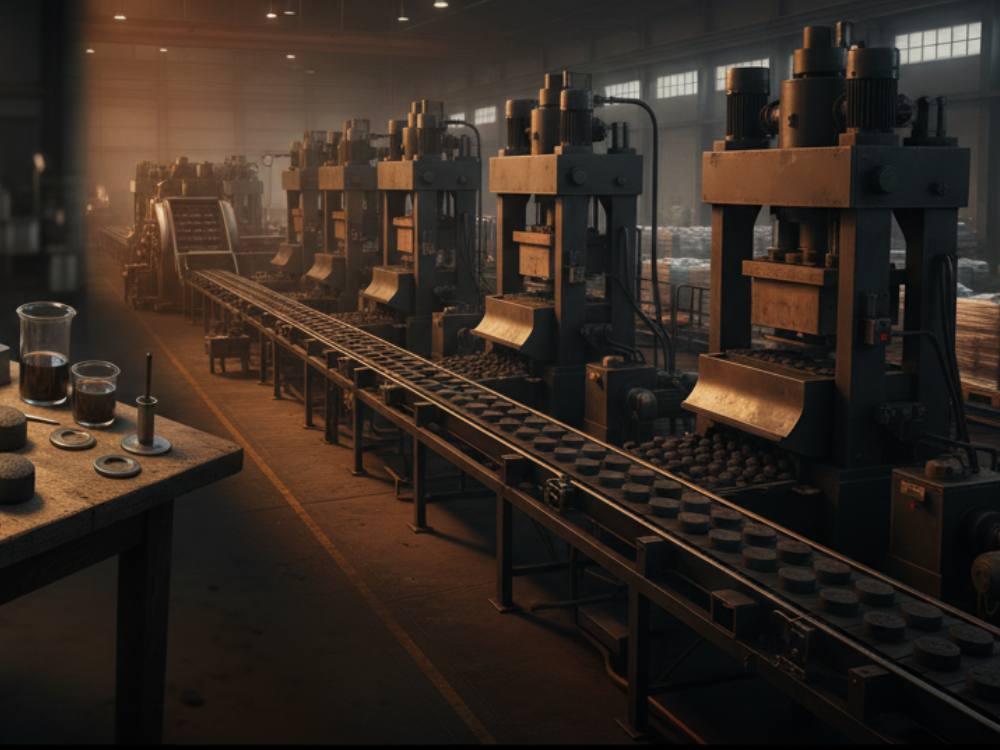
Moving coconut charcoal briquette formulas from laboratory development to commercial production requires systematic adjustments across raw material consistency, pressing equipment capabilities, drying infrastructure, and quality control protocols that ensure 95%+ specification compliance at 3-10 ton daily output levels. Successful scaling programs transition pilot batches from 50-100kg test runs to 500-1,000kg production batches over 8-12 week validation periods.
Understanding the Pilot-to-Production Gap
Laboratory pilot formulas developed at 10-50kg batch sizes face significant challenges when scaling to 500-2,000kg industrial production batches. Variables that remain stable in controlled test environments become sources of variation in commercial manufacturing settings.
Critical Scaling Challenges:
- Raw Material Variation: Pilot batches use carefully selected, homogeneous coconut shells while production processes mixed-source materials with varying moisture content, shell thickness, and carbonization characteristics
- Equipment Differences: Laboratory presses operating at 5-20kg/hour cannot replicate the heating, compression timing, and die-cooling effects of 200-500kg/hour industrial machines
- Binder Performance: Adhesive materials behaving consistently in small batches may exhibit different binding characteristics when mixed in 500kg lots with varying temperature and moisture conditions
- Drying Variations: Controlled laboratory drying at consistent temperatures differs from industrial solar drying or kiln systems with temperature gradients and airflow variations
- Quality Control Frequency: Testing every pilot batch becomes economically impractical at production scale, requiring statistical sampling protocols
A briquette formula producing 100% specification compliance in 50kg pilot runs typically achieves 75-85% compliance in initial production batches. Systematic formula adjustments and process optimization restore 95%+ compliance within 4-8 weeks of production trials.
Financial Impact of Scaling Failures:
Failed scaling attempts create substantial costs:
- Wasted raw materials: $2,000-4,000 per failed production batch
- Lost production time: 8-16 hours per batch rework
- Equipment damage: $5,000-15,000 from improper formula causing die breakage or press malfunction
- Customer rejections: $25,000-45,000 per container if scaled formula fails to meet specifications
Investing 8-12 weeks in systematic scaling validation prevents these failures while building production knowledge that improves long-term manufacturing consistency.
Phase 1: Raw Material Standardization and Sourcing
Production-scale operations require consistent raw material specifications across hundreds of tons annually rather than carefully selected pilot batch materials.
Coconut Shell Quality Standards
Establish procurement specifications ensuring raw material consistency:
Shell Source Requirements:
- Maturity level: Fully mature coconuts (10-12 months) with hard, thick shells
- Geographic origin: Consistent regions with similar soil conditions and coconut varieties
- Harvest season: Preference for dry-season harvests with lower shell moisture content
- Processing freshness: Shells processed within 7-14 days of coconut opening
Physical Specifications:
- Shell thickness: 3-6mm range (thinner shells carbonize inconsistently)
- Moisture content at receipt: 8-12% maximum for efficient carbonization
- Foreign material: Less than 2% non-shell content (fibers, dirt, coconut meat residue)
- Size distribution: 70%+ of shells in 30-80mm size range after initial breaking
Supplier Qualification Process:
- Sample testing from 3-5 potential suppliers
- Laboratory analysis of carbonization yield and charcoal quality
- Small production batch trials (200-300kg) from each source
- Quality consistency evaluation across 3-4 deliveries before long-term commitment
Many production facilities maintain 2-3 qualified shell suppliers to ensure supply continuity and quality leverage through competitive sourcing.
Binder Material Consistency
Natural binders (tapioca starch, cassava flour, cornstarch) show batch-to-batch variation affecting briquette formation and strength.
Binder Specification Requirements:
- Starch content: 80-90% for tapioca-based binders
- Moisture content: 10-13% maximum (higher moisture affects mixing ratios)
- Particle size: 80%+ passing through 100-mesh screen for uniform dispersion
- Purity level: Food-grade quality ensuring consistent binding performance
Binder Storage Protocols:
- Climate-controlled storage at 20-25°C, 50-60% relative humidity
- First-in-first-out rotation preventing age-related degradation
- Sealed containers preventing moisture absorption
- Maximum storage duration: 6 months before quality retesting required
Binder costs represent 8-12% of total raw material expenses but drive 40-50% of quality variation in scaled production. Investment in consistent, high-quality binders delivers disproportionate quality improvements.
Carbonization Process Standardization
Commercial carbonization kilns processing 2-5 tons per batch create different charcoal characteristics than laboratory kilns handling 50-100kg loads.
Critical Carbonization Parameters:
Temperature Profiles:
- Initial heating phase: 200-300°C for 60-90 minutes (moisture evaporation)
- Active carbonization: 400-600°C for 4-6 hours (pyrolysis and volatile removal)
- Cooling phase: Controlled cooling to below 100°C over 6-8 hours
Large-batch kilns develop temperature gradients where outer shells reach peak temperatures 30-60 minutes before core materials, creating carbonization inconsistency. Adjust kiln loading patterns and airflow management to minimize gradients.
Airflow Control:
- Limited oxygen environment maintaining 2-4% oxygen concentration
- Consistent airflow distribution through full kiln volume
- Adjustable dampers allowing temperature control during carbonization phases
Batch Consistency Targets:
- Fixed carbon content variation: Within ±3% across single batch
- Volatile matter consistency: ±2% maximum variation
- Ash content uniformity: ±0.5% across batch samples
Test carbonization batches at multiple kiln positions (top, middle, bottom, center, edges) to identify gradient patterns requiring airflow or loading adjustments.
Read: Charcoal Cargo Insurance 101: Clauses, Risks, and Claims
Phase 2: Equipment Selection and Process Optimization
Pilot formulas developed on small presses require adjustment for industrial equipment operating at 10-25x higher throughput rates.
Pressing Machine Capacity Matching
Hydraulic Press Specifications:
- Pressure capacity: 100-200 bar (1,450-2,900 PSI) for coconut charcoal briquettes
- Production rate: 200-500kg/hour depending on briquette size and shape
- Die cavity number: 12-48 cavities per pressing cycle
- Cycle time: 3-8 seconds per complete press cycle
Critical Press Variables Affecting Formula:
Compression Duration: Laboratory presses often hold compression for 5-10 seconds per cycle, allowing complete binder activation. Industrial presses reduce cycle time to 3-5 seconds for throughput optimization, requiring formula adjustments:
- Increase binder percentage by 10-15% to compensate for shorter activation time
- Reduce moisture content by 1-2% for faster binder engagement
- Consider quick-setting binder additives (calcium carbonate at 0.5-1%)
Die Temperature Effects: Continuous operation heats dies to 60-80°C, affecting binder behavior and briquette formation. Cold dies (first batches after startup) require different moisture levels than hot dies (continuous operation).
Solution: Establish separate “startup formula” with 2-3% higher moisture for first 200-300kg production, then transition to “running formula” for continuous operation.
Pressure Distribution: Multi-cavity industrial dies create pressure variations across cavities. Center cavities typically receive 5-10% higher pressure than edge positions, producing density variations.
Solution: Adjust die design with slightly larger edge cavities (0.5-1mm) or modify feed distribution favoring edge cavity filling.
Mixing Equipment and Batch Homogeneity
Laboratory mixing (often manual or small paddle mixers) achieves superior homogeneity compared to large-scale industrial mixers handling 300-800kg batches.
Industrial Mixer Requirements:
Ribbon Blenders (Preferred for Charcoal):
- Capacity: 500-1,000kg per batch
- Mixing time: 8-12 minutes for complete homogeneity
- Motor power: 15-25 HP for dense charcoal powder mixing
Intensive Mixers (Alternative):
- Higher shear mixing for difficult-to-blend formulas
- Shorter mixing time (4-6 minutes) but higher power consumption
- Better binder dispersion but higher equipment cost
Mixing Protocol Optimization:
Systematic testing determines optimal mixing sequence and duration:
- Dry mix charcoal powder: 2-3 minutes establishing baseline dispersion
- Add dry binder and mix: 3-4 minutes ensuring even distribution
- Add water gradually while mixing: 2-3 minutes preventing clumping
- Final homogenization: 1-2 minutes before pressing
Total mixing time: 8-12 minutes per batch. Insufficient mixing creates density variations; over-mixing can degrade charcoal particle structure reducing briquette strength.
Moisture Addition Control:
Pilot formulas specifying “15% moisture content” must translate to precise water addition in production:
- Calculate exact water mass for batch size (500kg charcoal at 15% moisture = 88.2kg water addition)
- Use flow meters or weight-based systems rather than visual estimation
- Account for base charcoal moisture (typically 3-5%) in water addition calculations
- Monitor mixed batch actual moisture with calibrated moisture meters
Moisture variation of ±2% creates pressing problems and quality inconsistency. Investment in automated water addition systems ($2,000-5,000) eliminates this variation source.
Drying System Scale-Up
Laboratory drying at controlled 80-100°C temperatures differs substantially from industrial solar drying or large-kiln systems.
Solar Drying Considerations (Most Common):
Climate-dependent drying extends 3-7 days depending on:
- Ambient temperature (25-35°C optimal)
- Relative humidity (below 70% preferred)
- Sunlight intensity and duration
- Airflow across drying surfaces
Solar Drying Optimization:
- Spread briquettes in single layers on elevated racks (no stacking)
- Orient drying beds north-south for maximum sun exposure
- Rotate briquettes every 24 hours for uniform drying
- Cover during rain or high-humidity periods
- Target moisture reduction from 15-20% (post-pressing) to below 6%
Formula adjustments for solar drying:
- Reduce initial pressing moisture to 12-14% (faster drying, acceptable if binder performance allows)
- Increase briquette density slightly (denser briquettes resist humidity reabsorption)
- Add hydrophobic treatments (vegetable oil spray at 0.1-0.2%) after partial drying
Kiln Drying (Climate-Independent):
Hot-air kilns provide consistent drying in 24-48 hours:
- Temperature: 60-80°C (higher temperatures risk briquette cracking)
- Airflow: 3,000-6,000 m³/hour circulation
- Humidity exhaust: Continuous moisture removal from kiln atmosphere
Kiln-dried briquettes may show different characteristics than solar-dried:
- Faster moisture loss creates internal stress (slightly lower strength)
- More uniform moisture content across batch
- Better dimensional consistency
Test both drying methods with scaled formula, adjusting binder ratios and moisture levels to optimize for available drying infrastructure.
Read: Preventive Maintenance for Briquette Plants: Minimizing Downtime
Phase 3: Quality Control Protocol Development
Production-scale operations require statistical quality control replacing 100% testing used in pilot batches.
Sampling Protocols and Testing Frequency
Raw Material Testing:
Incoming Coconut Shells (Per Delivery):
- Visual inspection: 100% of delivery for obvious contamination
- Moisture content: Composite sample from 10+ grab samples per truckload
- Foreign material percentage: 2kg sample screening
- Shell thickness: Caliper measurement of 20 random shells
Binder Materials (Per Batch):
- Moisture content: Every incoming batch before storage
- Starch content analysis: Quarterly from each supplier
- Particle size distribution: Monthly verification
In-Process Quality Checks:
Carbonization Output (Per Batch):
- Fixed carbon content: Composite sample from 5 kiln positions
- Ash content analysis: Same composite sample
- Volatile matter determination: Weekly verification
- Particle size distribution: Before and after grinding
Pressing Operation (Hourly):
- Briquette weight: 10 random pieces per hour
- Dimensional accuracy: Caliper measurement of 5 briquettes
- Density calculation: Weight/volume measurement
- Visual defects: Surface cracks, incomplete formation, contamination
Finished Product Testing:
Per Production Day:
- Moisture content: Composite sample of 20+ briquettes
- Burn time testing: 3 briquettes under standardized conditions
- Ash production measurement: Post-burn residue weighing
- Breakage resistance: Drop test from 1 meter height (10 briquettes)
Weekly Comprehensive Analysis:
- Complete laboratory testing (fixed carbon, ash, moisture, volatile matter, calorific value)
- Comparative testing against competitor products
- Long-term storage stability testing (humidity exposure)
Statistical Process Control Implementation
Control Charts for Critical Parameters:
Establish upper and lower control limits for key specifications:
Briquette Weight Control:
- Target: 25 grams per piece
- Upper control limit: 27 grams (+8%)
- Lower control limit: 23 grams (-8%)
- Action required if: 3 consecutive measurements outside limits or single measurement exceeding ±15%
Moisture Content Control:
- Target: 5% moisture content
- Upper control limit: 7%
- Lower control limit: 3%
- Action required if: Any measurement outside limits (critical specification)
Burn Time Control:
- Target: 120 minutes
- Lower control limit: 108 minutes (-10%)
- Action required if: 2 consecutive tests below limit
Process Capability Analysis:
Calculate Cpk (Process Capability Index) for critical parameters:
- Cpk > 1.33: Process capable and well-controlled
- Cpk 1.00-1.33: Process marginally capable, improvement needed
- Cpk < 1.00: Process incapable, immediate corrective action required
Monthly Cpk calculation identifies degrading processes before customer complaints occur.
Corrective Action Protocols
Minor Deviations (Within Control Limits but Trending):
- Adjust mixing moisture by ±1%
- Modify pressing pressure by ±5-10 bar
- Extend or reduce mixing time by 1-2 minutes
- Document adjustment and monitor for 3-5 batches
Major Deviations (Outside Control Limits):
- Stop production immediately
- Quarantine affected batch pending investigation
- Conduct root cause analysis (5-why methodology)
- Implement corrective action and verify effectiveness
- Update process documentation with lessons learned
Many quality variations trace to:
- Raw material moisture content changes (40% of issues)
- Binder batch-to-batch variation (25% of issues)
- Equipment wear or calibration drift (20% of issues)
- Operator training or procedure non-compliance (15% of issues)
Phase 4: Production Trials and Formula Refinement
Systematic production trials validate scaled formulas while identifying necessary adjustments.
Trial Batch Sequencing
Week 1-2: Baseline Production Trials
Produce 3-5 batches using exact pilot formula scaled to production equipment:
- Batch size: 500kg (half of typical production run)
- Process monitoring: Detailed observation of all parameters
- Complete testing: Laboratory analysis of each batch
- Problem documentation: Record all difficulties or variations
Expected results: 60-75% specification compliance (normal for initial scaling)
Week 3-4: Formula Adjustment Trials
Based on Week 1-2 results, implement single-variable adjustments:
Trial Series A – Moisture Optimization:
- Batch A1: Pilot formula moisture -2%
- Batch A2: Pilot formula moisture -1%
- Batch A3: Pilot formula moisture (baseline)
- Batch A4: Pilot formula moisture +1%
- Batch A5: Pilot formula moisture +2%
Identify moisture level producing optimal pressing behavior and briquette quality.
Trial Series B – Binder Optimization:
- Batch B1: Pilot formula binder -1%
- Batch B2: Pilot formula binder (baseline)
- Batch B3: Pilot formula binder +1%
- Batch B4: Pilot formula binder +2%
Determine minimum binder level achieving strength specifications while controlling costs.
Trial Series C – Mixing Time Optimization:
- Batch C1: Mixing time 6 minutes
- Batch C2: Mixing time 8 minutes
- Batch C3: Mixing time 10 minutes
- Batch C4: Mixing time 12 minutes
Establish minimum mixing duration ensuring homogeneity without over-processing.
Week 5-6: Integrated Formula Validation
Combine optimal parameters from trial series into refined production formula:
- Produce 10-15 batches at full production scale (1,000kg+)
- Test for consistency across batches (coefficient of variation <5%)
- Evaluate operator ease and process repeatability
- Calculate production costs and yield percentages
Target: 85-90% specification compliance with consistent process control.
Week 7-8: Extended Production Run
Continuous production of 30-50 batches over 2-week period:
- Simulate normal production conditions and shift changes
- Evaluate formula performance across different operators
- Test batch-to-batch consistency over extended period
- Verify equipment durability with formula (die wear, press stress)
Target: 95%+ specification compliance with statistical process control.
Common Scaling Adjustments
Moisture Reduction (Most Common): Pilot formulas averaging 15-18% moisture typically require reduction to 12-15% for production scale because:
- Industrial mixers achieve better binder distribution (less moisture needed)
- Faster pressing cycles require lower moisture for proper briquette ejection
- Solar drying handles lower initial moisture more efficiently
Binder Increase (Frequent): Production-scale formulas often require 10-20% more binder than pilot batches because:
- Shorter compression duration reduces binder activation
- Larger batch mixing creates slight homogeneity reduction
- Handling stress during drying and packaging requires additional strength
Charcoal Particle Size Adjustment: Industrial crushers produce different size distributions than laboratory mills:
- Coarser particles: Better briquette strength but slower pressing
- Finer particles: Faster pressing but potential dust problems and reduced strength
- Optimal: 70% in 0.5-2mm range with minimal fines (<0.1mm) and oversized (>5mm)
Pressing Pressure Modification: Laboratory presses may operate at different pressures than industrial equipment:
- Higher pressure: Denser briquettes, longer burn time, higher breakage during ejection
- Lower pressure: Easier ejection, lower strength, reduced burn time
- Optimal: Minimum pressure achieving density specifications (typically 100-150 bar)
Phase 5: Production Documentation and Standardization
Validated production formulas require comprehensive documentation ensuring consistent replication across shifts and operators.
Standard Operating Procedures (SOPs)
Raw Material Preparation SOP:
Detailed instructions covering:
- Coconut shell reception and quality inspection procedures
- Storage conditions and FIFO rotation protocols
- Pre-carbonization preparation (washing, size reduction if needed)
- Carbonization kiln loading patterns and density targets
- Cooling and post-carbonization handling
Mixing and Pressing SOP:
Step-by-step process documentation:
- Batch size calculation and ingredient weighing procedures
- Mixing sequence, duration, and visual homogeneity checks
- Moisture addition rate and distribution technique
- Press startup procedures and parameter settings
- Quality checks during pressing operation
- Die cleaning and maintenance frequency
Drying and Packaging SOP:
Complete drying management protocols:
- Briquette arrangement on drying racks (spacing, orientation)
- Rotation schedules for uniform drying
- Moisture testing frequency and acceptance criteria
- Weather-related procedure modifications
- Packaging specifications and carton preparation
- Finished product storage conditions
Formula Documentation Standards
Master Formula Record:
Comprehensive formula specification including:
Ingredient Specifications:
- Carbonized coconut shell powder: 85.0% by weight
- Particle size: 70%+ in 0.5-2mm range
- Fixed carbon: 75-80%
- Moisture content: 3-5%
- Tapioca starch binder: 7.0% by weight
- Starch content: 85%+
- Moisture: 10-12%
- Particle size: 80%+ through 100-mesh
- Water addition: 8.0% by weight
- Calculated from base material moisture content
- Added during mixing phase
Process Parameters:
- Mixing time: 10 minutes total (2 min dry, 3 min binder, 3 min water, 2 min final)
- Mixing speed: 45 RPM ribbon blender
- Pressing pressure: 130 bar
- Pressing cycle: 4 seconds per cycle
- Die temperature: 65-75°C (continuous operation)
Quality Specifications:
- Briquette weight: 25g ±2g
- Dimensions: 25mm cube ±1mm
- Moisture content: 4-6% post-drying
- Density: 0.95-1.05 g/cm³
- Burn time: 110-130 minutes
- Ash content: <2.5%
Batch Production Record:
Real-time documentation for each production batch:
- Date and shift information
- Batch number (sequential tracking)
- Operator names and signatures
- Raw material lot numbers and weights
- Actual process parameters (mixing time, pressure, temperature)
- In-process test results
- Deviations from standard formula or procedures
- Batch disposition (approved, rework, rejected)
Batch records provide traceability for customer complaints and enable trend analysis identifying gradual process drift.
Phase 6: Operator Training and Consistency
Production formula success depends on trained operators executing procedures consistently across multiple shifts.
Technical Skills Training
Equipment Operation:
- Carbonization kiln operation and temperature management
- Mixer operation, cleaning, and maintenance
- Hydraulic press operation, die changing, troubleshooting
- Drying system management and moisture monitoring
- Material handling equipment (conveyors, elevators, packaging)
Quality Control Skills:
- Moisture meter operation and calibration
- Visual quality inspection and defect identification
- Sample collection and testing procedures
- Recording measurements and batch documentation
- Statistical process control chart interpretation
Process Understanding Training
Formula Science Education:
Operators understanding formula science make better real-time decisions:
- Binder chemistry and activation mechanisms
- Moisture effects on pressing and briquette formation
- Particle size influence on density and strength
- Temperature impacts on binder performance
- Drying science and humidity relationships
Troubleshooting Training:
Common problems and corrective actions:
Briquettes Not Forming or Crumbling:
- Possible causes: Insufficient moisture, inadequate mixing, low binder percentage, excessive pressure
- Operator actions: Check and adjust moisture, extend mixing time, reduce pressure
Briquettes Sticking in Dies:
- Possible causes: Excessive moisture, low die temperature, inadequate die cleaning
- Operator actions: Reduce moisture addition, clean dies, allow proper warm-up
Inconsistent Burn Time:
- Possible causes: Density variation, moisture variation, charcoal quality inconsistency
- Operator actions: Verify pressing pressure, check moisture content, inspect raw material quality
High Breakage During Handling:
- Possible causes: Inadequate drying, insufficient binder, rough handling, over-drying brittleness
- Operator actions: Verify moisture specifications, review handling procedures, adjust drying time
Cross-Shift Consistency
Shift Handover Protocols:
- Written shift notes documenting problems, adjustments, and pending issues
- Direct verbal communication between outgoing and incoming operators
- Equipment status review (temperature, pressures, unusual behaviors)
- Production metrics comparison (output rates, quality results, downtime)
Performance Monitoring:
Track metrics by shift and operator to identify training needs:
- Production rate (kg/hour per shift)
- Quality compliance percentage per shift
- Downtime incidents and causes
- Raw material waste percentages
Significant inter-shift variation indicates inadequate standardization or operator skill gaps requiring additional training.
Read: Binder Science for Briquettes: Tapioca and Alternatives
Managing Scale-Up Costs and ROI
Production scaling requires capital investment in equipment, inventory, and validation trials. Understanding costs and timeline enables realistic financial planning.
Scale-Up Investment Requirements
Equipment Purchases:
- Industrial briquette press: $15,000-35,000
- Large-batch mixer: $8,000-15,000
- Drying infrastructure: $5,000-20,000 (depending on method)
- Material handling systems: $3,000-8,000
- Total equipment investment: $31,000-78,000
Trial and Validation Costs:
- Raw material consumption during trials: $2,000-4,000
- Laboratory testing for all trial batches: $1,500-3,000
- Consultant or technical advisor fees: $3,000-8,000 (if external expertise needed)
- Operator training program: $1,000-2,500
- Total trial costs: $7,500-17,500
Working Capital Requirements:
- Raw material inventory (30-day supply): $8,000-15,000
- Spare parts inventory: $3,000-6,000
- Finished goods inventory (15-day buffer): $12,000-25,000
- Total working capital: $23,000-46,000
Grand Total Scale-Up Investment: $61,500-141,500
Investment scale depends on target production capacity (3-ton vs 10-ton daily output) and existing infrastructure versus complete facility development.
Financial Return Timeline
Months 1-3: Validation Phase
- Negative cash flow: Trial costs and equipment investment
- Revenue: Minimal (trial batches may be saleable at discounted prices)
- Net position: -$60,000 to -$140,000
Months 4-6: Ramp-Up Phase
- Production: 50-70% of capacity during stabilization
- Revenue: $45,000-75,000 (partial production sales)
- Operating costs: $30,000-50,000 (materials, labor, overhead)
- Net position: Approaching break-even
Months 7-12: Mature Production
- Production: 85-95% of capacity with consistent quality
- Revenue: $80,000-150,000 monthly
- Operating costs: $50,000-90,000 monthly
- Net profit: $30,000-60,000 monthly
Payback Period: 8-14 months from initial investment to full capital recovery, followed by ongoing profitable production.
Common Scale-Up Pitfalls and Prevention
Rushing Validation Timeline
Mistake: Skipping systematic trials and moving directly to full production, assuming pilot formula will work at scale.
Consequence: 40-60% quality rejection rates, customer complaints, equipment damage, wasted materials.
Prevention: Allocate full 8-12 weeks for validation regardless of market pressure. Lost revenue during validation is minimal compared to failed product launches.
Inadequate Quality Control
Mistake: Relying on visual inspection or intermittent testing instead of statistical process control.
Consequence: Gradual quality drift undetected until customer rejections occur.
Prevention: Implement hourly in-process checks and daily comprehensive testing from first production batch. Quality systems cost 2-3% of production value but prevent 15-25% loss from quality failures.
Poor Documentation
Mistake: Informal verbal procedures instead of written SOPs and batch records.
Consequence: Inter-operator variation, inability to diagnose problems, lack of traceability for customer issues.
Prevention: Document everything during validation trials. Production SOPs should enable new operators to achieve 90%+ compliance with 2-3 days training.
Single-Source Dependencies
Mistake: Qualifying only one supplier for critical raw materials or relying on single piece of equipment.
Consequence: Production stops entirely if supplier delivery fails or equipment breaks down.
Prevention: Qualify 2-3 raw material suppliers during validation. Maintain critical spare parts inventory for essential equipment.
Underestimating Working Capital
Mistake: Calculating only direct production costs without accounting for inventory requirements and payment timing.
Consequence: Cash flow crisis forcing production stops or emergency financing at unfavorable terms.
Prevention: Model complete cash conversion cycle including 30-60 day raw material inventory, 20-40 day production and drying time, and 30-60 day customer payment terms. Maintain working capital covering 90-120 days of operations.
Continuous Improvement Post-Scale-Up
Successful scaling launches ongoing optimization programs improving efficiency, quality, and profitability.
Yield Improvement Programs
Raw Material Utilization: Monitor and reduce waste sources:
- Carbonization yield: Target 28-32% charcoal output from coconut shells
- Grinding losses: Minimize dust generation to below 3%
- Pressing rejections: Reduce malformed briquettes to below 2%
- Drying breakage: Decrease handling damage to below 1%
Each 1% yield improvement on 5-ton daily production saves $15,000-25,000 annually in raw material costs.
Quality Enhancement
Performance Improvements:
- Extend burn time from 120 to 135+ minutes through density optimization
- Reduce ash content from 2.5% to below 2% through charcoal purification
- Decrease breakage from 3% to below 1% through formula strengthening
- Improve dimensional consistency to ±0.5mm through die maintenance
Premium specifications justify 10-15% price premiums over commodity charcoal, adding $100,000-200,000 annual revenue for medium-scale operations.
Cost Reduction Initiatives
Operational Efficiency:
- Reduce energy consumption through kiln insulation and heat recovery
- Decrease labor costs through automation and improved layout
- Negotiate better raw material pricing through volume commitments
- Minimize packaging costs through design optimization
Systematic cost reduction programs targeting 5-10% annual cost improvement maintain competitiveness as markets mature.
Scaling Delivers Sustainable Competitive Advantage
Moving pilot briquette formulas to commercial production requires systematic validation addressing raw material variation, equipment differences, and quality control scalability. Successful programs invest 8-12 weeks in structured trials that optimize moisture levels, binder ratios, mixing protocols, and pressing parameters for industrial equipment capabilities.
Production-scale operations achieve 95%+ specification compliance through statistical process control, comprehensive operator training, and documented procedures enabling consistent replication across shifts. Initial investments of $60,000-140,000 recover within 8-14 months through profitable production serving export markets demanding reliable quality and capacity.
Our production facilities have successfully scaled multiple briquette formulas from laboratory development to 5-ton daily output operations. We provide scaling consultation, trial support, and operator training services for manufacturers transitioning from pilot batches to commercial production. Contact us to discuss your formula scaling challenges and develop customized validation programs for your production environment.