
Coconut charcoal costs more per kilogram than standard wood briquettes. That price difference is recoverable — and then some — through proper extinguishing and reuse protocols.
A coconut charcoal briquette that burns for 3-4 hours in a single session contains enough residual fuel to deliver another 1.5-2 hours of cooking heat in a second session if extinguished correctly.
Most commercial kitchens discard partially burned charcoal by default. Staff douse it with water, it goes in the bin, and the next service starts with fresh charcoal. This practice wastes 30-40% of the fuel value in every briquette that was not fully depleted during service.
For a restaurant consuming 50 kilograms of charcoal per week, a disciplined reuse protocol recovers the equivalent of 15-20 kilograms of fuel weekly. At commercial pricing for premium coconut charcoal, that recovery represents meaningful cost reduction across an annual operating period.
This guide covers safe extinguishing methods, storage of partially burned charcoal, reuse protocols, and the staff practices that make systematic reuse operationally sustainable in a commercial kitchen.
Why Coconut Charcoal Is Particularly Suited to Reuse
Not all charcoal reuses well. Wood lump charcoal, with its irregular piece sizes and variable density, fractures during the extinguishing process and produces pieces too small to stack and use effectively in a second session. Standard wood briquettes with chemical binders absorb moisture during water extinguishing and lose structural integrity. Relit wood briquettes often crumble on the grill before they reach cooking temperature.
Coconut charcoal briquettes — hexagonal and pillow formats — maintain structural integrity through extinguishing and relighting cycles because their raw material properties and binder chemistry differ from wood-based alternatives.
High fixed carbon content of 75-85% means the briquette retains a dense carbon structure even after partial combustion. The burned exterior forms a stable shell rather than crumbling. The interior carbon remains intact and combustible. When the piece is relit, combustion resumes from the surface inward on the remaining carbon mass.
Food-grade cassava starch binders used in premium coconut charcoal production maintain cohesion through wet extinguishing better than chemical binder alternatives. The briquette absorbs some moisture during water extinguishing, which requires drying before reuse, but the piece does not disintegrate the way chemically bound wood briquettes do.
Binder chemistry and its effects on briquette durability explains why binder type affects reuse viability as much as raw material does. Operators evaluating suppliers for a reuse-focused procurement strategy should verify binder composition alongside the standard proximate analysis figures.
The Core Safety Principle
Before covering extinguishing methods, one safety principle applies to every technique in this guide: partially burned charcoal continues to produce carbon monoxide during the smoldering phase even when it produces no visible flame or smoke.
Carbon monoxide is odorless, colorless, and lethal at concentrations that develop quickly in enclosed spaces. Staff who move smoldering charcoal indoors, place it in enclosed containers without adequate ventilation, or store it in walk-in spaces before it has fully cooled create a carbon monoxide hazard that has caused fatalities in commercial kitchen settings.
Every extinguishing and storage protocol in this guide assumes outdoor or well-ventilated handling until the charcoal reaches ambient temperature. No exceptions apply for time pressure, convenience, or low visible smoke levels. Smoldering charcoal that appears inactive is not safe to bring inside.
Establish this as a non-negotiable staff safety rule before implementing any reuse protocol.
Method 1: Oxygen Deprivation Extinguishing
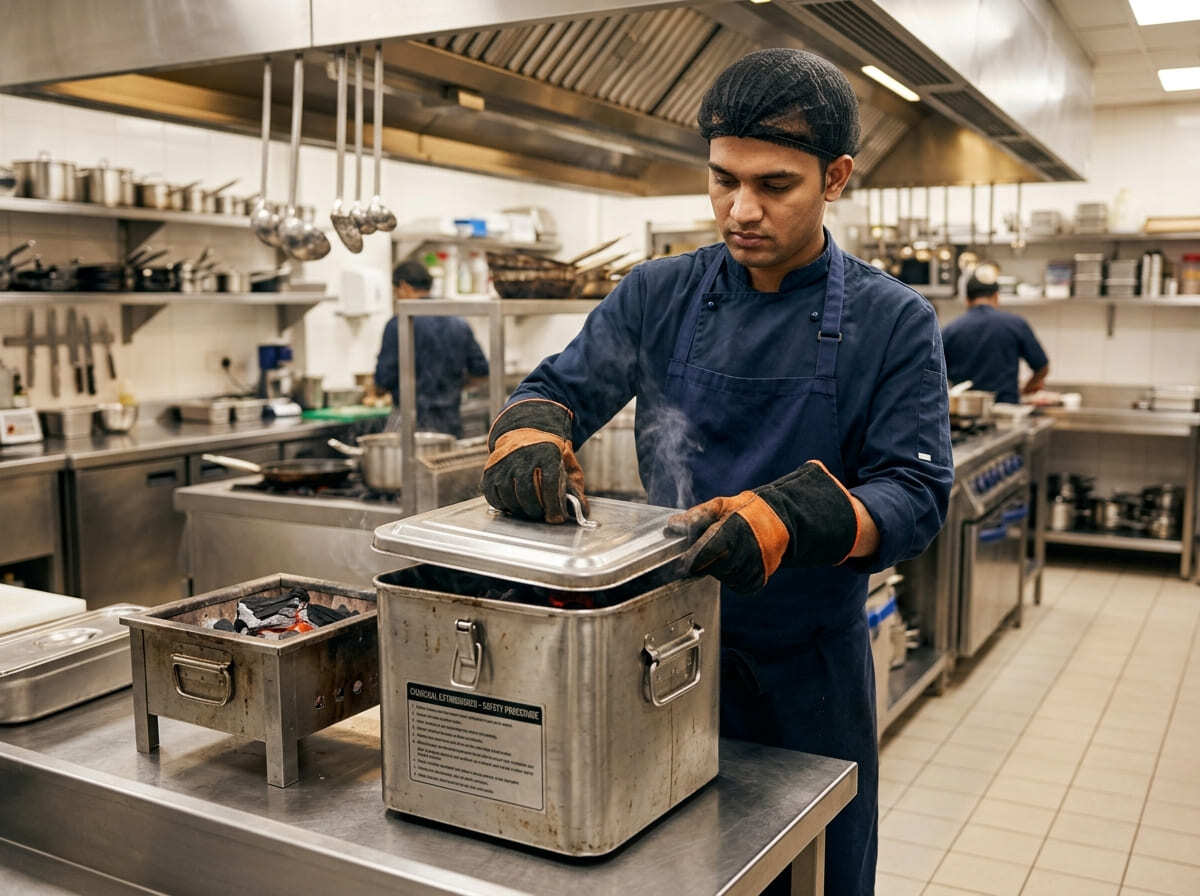
Oxygen deprivation is the preferred extinguishing method for coconut charcoal intended for reuse. It preserves the briquette’s structure and avoids moisture absorption that degrades relighting performance.
The method requires a metal container with a tight-fitting lid — a purpose-made charcoal extinguishing container, a cast iron pot with a lid, or a metal bucket with a metal cover. Plastic containers are unsuitable. Partially burned charcoal at 600-800°C melts plastic, and off-gassing from melting plastic in proximity to food preparation equipment creates contamination risk.
The process:
Transfer burning charcoal from the grill into the metal container using long-handled tongs. Do not handle charcoal with bare hands or short-handled tools — the radiant heat from glowing charcoal at close range causes burns before contact is made. Wear heat-resistant gloves rated for temperatures above 500°C.
Place pieces into the container without stacking them tightly. Tightly packed pieces trap residual heat and slow the cooling process, which extends the time the container remains a carbon monoxide source. A single layer of pieces with space between them allows heat to dissipate efficiently once the lid is sealed.
Seal the container lid immediately after loading. The sealed lid cuts oxygen supply to the charcoal. Combustion ceases within 3-5 minutes as the remaining oxygen in the container depletes. The charcoal continues to cool passively over the next 4-6 hours.
Leave the sealed container in a ventilated outdoor location until the exterior of the container reaches ambient temperature. A container that remains warm to the touch contains charcoal that has not fully cooled. Do not bring it indoors.
Once cool, store the container in a dry indoor location. The extinguished charcoal is ready for reuse in the next service.
Method 2: Water Extinguishing
Water extinguishing is faster than oxygen deprivation but introduces moisture into the briquette that requires drying before reuse. It suits operations that need the grill area cleared quickly but have time to dry charcoal before the next service.
The process:
Move burning charcoal to a metal tray or container outdoors. Do not extinguish charcoal in place on the grill — water that contacts the hot grill grate and firebox causes thermal shock that can crack ceramic components and warp metal grates over time.
Apply water gradually rather than in a single pour. A sudden large water application on very hot charcoal produces a steam explosion that projects boiling water and charcoal fragments outward. Pour water in controlled amounts using a watering can or similar low-pressure applicator, working from the edges of the pile toward the center.
Continue adding water until all visible glow and steam production stops. Charcoal that stops steaming has dropped below 100°C at the surface but may retain significant heat in the interior. Allow 15-20 minutes after steam stops before handling the extinguished pieces.
Spread the wet charcoal in a single layer on a metal drying surface — a mesh tray or grill grate works well — in a ventilated area. The charcoal needs to dry to below 8% moisture content before reuse. In dry ambient conditions, this takes 12-24 hours. In humid environments above 70% relative humidity, drying may require 24-48 hours or a brief period in a low-temperature oven at 80-100°C.
The drying requirement is non-negotiable for performance. Moisture content above 8% produces sparking during relighting and reduces effective burn time in the subsequent session. Operators who skip drying and reignite wet charcoal experience exactly the performance problems that motivate them to discard partially burned pieces rather than reuse them — creating a self-reinforcing waste habit based on a correctable procedural error.
Method 3: Controlled Burndown
For operations where the next service starts more than 6 hours after the current service ends, controlled burndown is the simplest reuse-compatible approach. Rather than extinguishing charcoal actively, the operator closes all grill vents fully at the end of service and allows the charcoal to deplete oxygen and self-extinguish over 1-2 hours.
This method requires no handling of hot charcoal and preserves piece integrity fully. The limitation is time — controlled burndown takes longer than active extinguishing, and the grill remains a carbon monoxide source during the 1-2 hour self-extinguishing phase.
For outdoor grilling setups or well-ventilated kitchen environments, controlled burndown is a low-labor option that works well for lunch-service operations where staff have afternoon hours before dinner service. The partially burned pieces remaining in the grill after controlled burndown are ready to supplement fresh charcoal at the start of the next service without any handling or storage step.
Do not use controlled burndown in enclosed indoor kitchen environments without confirmed adequate ventilation. The smoldering phase produces carbon monoxide concentrations that accumulate in enclosed spaces.
Assessing Reuse Viability
Not every partially burned piece is worth reusing. A piece that has burned to less than 40% of its original mass delivers insufficient burn time to contribute meaningfully to the next session and creates grill management complexity without proportional fuel value return.
Assess reuse viability by weight and visual inspection after extinguishing and cooling:
Weight check. A fresh 26mm coconut charcoal cube weighs approximately 10-12 grams. A piece weighing less than 5 grams after extinguishing has burned past the economically viable reuse threshold. Combine small residual pieces to supplement fresh charcoal rather than treating them as standalone fuel loads.
Structural integrity check. A reusable piece holds its shape when lifted with tongs and shows no crumbling at the edges. A piece that fractures or crumbles during handling will not survive the ignition process intact and should go into the ash disposal rather than the reuse container.
Ash coverage check. Heavy ash coverage on all surfaces indicates the piece has progressed far through its combustion cycle. A piece with ash on the exterior but visible carbon color on fractured edges retains adequate fuel for a productive second session. A piece covered entirely in white or silver ash has completed most of its combustion and offers limited reuse value.
Ash content specification directly affects how many pieces pass the reuse viability assessment after a standard service. Low ash content charcoal — below 3% — produces less ash coverage per unit of carbon consumed, which means more pieces retain visibly assessable carbon after extinguishing and pass the structural integrity check.
Storage of Extinguished Charcoal
Extinguished and cooled charcoal for reuse requires the same storage discipline as fresh charcoal. The porous carbon structure of a partially burned briquette absorbs ambient moisture faster than a fresh briquette because combustion has opened additional pore pathways through the piece.
Store extinguished charcoal in sealed containers or sealed bags. Label containers with the date of extinguishing. Do not store reuse charcoal for longer than 7 days in humid environments — moisture reabsorption over that period degrades relighting performance enough to offset the fuel value recovery.
Separate reuse charcoal from fresh charcoal in storage. Staff who mix extinguished pieces with fresh pieces create inconsistent fuel loads that produce variable service-to-service cooking performance. A clearly labeled reuse container alongside the fresh charcoal supply prevents this.
The storage principles for bulk fresh charcoal apply to reuse charcoal with one additional requirement: because extinguished pieces have more open pore structure than fresh pieces, the maximum acceptable storage period before moisture testing is shorter. Build moisture checks into the reuse workflow rather than assuming stored extinguished charcoal maintains acceptable moisture content across extended holding periods.
Relighting Protocol for Reuse Charcoal
Partially burned charcoal relights faster than fresh charcoal because it has no residual volatile matter to burn off and its pore structure is already fully open. The relighting phase that requires 8-12 minutes for a fresh coconut briquette takes 4-6 minutes for a piece in its second use cycle.
Combine fresh and reuse charcoal in the fuel load rather than using reuse charcoal alone. A fuel load of 60% fresh charcoal and 40% reuse pieces delivers consistent session performance. The fresh pieces provide the full burn duration. The reuse pieces contribute heat during their remaining fuel value and reduce the total fresh charcoal consumed per service.
Place reuse pieces in the center of the fuel load where they receive radiant heat from adjacent fresh pieces. Reuse pieces at the edges of the fuel bed receive less heat from neighboring pieces and may take longer to reach full combustion temperature.
Do not place reuse charcoal that absorbed moisture during water extinguishing directly into an HMD or over food until it has passed through the steam-release phase. Even adequately dried reuse charcoal retains slightly more moisture than fresh charcoal. Light it in open air first and allow the brief steam-release phase to complete before moving it to the cooking position.
Staff Training and Protocol Enforcement
A reuse protocol that exists on paper but is not followed consistently in service produces neither the cost savings nor the safety assurance that the protocol was designed to deliver. Staff training and physical kitchen setup both determine whether the protocol runs automatically or requires constant management attention.
Physical setup that supports compliance. Place the extinguishing container in a visible, accessible location near the grill station. If the container requires staff to carry hot charcoal more than 3-4 meters, the physical inconvenience becomes a reason to skip the step. Make the safe behavior the easy behavior through equipment placement.
Clear shift handover protocols. The service that ends and the service that begins are often staffed by different people. A shift handover checklist that includes charcoal extinguishing status, reuse container contents, and moisture check results for stored reuse pieces prevents the knowledge gap between shifts from becoming a waste or safety gap.
New staff induction. Carbon monoxide hazard awareness and the correct extinguishing sequence belong in the onboarding training for every kitchen staff member who works at the grill station. This training should be documented and signed, not delivered informally. In markets with occupational health and safety inspection frameworks, documented carbon monoxide safety training is a compliance requirement rather than an operational preference.
Periodic protocol review. Kitchen operations change over time. Equipment changes, service volume changes, staff changes. Review the extinguishing and reuse protocol every six months to verify that it reflects current kitchen setup and service requirements. A protocol written for a two-grill operation may not function correctly after the kitchen adds a third grill and doubles charcoal volume.
Calculating Your Reuse Savings
The financial case for systematic reuse is straightforward to calculate once you establish baseline figures for your operation.
Measure fresh charcoal consumption per service week over a standard four-week period. This is your current consumption baseline. Implement the reuse protocol and measure again over the following four weeks. The difference in fresh charcoal consumption, multiplied by your purchase price per kilogram, is the weekly cost saving attributable to the protocol.
Most commercial operations running a disciplined reuse protocol reduce fresh charcoal consumption by 25-35% relative to the discard baseline. On a weekly consumption of 50 kilograms at a landed cost of USD 1.50-2.50 per kilogram for premium coconut charcoal, the weekly saving runs USD 18-44. Annualized, that is USD 950-2,300 in recovered fuel value from a protocol change that requires no capital investment beyond a metal extinguishing container.
The total cost of ownership framework for coconut charcoal that applies to the purchase decision extends to the operational decision about reuse. The charcoal’s higher purchase price per kilogram relative to wood alternatives becomes less significant when the effective cost per service hour accounts for reuse recovery.
When Reuse Is Not Appropriate
Reuse protocols apply to charcoal that was extinguished cleanly and stored correctly. Several conditions disqualify a piece from the reuse stream:
Charcoal extinguished with water and not fully dried. Moisture content above 8% produces sparking and performance degradation that outweighs the fuel value recovered.
Charcoal stored beyond 7 days in humid conditions without moisture verification. The fuel value may be intact, but unknown moisture content creates unpredictable performance.
Charcoal that fractured during extinguishing or handling. Small fragments do not hold position in the fuel load and create ash management problems without contributing proportional heat.
Charcoal from a session where accelerants or chemical starters were used. Chemical residues absorbed into partially burned pieces off-gas during relighting and can affect food flavor in cooking applications.
Charcoal showing visible contamination — grease buildup, food debris, or foreign material on the surface. Contaminated pieces produce off-flavors during the relighting phase that affect food quality.
Supplier Quality and Reuse Performance
The reuse viability of coconut charcoal depends on the specification of the original product. Low ash content, high fixed carbon content, and starch-based binders are the three specification variables that determine how well a briquette survives extinguishing and relighting cycles.
Our commercial BBQ briquettes in hexagonal and pillow formats meet the specification requirements for repeated reuse cycles: ash content of 2-4%, fixed carbon content of 75-85%, moisture content below 8%, and food-grade cassava starch binders.
We include proximate analysis documentation with every shipment. Contact us to discuss volume requirements and delivery logistics for your operation.
Our wholesale coconut charcoal page covers minimum order quantities and shipping terms. For operators evaluating us alongside existing suppliers, our quality assurance documentation provides the full specification reference.