
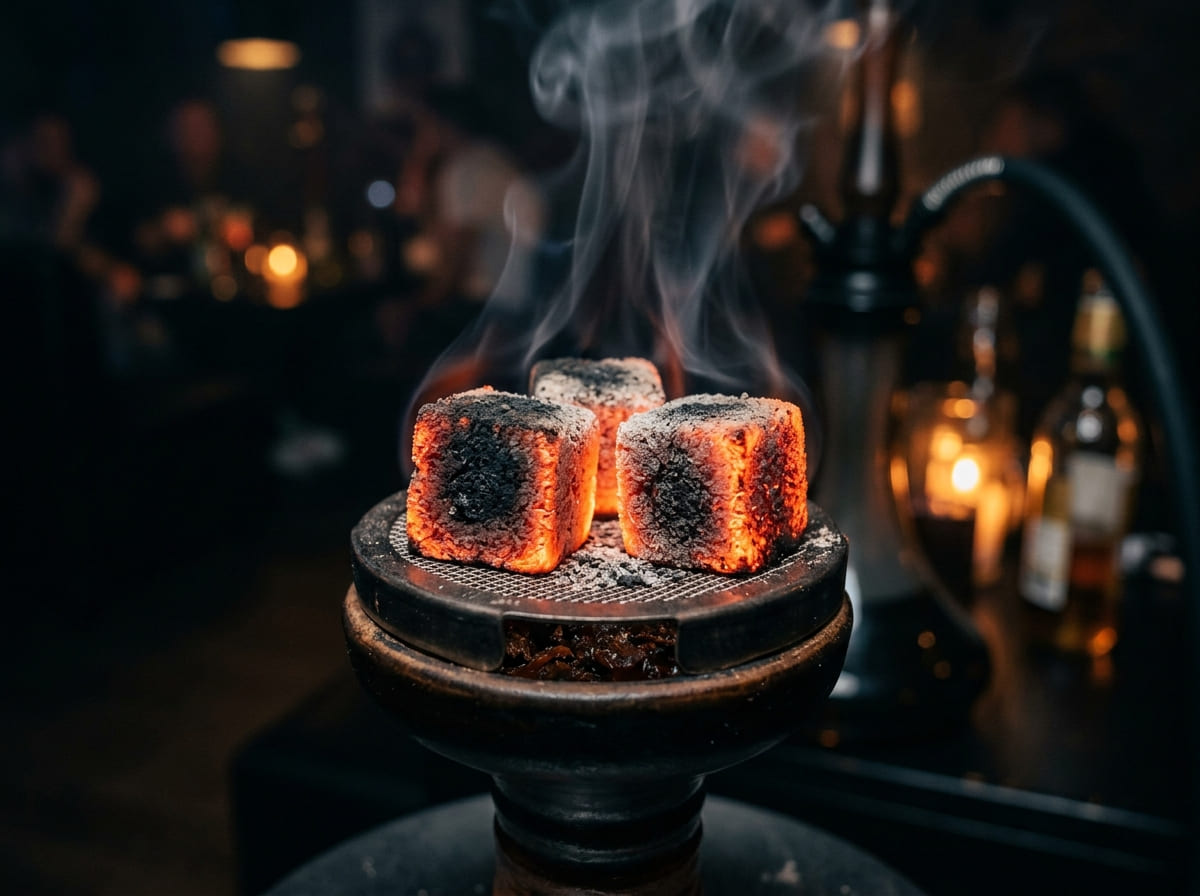
Ash content is one of the four values on every proximate analysis certificate, but it receives less attention than fixed carbon or burn time in most purchasing conversations. Buyers focus on how long the charcoal burns and how hot it gets. Ash content determines what happens to the grill during and after that burn — and in commercial operations, what happens to the grill matters as much as what happens to the food.
The ideal ash content percentage for BBQ briquettes is not a single universal figure. It depends on the cooking application, the grill type, and the service model. This article establishes what ash content measures, how different percentage ranges affect cooking performance, and what specifications to require for different BBQ contexts.
What Ash Content Actually Measures
Ash content is the percentage of a briquette’s original weight that remains as inorganic residue after complete combustion. A briquette with 5% ash content leaves 50 grams of residue per kilogram burned. A briquette with 12% ash content leaves 120 grams per kilogram burned.
This residue is mineral matter — silica, calcium, potassium, and magnesium compounds — that was present in the original raw material and does not combust. It contributes no heat energy. It produces no flavor compounds. Its only role in the cooking process is passive, and that role is consistently negative: it accumulates, insulates, and restricts airflow.
Proximate analysis explains the relationship between ash content and the other key measurements. Fixed carbon and ash content are inversely related within a given raw material. Higher fixed carbon content — more combustible carbon per gram — means less inorganic mineral matter and therefore lower ash content. A briquette with 82% fixed carbon content typically produces less ash than one with 68% fixed carbon content from the same raw material source.
This inverse relationship means ash content functions as a proxy for carbonization quality. Well-carbonized coconut shell charcoal with high fixed carbon content produces low ash. Poorly carbonized or diluted charcoal produces higher ash. Buyers who request both figures simultaneously get a more complete picture of production quality than either figure provides alone.
How Ash Accumulation Affects BBQ Cooking Performance
Ash affects cooking performance through three mechanisms, each of which operates differently depending on grill type and session length.
Thermal insulation of the fuel bed. As ash accumulates around and between burning briquettes, it creates an insulating layer between the charcoal and the surrounding air. This layer restricts oxygen access to the combustion zone. The combustion rate slows, heat output drops, and grill surface temperature falls below the level required for effective cooking.
In a home BBQ context, this typically appears as a grill that performs well for the first 45 minutes then loses heat progressively. The user adds more charcoal, which temporarily restores temperature, but the underlying problem is that the existing ash bed is insulating the new fuel as well. In a commercial kitchen running a 4-hour service, the same insulation effect disrupts cooking consistency across the service window.
Airflow restriction through the grate. Ash falls from the burning fuel bed and accumulates in the ash collection area below the grate. As this layer builds, it reduces the air gap between the collection area and the grate, which restricts the convective airflow that feeds oxygen to the fuel bed from below.
Grills with adjustable air vents compensate partially — operators open vents wider as ash accumulates — but grill designs with fixed airflow geometry lose cooking performance as the ash bed builds. This is particularly relevant for commercial BBQ restaurant operations using high-volume equipment where mid-service ash clearing is operationally disruptive.
Contamination of the cooking surface. Ash is light enough to become airborne under the airflow conditions present in an active grill. Wind, fan-assisted grills, or the convective currents from a hot fire carry ash particles upward onto the cooking grate and food surface. White ash deposits on cooked food are not a food safety issue but they are a presentation issue in any restaurant context.
Higher ash content charcoal produces more airborne ash under identical airflow conditions. For open-fire and Argentine-style parrilla setups where food sits close to the fuel bed, ash content specification becomes a food quality consideration alongside a grill management consideration.
Ash Content Ranges and What They Mean
Ash content in commercially available BBQ briquettes spans a wide range. Understanding what each range means for cooking performance guides purchasing decisions across different application contexts.
Below 3%: Premium performance specification. Briquettes in this range produce minimal residue per kilogram burned. Grill management during service requires less frequent intervention. Ash accumulation insulates the fuel bed slowly enough that a single charcoal load maintains consistent heat across a 3-4 hour commercial service without management beyond the normal mid-service stir. Food contamination from airborne ash is negligible.
This specification range applies primarily to premium coconut shell charcoal with fixed carbon content of 80-85%. Achieving sub-3% ash content requires high-quality raw material and controlled carbonization. It commands a price premium over standard specification charcoal that is justified in high-volume commercial applications where grill management labor is a measurable cost.
3-5%: Standard premium specification. The practical target for most commercial BBQ applications. Briquettes in this range deliver consistent cooking performance across standard service periods. Grill management intervention — a stir or tap to redistribute ash — occurs once or twice during a 4-hour service rather than continuously.
Coconut shell charcoal consistently achieves this range because coconut shell contains lower mineral content than wood-based raw materials. The same carbonization quality applied to wood produces higher ash content output than coconut shell, which is one of the primary performance advantages coconut charcoal holds over hardwood alternatives in professional kitchen applications.
5-8%: Acceptable for casual and home use. Briquettes in this range work adequately for shorter sessions — a 90-minute home BBQ where the operator manages the grill actively throughout. Commercial service applications begin to encounter problems at this range. A 4-hour service on 6-7% ash content charcoal requires mid-service grill cleaning to maintain heat consistency. Labor cost for that intervention erodes the purchase price advantage that higher ash content charcoal typically offers.
Above 8%: Problematic for most applications. Briquettes above 8% ash content produce enough residue to cause measurable grill management problems in any service lasting longer than 90 minutes. In commercial kitchen contexts, this range is unsuitable for continuous service operations. For home BBQ use, ash accumulation becomes visible and disruptive before a typical cooking session concludes.
Some lower-cost briquettes made from sawdust, agricultural waste, or mixed raw materials fall into this range. Coconut shell versus sawdust briquette comparison details how raw material choice drives ash content outcomes independently of production quality.
Ideal Ash Content by BBQ Application
The appropriate ash content target varies by cooking context. A single specification does not serve all applications equally.
Commercial BBQ restaurants with continuous service. Target: below 3%. Rationale: Multi-hour service windows with high table turnover and limited mid-service grill management time require charcoal that maintains consistent heat without intervention. Sub-3% ash content provides that consistency. The price premium over standard specification charcoal is offset by reduced grill management labor and more consistent cooking output.
Catering and event grilling. Target: 3-5%. Rationale: Catering timelines involve less predictable service windows than fixed restaurant operations. Moderate ash content in the 3-5% range delivers adequate performance across variable session lengths without requiring the premium pricing of sub-3% specification product. Grill management expectations in catering contexts are more flexible than in restaurant service.
Casual and home BBQ grilling. Target: below 8%. Rationale: Home users managing a single grill with direct involvement throughout the session tolerate higher ash production than commercial operators. Sessions typically run 1-2 hours rather than 4-5 hours, so ash accumulation has less time to affect performance. Below 8% remains the ceiling for acceptable home performance. Above 8%, ash management disrupts the cooking experience noticeably even in casual contexts.
Argentine parrilla and live-fire concepts. Target: below 3%. Rationale: Open-fire setups with food close to the fuel bed make airborne ash a food quality concern in addition to a grill management concern. The cooking style also typically involves longer service windows on a continuous fuel bed. Both factors push the specification toward the lowest achievable ash content.
Kamado and ceramic grill cooking. Target: below 5%. Rationale: Kamado-style grills have restricted ash clearing access during cooking. Ash accumulates in a contained firebox and restricts the precisely controlled airflow that defines kamado cooking performance. Ash content above 5% degrades the temperature control precision that kamado users specifically seek. Below 5% keeps the firebox functional through a full cooking session without requiring the access panel removal that mid-session ash clearing requires.
Ash Content and Total Cost of Ownership
Purchase price per kilogram is the figure buyers compare first. Total cost of ownership — charcoal cost plus operational costs attributable to charcoal performance — is the figure that reflects actual business economics.
Three operational costs connect directly to ash content specification:
Grill management labor. Each grill intervention during service — stirring the fuel bed, clearing accumulated ash, adjusting vents to compensate for restricted airflow — takes a kitchen staff member away from cooking tasks. In a commercial kitchen running four grills during peak service, frequent ash management interventions represent measurable labor diversion. Lower ash content charcoal reduces intervention frequency.
Charcoal replacement frequency. High ash content charcoal that insulates its own fuel bed delivers heat output that drops faster per hour than low ash content charcoal. Operators compensate by adding charcoal more frequently. This additional consumption partially or fully offsets the lower purchase price per kilogram of higher ash content product.
Post-service cleaning time. Higher ash production means more residue to remove after service. One client, a 150-seat BBQ restaurant in the UAE, reduced post-service grill cleaning time by 35 minutes per night after switching from 8% ash content hardwood briquettes to our 3% ash content coconut charcoal. At a kitchen labor rate of USD 8-12 per hour, that reduction delivers USD 4-6 of labor saving per service night — approximately USD 1,400-2,200 per year on grill cleaning alone.
The cost and performance comparison between coconut and wood charcoal covers this total cost framework in detail. Ash content sits at the center of that comparison because it drives the operational cost differences more than any other single specification variable.
Verifying Ash Content in Purchased Charcoal
Ash content claims on packaging and in supplier communications are not always reliable. Verification requires either laboratory testing or field observation consistent with specification claims.
Proximate analysis certificate. Every reputable supplier provides a proximate analysis certificate showing ash content alongside fixed carbon, volatile matter, and moisture content. Request this document before placing a first order and with each subsequent shipment. Suppliers who cannot provide batch-specific proximate analysis cannot guarantee consistency across shipments.
Weight loss calculation. Weigh a fixed quantity of briquettes before burning. Weigh the ash residue after complete combustion. The ratio of ash weight to original briquette weight is the ash content percentage. This field method does not require laboratory equipment and provides a direct verification of claimed specifications. Complete combustion is essential for accurate measurement — partially burned residue inflates the ash content figure.
Visual observation during service. Experienced operators develop a qualitative sense for ash production rate over time. Charcoal that requires grill intervention significantly more frequently than the proximate analysis specification suggests is either producing more ash than specified or has absorbed moisture that is disrupting combustion efficiency. Both possibilities warrant investigation before the next order.
Post-arrival quality inspection protocols include ash content verification alongside moisture and physical integrity checks. Building this into the receiving process catches specification discrepancies before the product enters service.
What Our BBQ Charcoal Delivers
Our hexagonal and pillow briquettes for commercial BBQ applications measure between 2% and 4% ash content across production batches, with fixed carbon content of 75-85% and moisture content below 8%.
We provide proximate analysis certificates with every shipment and maintain batch records that allow traceability between delivered product and test results. Request samples to run your own ash content verification before placing a first order.
Our wholesale coconut charcoal page covers minimum order quantities and logistics details for commercial kitchen supply. For operators evaluating us as a replacement supplier, our quality assurance documentation provides the full production standard reference.