
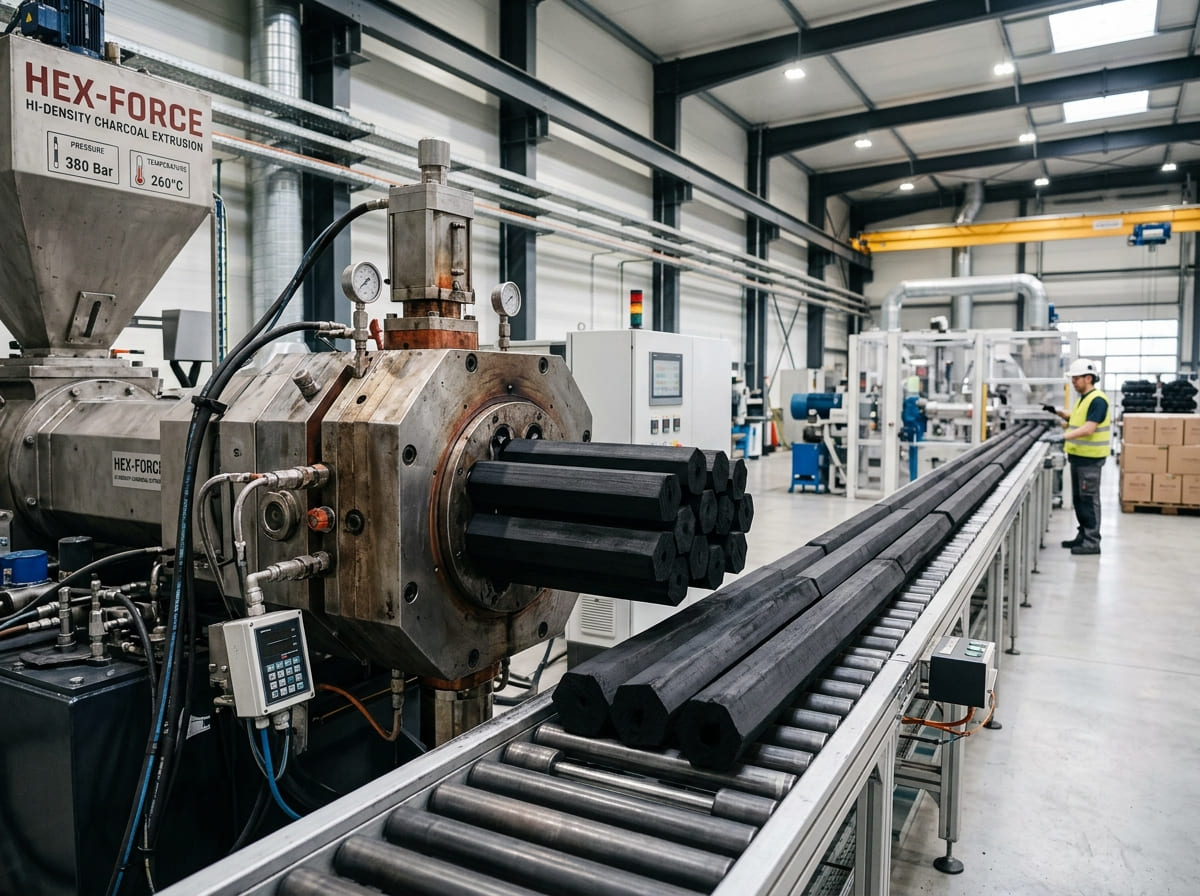
The hexagonal shape of a coconut charcoal briquette is not simply a geometric preference. It is the output of a specific manufacturing process — extrusion — that determines the briquette’s density, internal structure, channel geometry, and mechanical strength simultaneously. Every performance characteristic that distinguishes a high-density hexagonal briquette from a lower-quality alternative traces back to decisions made in the extrusion process.
Buyers who understand how extrusion works are better positioned to evaluate supplier quality claims, ask productive questions during factory assessments, and interpret performance differences between products that carry identical proximate analysis specifications.
What Extrusion Is and How It Differs from Compression Pressing
Two primary forming methods exist for coconut charcoal briquettes: extrusion and compression pressing. They produce different piece geometries, different internal structures, and different performance profiles.
Compression pressing forces charcoal powder and binder mixture into a mold cavity from above. The press applies force perpendicular to the mold face, compressing the material to the shape of the cavity. Pillow briquettes and tablet formats are compression-pressed. The process suits shapes with two defined flat faces — the top and bottom of the mold — and rounded edges where the material flows under lateral compression.
Extrusion forces the same mixture through a shaped die opening using a screw or hydraulic ram. The material flows continuously through the die, which imparts the die’s cross-sectional profile to the output. A hexagonal die with a central pin produces a continuous hexagonal column with a hollow center channel. The column exits the die and is cut to length by a rotating blade or wire cutter.
The distinction matters for several reasons. Compression pressing applies force in one direction. Extrusion applies force in the direction of flow while the die walls constrain the material on all sides simultaneously. This multi-directional constraint produces a different internal particle arrangement — and therefore a different mechanical strength profile — than single-direction compression achieves.
Charcoal shape engineering covers how geometry and manufacturing method interact to produce different combustion profiles. The extrusion process creates hexagonal briquettes whose performance characteristics are inseparable from the manufacturing method that produces them — you cannot replicate a high-density extruded hexagonal briquette’s performance by compression-pressing a hexagonal mold.
The Extrusion Machine: Key Components
An industrial charcoal extrusion machine consists of five functional components that each affect output quality in specific ways.
The feed hopper and mixing chamber. Raw material — coconut shell charcoal powder mixed with binder and water — enters the machine through the feed hopper. The mixing chamber ensures homogeneous distribution of binder throughout the powder mass before it reaches the extrusion zone. Inadequate mixing at this stage produces binder-rich and binder-poor zones in the extrudate, which creates density variation and micro-crack susceptibility during subsequent drying.
The screw or ram mechanism. Most industrial charcoal extruders use a screw mechanism — a rotating helical screw that conveys material from the feed zone toward the die under progressively increasing pressure. Some high-output facilities use hydraulic ram extruders that deliver intermittent high-pressure shots through the die rather than continuous flow. Screw extruders produce continuous output at moderate pressure. Ram extruders produce higher peak pressure that achieves greater compaction density but require pressure management to prevent die clogging and extrudate fracture at the die exit.
The die assembly. The die is the component that imparts the hexagonal profile. It consists of an outer die body that defines the six outer faces of the hexagonal cross-section and a central pin that creates the hollow channel. The dimensional precision of the die determines the dimensional consistency of every briquette the machine produces. Die wear over time enlarges the die opening and widens the channel, which reduces wall thickness and briquette density. Facilities that do not replace dies at appropriate wear intervals produce progressively lower-density output without the reduction appearing on proximate analysis certificates.
The cutting mechanism. The continuous extrudate exiting the die is cut to the specified briquette length. Rotary blade cutters produce cleaner cuts at the specified length with minimal material disturbance. Wire cutters are simpler but can drag material at the cut face, creating a slightly deformed end face that reduces piece-to-piece stacking consistency. End face quality affects how briquettes pack in the carton and how they contact adjacent pieces on the grill or in the HMD.
The conveyor and transfer system. Fresh extrudate is mechanically weak — the binder has not yet set and the piece contains 25-35% moisture. Transfer from the cutting mechanism to the drying system without physical deformation requires conveyor systems that support the piece without point loading. Facilities that allow fresh extrudate to stack or contact hard surfaces before drying introduce deformation and contact-point stress concentrations that become structural defects in the finished piece.
How Extrusion Creates High Density
Density is the most consequential output variable of the extrusion process for commercial charcoal performance. Higher density briquettes deliver longer burn times, more consistent heat output, and greater mechanical strength than lower density equivalents with identical proximate analysis specifications.
Extrusion creates density through two mechanisms that compression pressing cannot replicate simultaneously.
Continuous die-wall constraint. As material flows through the die, the die walls exert lateral constraint on the material from all sides simultaneously. This constraint prevents the lateral expansion that occurs when compression pressing applies force from one direction — the material compresses in the pressing direction but has some freedom to expand laterally before the die walls arrest the movement. In extrusion, the die walls prevent lateral expansion entirely, forcing all compaction energy into densification of the material rather than lateral deformation.
Progressive pressure buildup. The screw mechanism builds pressure progressively as material advances toward the die. By the time material reaches the die entry, it has been subjected to sustained pressure rather than a single peak compression event. This sustained pressure allows the charcoal powder particles more time to rearrange into efficient packing configurations before the binder sets the arrangement permanently. Better particle packing means higher density at equivalent binder content.
The result of these two mechanisms is a briquette with bulk density typically in the range of 1.1-1.3 g/cm³ for high-quality extruded coconut charcoal, compared to 0.9-1.1 g/cm³ for compression-pressed briquettes from equivalent raw material. This density difference — 10-20% more carbon per unit volume — directly translates to burn time and heat output per piece.
Proximate analysis figures express fixed carbon content as a weight percentage, which does not reflect density differences between pieces of the same weight. Two briquettes with identical fixed carbon percentages but different densities deliver different burn times because the denser piece contains more total carbon mass within the same physical volume. Buyers who compare charcoal specifications by proximate analysis alone without considering density may underestimate the performance advantage that high-density extruded pieces deliver per session.
The Channel Geometry and Its Combustion Consequences
The hollow center channel that extrusion creates is not incidental to hexagonal briquette design. It is a deliberate engineering feature that the extrusion process uniquely enables at commercial production scale.
The channel serves as an internal airflow pathway. During combustion, hot combustion gases rise through the channel in a chimney effect, drawing fresh air from below. This internal convective current supplements the external surface combustion occurring on the six outer faces simultaneously. The briquette effectively burns from the inside and outside simultaneously during the active combustion phase.
Channel geometry — diameter, wall thickness, and length — determines how strongly this chimney effect operates. A channel too narrow relative to the briquette diameter creates high flow resistance that limits the convective current. A channel too wide leaves insufficient wall thickness for sustained long-duration combustion. The die pin diameter that creates the channel is therefore an optimized engineering parameter rather than an arbitrary geometric choice.
Standard hexagonal shisha briquette channel diameters run approximately 8-10mm for a 26mm outer dimension piece. This geometry produces wall thicknesses of approximately 7-8mm per face — sufficient for 65-90 minute burn times — while maintaining channel diameter adequate for meaningful convective airflow enhancement.
For commercial BBQ applications, hexagonal briquette channel geometry contributes to the faster heat ramp-up that distinguishes hexagonal from pillow format performance in kitchen settings. The internal airflow established early in the combustion cycle raises the piece’s core temperature faster than surface-only combustion would achieve, which shortens the time from lighting to cooking-ready temperature.
Extrusion Speed, Pressure, and the Density-Defect Tradeoff
Extrusion machines operate across a range of screw speeds and feed rates. The density of the output briquette relates directly to the pressure at which material passes through the die, which relates to screw speed, feed rate, and material consistency.
Higher screw speeds increase throughput but reduce the time material spends under progressive pressure before reaching the die. Less pressure dwell time means less opportunity for particle rearrangement into efficient packing configurations. Output density decreases as screw speed increases beyond the optimum for the specific material and die geometry.
Facilities under production pressure to meet large orders or tight delivery schedules face a recurring temptation to increase extrusion speed to raise daily output. Each speed increase above the optimum reduces output density. The density reduction does not appear on proximate analysis certificates, which measure composition rather than physical density. It appears in buyer feedback about reduced burn times and lower piece-to-piece consistency.
This is the same production pressure dynamic that creates micro-crack risk during aggressive drying. Both problems originate from the conflict between throughput pressure and quality-optimized process parameters. A facility that manages extrusion speed within quality-defined limits produces consistent density. A facility that optimizes for throughput produces variable density that manifests as performance inconsistency in the market.
The practical check for buyers: request bulk density data alongside proximate analysis from potential suppliers. Bulk density measurement is straightforward — weigh a known volume of product and calculate mass per unit volume — and reveals density variation that proximate analysis cannot detect. A supplier who cannot provide bulk density data either does not measure it or does not want to share it. Both situations warrant investigation.
Raw Material Preparation and Its Effect on Extrusion Output
The extrusion process can only work with what the feed material provides. Raw material preparation — carbonization quality, powder fineness, and moisture content at feed — determines the ceiling on extrusion output quality regardless of machine capability.
Carbonization completeness. Coconut shell that has not completed the carbonization process fully contains residual organic compounds and partially converted carbon that behave differently under extrusion pressure than fully carbonized material. Under-carbonized particles are softer and more compressible than fully carbonized particles. They compact more easily in the die but spring back partially after die exit as the compressed organic material recovers some of its original volume. This spring-back reduces final density below what the extrusion pressure achieved in the die and creates dimensional variation between pieces cut from the same extrudate.
Powder fineness and consistency. The particle size distribution of the feed powder determines how efficiently particles pack under extrusion pressure. Finer, more uniform powder packs more efficiently than coarser, irregular powder. However, powder that is too fine — below approximately 0.5mm average particle size — increases the binder requirement to achieve adequate green strength, which raises binder costs and may affect combustion behavior. The optimal particle size range for high-density hexagonal extrusion is typically 0.5-2mm, with the distribution concentrated in the 0.8-1.5mm range.
Facilities that use consistent screening after grinding produce feed powder within this range reliably. Facilities that skip screening or use inconsistent screening produce variable particle size distribution that creates batch-to-batch density variation even when all other process parameters remain constant.
Feed moisture content. The powder-binder mixture entering the extruder requires a specific moisture content to achieve the plasticity necessary for die flow. Too dry, and the mixture does not flow through the die smoothly — pressure builds unevenly, the extrudate fractures at the die exit, and surface cracks form before the piece reaches the drying system. Too wet, and the mixture flows too easily, reducing the pressure that achieves densification and producing a low-density, soft extrudate that deforms during handling before the binder sets.
The optimal feed moisture range for most coconut charcoal extrusion formulations runs between 28% and 35%. Facilities that measure and control feed moisture with a dedicated moisture sensor before each batch produce more consistent density than facilities that estimate feed moisture by tactile assessment or fixed water addition schedules.
Die Maintenance and Its Effect on Long-Run Consistency
The die is a precision-machined component subject to abrasive wear from continuous contact with charcoal powder. Coconut shell charcoal powder is harder than many other biomass materials due to its silica content, which accelerates die wear relative to softer feedstocks.
As the die wears, the hexagonal opening enlarges and the central pin diameter reduces. The extrudate produced by a worn die has:
Larger outer dimensions than the specification — pieces may no longer fit correctly in standard HMD chambers that were optimized for the nominal piece size. Thinner walls due to channel enlargement — burn time decreases as wall thickness reduces. Lower surface smoothness — worn die surfaces produce rougher extrudate surfaces that create more ash contact area and slightly increase ash production per session.
None of these changes appear in a proximate analysis. They appear in customer feedback over time as a supplier’s production run extends without die replacement.
Reputable facilities track cumulative die throughput — total kilograms of material extruded through a given die — and replace dies at manufacturer-specified wear intervals. Facilities without this tracking produce output that drifts from specification progressively and invisibly until customer complaints reveal the deviation.
Buyers who establish long-term supply relationships should ask suppliers about die replacement schedules and maintenance records. Benefits of stable OEM partnerships include consistent dimensional specification across repeated orders — an outcome that requires production infrastructure discipline, not just raw material quality.
Machine Capability and Production Scale
Industrial charcoal extrusion machines vary significantly in their output capacity, pressure capability, and process control instrumentation. The machine specification determines the upper bound on density and consistency achievable at a given production volume.
Entry-level extrusion machines produce 200-500 kg per hour at moderate pressure. They suit small-scale production and pilot runs but struggle to maintain consistent pressure at feed rate variations that occur with changing raw material batches. Density variation between batches is higher on lower-capability equipment.
Industrial-grade extrusion machines produce 800-2,000 kg per hour with pressure control systems that maintain consistent die pressure despite feed rate variation. Pressure sensors at the die entry provide feedback to the screw speed control, adjusting throughput to maintain target pressure rather than target speed. This pressure-controlled operation produces more consistent density across batches and across the duration of individual production runs.
Scaling production from pilot to mass quantities requires matching machine capability to production volume requirements. A facility that developed its formulation on a pilot extruder and then transferred it to a high-speed industrial machine without recalibrating process parameters produces output that differs from the pilot specification in density and dimensional consistency. Buyers who receive samples from pilot production and then place large orders may receive product that differs from the samples if the supplier did not validate the production-scale transfer.
Connecting Extrusion Quality to Buyer Decisions
The extrusion process is several steps removed from the proximate analysis certificate that buyers typically use to evaluate suppliers. But extrusion quality determines whether the fixed carbon content on that certificate translates into consistent burn time per piece, whether the piece survives transit without developing micro-cracks, and whether it fits correctly in a Kaloud Lotus or a commercial BBQ grill.
The questions that reveal extrusion quality in a supplier assessment:
What extrusion machine type and capacity does the facility use? The answer reveals whether the facility invested in equipment capable of consistent pressure control or operates on entry-level equipment whose output variability is managed informally.
What bulk density specification does the facility target for finished pieces? A specific figure with a stated tolerance — for example, 1.15-1.25 g/cm³ — indicates a measured and controlled output parameter. No answer or a vague answer indicates density is not monitored.
What die replacement schedule does the facility follow? A specific cumulative throughput figure indicates infrastructure maintenance discipline. No schedule indicates dimensional drift is not managed.
What feed moisture range does the facility control to? A specific range with a measurement method indicates process instrumentation. Estimation by feel indicates informal process control.
Our hexagonal briquettes are produced on pressure-controlled extrusion equipment with die replacement scheduling, feed moisture monitoring, and bulk density verification on every production batch. Our process documentation covers production standards in detail. Contact us to discuss production specifications or to request samples for independent density and dimensional verification. Our quality assurance documentation provides the full production standard reference for buyers conducting supplier assessments.avvv