
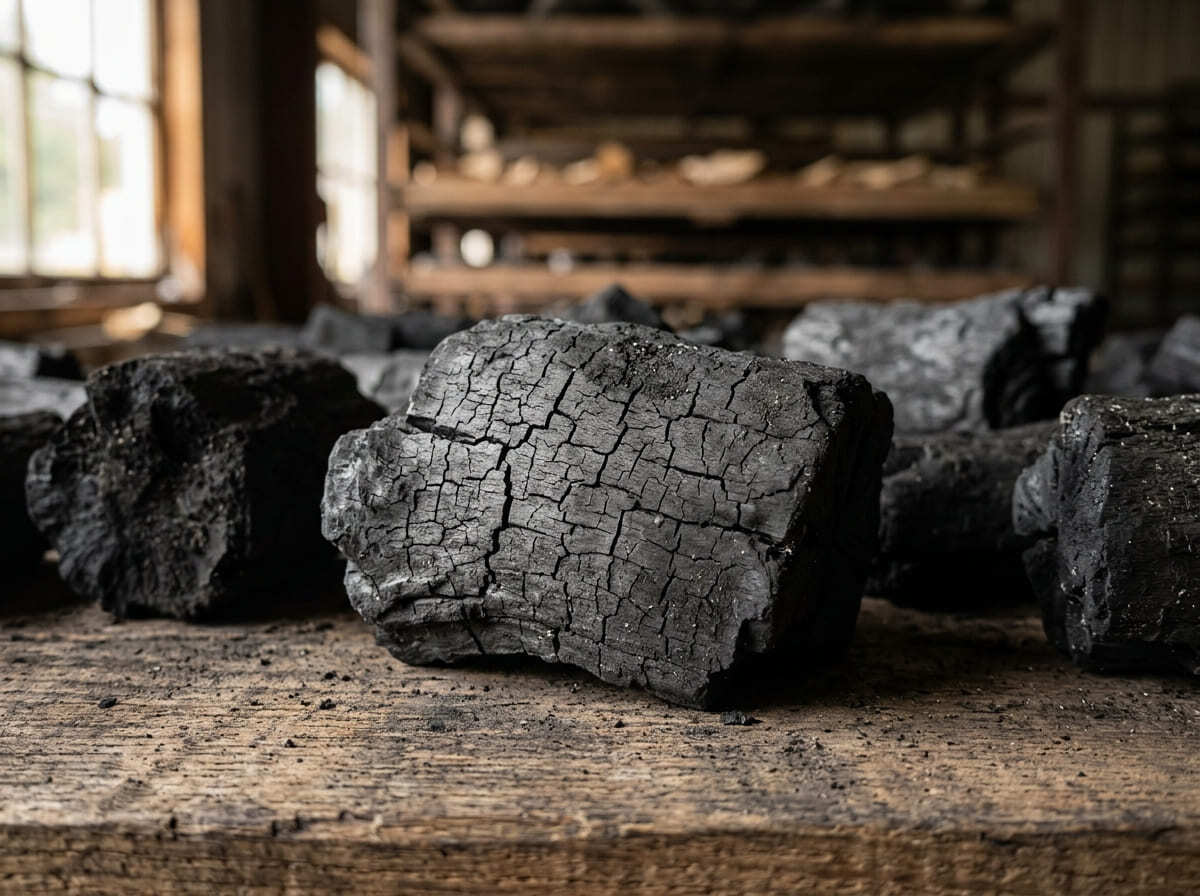
Micro-cracks are invisible to the buyer at the point of purchase. They do not appear on proximate analysis certificates. Customs inspectors do not flag them. The briquette looks intact in the carton, intact in the retail pack, and intact on the lighting coil — until it fractures mid-session, produces elevated sparking during lighting, or delivers inconsistent burn times that the end user attributes to product quality without being able to identify the specific cause.
Micro-cracks form during the drying phase of briquette production. They are a manufacturing defect that originates from a controllable process variable, which means they are preventable. Understanding how they form, what production conditions create them, and what quality controls catch them before shipment separates suppliers who manage this risk from those who do not.
What Micro-Cracks Are and Why They Matter
A micro-crack is a structural fracture within the briquette body that does not extend fully through the piece and is not visible to the naked eye under normal inspection conditions. The crack forms when internal stress exceeds the tensile strength of the briquette material at a localized point.
Unlike visible surface cracks or breakage detected by drop tests and strength assessments, micro-cracks pass standard visual inspection. They become consequential under thermal stress — specifically, when a briquette heats rapidly during lighting and the crack propagates under thermal expansion forces.
The consequences for end-user performance are specific and measurable:
Sparking during lighting. A micro-crack creates a stress concentration point. As the briquette heats during lighting, thermal expansion generates force at the crack tip. If that force exceeds the local material strength, the crack propagates rapidly and ejects a fragment from the briquette surface. The user experiences this as sparking — indistinguishable from moisture-related sparking without laboratory analysis of the piece.
Inconsistent burn time. A micro-cracked briquette has internal surfaces exposed to airflow that an intact briquette does not. Those internal surfaces combust faster than the controlled outer surface burn that the piece geometry was designed to deliver. The burn time shortens and varies between pieces within the same batch depending on crack location and depth.
Premature fracture during handling. A piece with internal micro-cracks has reduced mechanical strength relative to its apparent intact exterior. Drop tests designed to simulate transit vibration and handling impact catch some micro-cracked pieces at the factory. They do not catch all of them — pieces that survive the drop test with micro-cracks present may fracture during the subsequent packing, container loading, ocean transit, and unpacking sequence that precedes end use.
Mid-session breakage. In shisha applications, a micro-cracked cube placed in an HMD may fracture completely during the session as thermal cycling — heating during use, partial cooling during vent adjustment — propagates the crack through the remaining material. The broken piece drops ash and fragments into the bowl area and disrupts heat management.
The Drying Phase and Why It Creates Stress
Fresh-pressed briquettes contain significant moisture. The pressing process uses water as both a processing aid and a binder activation medium. A briquette at the exit of the press contains 25-35% moisture by weight depending on the formulation and pressing method.
That moisture must leave the briquette before the piece is suitable for packaging and shipment. The drying phase drives moisture out through heat application, airflow, or both. The physics of this process creates the conditions for micro-crack formation.
Moisture does not leave a briquette uniformly. It migrates from the interior toward the surface through the material’s pore network, then evaporates from the surface into the surrounding air. The drying rate at any point in the process depends on the difference between moisture concentration at the surface and moisture concentration in the interior — the moisture gradient.
When the surface dries significantly faster than the interior, a large moisture gradient develops across the briquette cross-section. The dry surface material shrinks as moisture leaves it. The wet interior does not shrink at the same rate because it still contains moisture. This differential shrinkage creates internal stress. The dry, shrinking surface pulls against the wet, non-shrinking interior. When that stress exceeds the tensile strength of the material at any point, a micro-crack forms.
Drying method selection determines how aggressively the surface dries relative to the interior and therefore how large the moisture gradient becomes during the drying process.
How Different Drying Methods Create Different Crack Risks
The three primary drying methods used in coconut charcoal production — sun drying, oven drying, and hybrid systems — create fundamentally different moisture gradient profiles and therefore different micro-crack risk levels.
Sun drying exposes briquettes to solar radiation and ambient airflow. The top surface of each piece receives direct radiation and dries quickly. The bottom surface, resting on the drying rack or ground, dries through contact evaporation and ambient airflow only. The interior dries last as surface moisture depletes and the evaporation front moves inward.
Sun drying creates the largest and most asymmetric moisture gradients of the three methods. The top surface of a sun-dried briquette may reach 8% moisture while the interior still contains 20% or more. This gradient creates asymmetric stress — the top surface shrinks while the bottom and interior do not — which produces micro-cracks oriented preferentially on the top surface and in the interior zone directly below it.
Sun drying also subjects briquettes to ambient temperature cycling. Temperatures drop at night and rise during the day. Each temperature cycle is a thermal stress cycle that compounds the moisture gradient stress already present in the piece. Producers who solar-dry across multiple days apply repeated thermal stress cycles to pieces that already contain moisture gradient stress.
The additional variable sun drying cannot control is ambient humidity. On humid days, surface evaporation slows as the humidity differential between the briquette surface and the surrounding air narrows. Drying rate drops, production schedules extend, and producers sometimes respond by increasing solar exposure time rather than addressing the humidity variable. Extended exposure compounds thermal cycling stress.
Oven drying circulates heated air around the briquettes at controlled temperature and airflow velocity. The controlled environment eliminates the asymmetric radiation problem of sun drying — all surfaces of the piece receive equivalent heat and airflow rather than one face receiving direct radiation.
Oven drying still creates moisture gradients, but the gradient is radially symmetric rather than directional. Stress develops evenly around the circumference of the piece rather than concentrating on one face. Symmetric stress distributions are less likely to produce localized crack initiation than asymmetric stress concentrations.
The risk in oven drying comes from excessive temperature or airflow velocity. An oven set at 120°C with high-velocity airflow drives surface moisture away from the briquette much faster than the interior can replenish it through pore migration. The resulting gradient, though symmetric, can be steeper than a poorly managed sun-drying process produces. Operators who run ovens at maximum temperature and airflow to accelerate throughput create the same fundamental problem as aggressive sun drying — a steep moisture gradient that generates stress exceeding material strength.
Correctly operated oven drying — controlled temperature of 60-80°C, moderate airflow velocity, sufficient dwell time — produces the most uniform moisture gradient of any drying method and the lowest micro-crack risk.
Hybrid drying combines an initial oven phase with a subsequent sun or ambient drying phase. The oven phase drives moisture from the high-moisture fresh-pressed briquette down to an intermediate moisture level — typically 12-15%. The sun or ambient phase completes drying from 12-15% down to the target below 8%.
The hybrid approach reduces the total moisture that must be removed by the more aggressive oven phase, which reduces peak moisture gradient stress. The ambient finishing phase operates on a briquette that is structurally stronger than a fresh-pressed piece because the initial drying has already allowed the binder to begin setting. The piece resists the moderate stress of ambient drying better than a fresh-pressed briquette resists aggressive oven drying.
Hybrid systems managed correctly produce micro-crack rates lower than either pure sun or pure oven methods run aggressively. They require more process steps and more production floor management attention, which is why not all producers invest in them.
Material Variables That Influence Crack Formation
Drying method creates the stress. Material properties determine whether the briquette survives that stress intact. Three material variables affect micro-crack susceptibility:
Binder type and concentration. The binder holds charcoal powder particles together and determines the tensile strength of the briquette under stress. Cassava starch and corn starch binders at the correct concentration — 5-12% of total briquette weight — provide adequate tensile strength to resist the stress gradients that controlled drying produces. Under-bound briquettes, where binder content falls below 5%, have insufficient particle-to-particle cohesion to resist moderate moisture gradient stress. They are the pieces most likely to develop micro-cracks under any drying method.
Over-bound briquettes at above 12% binder concentration have a different failure mode: the excess binder burns unevenly during lighting, creating internal hot spots that generate thermal stress sufficient to propagate existing micro-cracks or initiate new ones.
Charcoal powder particle size distribution. The pressed briquette is a compacted powder held together by binder. The strength of the compacted structure depends partly on how well the particle sizes interlock. A powder with a consistent, fine particle size distribution compacts into a denser structure with more particle-to-particle contact points. A powder with irregular particle size distribution — mixing fine and coarse particles — creates void spaces within the compacted structure that become stress concentration points where micro-cracks initiate.
Briquette defect analysis covers the relationship between particle size distribution and structural defects in detail. Producers who control their powder fineness through consistent screening produce more homogeneous briquettes that resist stress concentration better than producers who process powder inconsistently.
Moisture content at pressing. Briquettes pressed at the correct moisture level — typically 28-32% at press entry — compact into structures with adequate green strength to survive handling before drying. Briquettes pressed too dry — below 22% — require more pressing force to achieve equivalent density and may contain compressed internal stress from the pressing process itself. When drying stress is added to this pre-existing compressed stress, the combined load exceeds material strength at lower drying gradient levels than would otherwise trigger cracking.
Production Rate Pressure as a Crack Risk Factor
Micro-crack formation is not purely a technical problem. It is also a production management problem.
Drying takes time. The time required to dry briquettes to below 8% moisture without creating damaging moisture gradients is determined by physics — the rate at which moisture can migrate through the briquette pore structure toward the surface is finite. Accelerating beyond that rate through higher temperatures or stronger airflow creates steep gradients and cracks.
Production operations under pressure to meet shipment deadlines, fulfill large orders, or maximize throughput face a recurring temptation to accelerate drying. Each acceleration step above the physics-appropriate rate increases micro-crack risk. A producer who normally runs ovens at 70°C for 18 hours and switches to 110°C for 10 hours to meet a deadline produces the same dry-weight output in less time but with significantly higher micro-crack incidence.
Scaling production from pilot to mass quantities introduces this pressure systematically. Small-batch production allows the quality control attention that catches process deviations before they affect large quantities. Mass production under schedule pressure distributes that same quality control attention across a much larger output volume, and deviations that would have been caught at pilot scale affect entire containers at production scale.
Buyers who evaluate suppliers by their capacity to deliver large orders quickly should recognize that large-volume, fast-turnaround production creates the conditions for elevated micro-crack incidence unless the producer has invested in drying capacity that matches production capacity. A facility that can press 10 tons per day but can only dry 6 tons per day correctly either limits its pressing rate or accelerates its drying beyond the safe gradient rate.
Quality Controls That Detect Micro-Cracks
Standard visual inspection does not detect micro-cracks. Detecting them requires either destructive testing or acoustic analysis.
Drop test protocols. Standardized drop tests drop a briquette from a fixed height — typically 1.5-2 meters — onto a hard surface and measure the percentage of the original weight retained after a defined number of drops. A batch with elevated micro-crack incidence produces a higher breakage rate per drop than a structurally intact batch. The test does not locate individual cracked pieces but identifies batches where the crack incidence has reduced average structural integrity below the acceptable threshold.
Thermal shock testing. Subjecting briquettes to rapid heating — placing them directly on a high-temperature surface rather than using gradual electric coil lighting — exposes micro-cracks through accelerated crack propagation. Pieces that spark or fracture under thermal shock testing contain micro-cracks that would have produced the same behavior under aggressive end-user lighting conditions. This test identifies crack-susceptible pieces before they reach the customer.
Water submersion testing. Submerging a sample briquette in water and observing bubble emergence identifies macro internal voids and surface crack networks. Fine micro-cracks below a certain width do not produce visible bubbling but larger crack networks do. This test is a useful screening method that requires no specialized equipment.
Acoustic emission monitoring. Advanced production facilities use acoustic sensors mounted on drying racks or conveyor systems to detect the characteristic sound signature of crack formation during drying. The crack initiation event produces a brief acoustic emission that the sensor detects and logs. Monitoring the emission rate across drying batches identifies process conditions that correlate with elevated crack formation and allows process adjustment before the batch completes drying.
This level of instrumentation is not universal in coconut charcoal production. Its presence at a supplier facility is an indicator of production investment that correlates with overall quality management commitment.
What Buyers Should Ask Suppliers
Micro-crack risk is a production process question rather than a proximate analysis question. The figures on a certificate do not reveal whether the drying process was managed correctly. Direct questions about production process provide better information:
What drying method does the facility use? Oven drying or hybrid systems indicate more controllable processes than pure sun drying. This does not disqualify sun-dried producers — correctly managed sun drying produces acceptable results — but it requires more detailed follow-up questions about gradient control.
What drying temperature and dwell time does the process use? Temperatures above 90°C for coconut charcoal briquettes indicate aggressive drying that elevates gradient stress. Dwell times below 12 hours for an oven process suggest throughput pressure rather than quality-optimized timing.
What drop test protocol does the facility use? A specific answer — drop height, number of drops, acceptable breakage percentage threshold — indicates a documented and enforced standard. A vague answer indicates informal quality assessment that does not catch batch-level micro-crack incidence.
Can the supplier provide drop test results for the specific batch being ordered? Batch-specific results rather than facility average results reveal whether production consistency matches the claimed standard.
Our process documentation covers our drying and quality control approach. We use oven and hybrid drying systems with controlled temperature profiles and enforce drop test standards on every production batch before packing.
Micro-Cracks in the Context of Overall Briquette Quality
Micro-crack incidence is one quality dimension among several. A briquette that passes drop testing, meets proximate analysis specifications, and arrives within moisture content limits has addressed the primary quality variables that determine end-user performance. Micro-crack management is part of achieving those outcomes rather than a separate quality category.
The connection runs through the production process. A facility that controls its drying process well enough to minimize micro-crack formation is a facility that manages moisture content precisely, maintains consistent binder ratios, controls particle size distribution, and does not sacrifice quality for throughput. These are not independent capabilities — they reflect the same underlying production management discipline.
Buyers who evaluate suppliers on proximate analysis specifications, drop test results, moisture content on arrival, and drying process documentation are effectively evaluating micro-crack risk alongside every other quality variable. A supplier who performs well across all four of those dimensions is unlikely to have a micro-crack problem that the formal testing did not catch.
Our shisha and BBQ briquettes meet drop test thresholds that verify structural integrity at the batch level before packing. We include test results with our quality assurance documentation and provide batch-specific data on request. Contact us to discuss production process details or to request samples for independent structural testing before placing a first order. First-time buyers can review our complete documentation package before committing to an initial shipment.