For international procurement managers, sourcing agricultural commodities from Southeast Asia requires navigating deep regional differences in industrial specialization. When it comes to high-density biomass fuels, the debate frequently centers on finding the world’s best coconut charcoal exporter.
Importers who have already evaluated options in the Philippines or Sri Lanka often turn their attention to a compelling regional matchup: Indonesia vs. Thailand charcoal.
Both nations possess massive coconut cultivation footprints and sophisticated manufacturing sectors. However, their raw materials, industrial processing focuses, and export supply chains operate on completely different logic.
For a B2B buyer—whether supplying a premium shisha brand in the Middle East or a high-end restaurant group in Europe—understanding these structural differences is the only way to avoid costly customs delays and unpredictable product performance.
The Agricultural Footprint: Industrial Copra vs. Gourmet Export
The fundamental variance between Indonesian and Thai coconut charcoal begins in the soil and how each nation utilizes its agricultural yield.
Indonesia’s Biomass Scale
Indonesia is the largest producer of coconuts globally. On the production side, the Indonesian industry is heavily geared toward bulk processing—specifically copra (dried coconut meat for oil extraction) and desiccated coconut.
This creates an enormous, continuous volume of mature, discarded coconut shells as a secondary waste product. Because the factories processing coconut oil require older, fully matured nuts, the resulting shells are dense, thick, and highly lignified. From a sourcing perspective, this is the ideal raw material for heavy carbonization.
Thailand’s Horticultural Focus
Thailand’s coconut industry operates on a different economic model. A massive portion of Thai production is dedicated to specialized culinary varieties, such as the famous Nam Hom aromatic coconut, harvested young for its water and fresh meat.
Young coconut shells are thin, soft, and retain high levels of natural sugars and moisture. If a manufacturer attempts to carbonize these green shells, the resulting charcoal is light, brittle, and possesses a low fixed carbon value.
While Thailand does produce mature coconuts for coconut milk processing, a significant volume of their local shell supply is consumed by domestic artisanal markets or small-scale food-grilling operations rather than bulk industrial briquetting plants.
Technical Specifications: The Core Performance Metrics
When analyzing laboratory certificates of analysis (COA) for premium applications, the structural density of the raw shell translates directly into burning performance.
Here is how the two regional profiles match up across critical quality control factors:
- Fixed Carbon Content: High-grade Indonesian briquettes consistently hit between 80% and 85% fixed carbon. This high percentage is achieved because Indonesian factories utilize closed-pit or automated retort carbonization systems that burn off volatile matter without consuming the underlying carbon structure. Thai coconut charcoal, particularly when sourced from standard agricultural processors, frequently hovers between 72% and 78% fixed carbon due to the higher baseline volatility of the local shell mix.
- Ash Yield and Color: A primary concern for shisha distributors is the ash profile. Premium Indonesian coconut charcoal is globally recognized for producing a clean, stable white or light-ivory ash that remains under 2.2% to 2.5% of total mass. Thai charcoal often drops a more voluminous, dark grey or yellowish ash. In practice, a yellowish hue often indicates a higher concentration of silica or clay minerals absorbed from the local soil chemistry during open-air shell collection.
- Calorific Value and Burn Time: Due to higher material density and strict moisture control (typically kept below 6% to 8% via prolonged industrial oven baking), Indonesian cubes deliver a steady calorific value of 7,200 to 7,500 kcal/kg, translating to a reliable 90-to-120-minute burn time. Thai alternatives often feature lower calorific values (6,800 to 7,100 kcal/kg), resulting in faster consumption rates and the need for more frequent charcoal replacements during a commercial session.
Market Specialization: Shisha Cubes vs. Grilling Hexagons
That’s where things get interesting. The industrial divergence between the two countries has led them to specialize in entirely different end-use markets.
The Indonesian Shisha Dominance
Indonesia’s briquetting sector is hyper-specialized in the precision extrusion of uniform geometric shapes—specifically 22mm, 25mm, and 26mm cubes tailored exactly to the global hospitality and shisha lounge industries.
Because the product must burn inside enclosed heat management devices (HMDs) or atop fragile aluminum foil, Indonesian factories pass their carbonized powder through ultra-fine 60-to-80 mesh screens. This eliminates internal air pockets, ensuring the cubes do not crack, spark, or split when handled with tongs on a busy lounge floor.
Read: Indonesia vs Vietnam Coconut Charcoal Export: Why Indonesia Dominates
The Thai BBQ and Restaurant Focus
Thailand’s manufacturing strength lies primarily in its gourmet food culture. Consequently, the Thai briquette industry excels at producing larger, heavy-duty hollow hexagonal cylinders designed for long-form restaurant grilling and traditional Japanese Binchotan alternatives.
Many Thai producers blend coconut shell charcoal with local dense fruitwoods (such as tamarind or mangrove wood). While this creates an exceptional, aromatic heat profile perfect for premium open-pit culinary applications, it introduces natural volatile compounds. For a shisha brand, that woody aroma is a major defect that masks the delicate flavor profile of the tobacco molasses.
Sourcing Logic: Volume, Metrics, and Yield
For many high-volume buyers, procurement decisions cannot be made solely on a single lab sample. The choice between these two manufacturing hubs requires calculating how chemical specifications alter container loading efficiencies and long-term supply chain yield.
Logistics, Container Loading, and Maritime Compliance
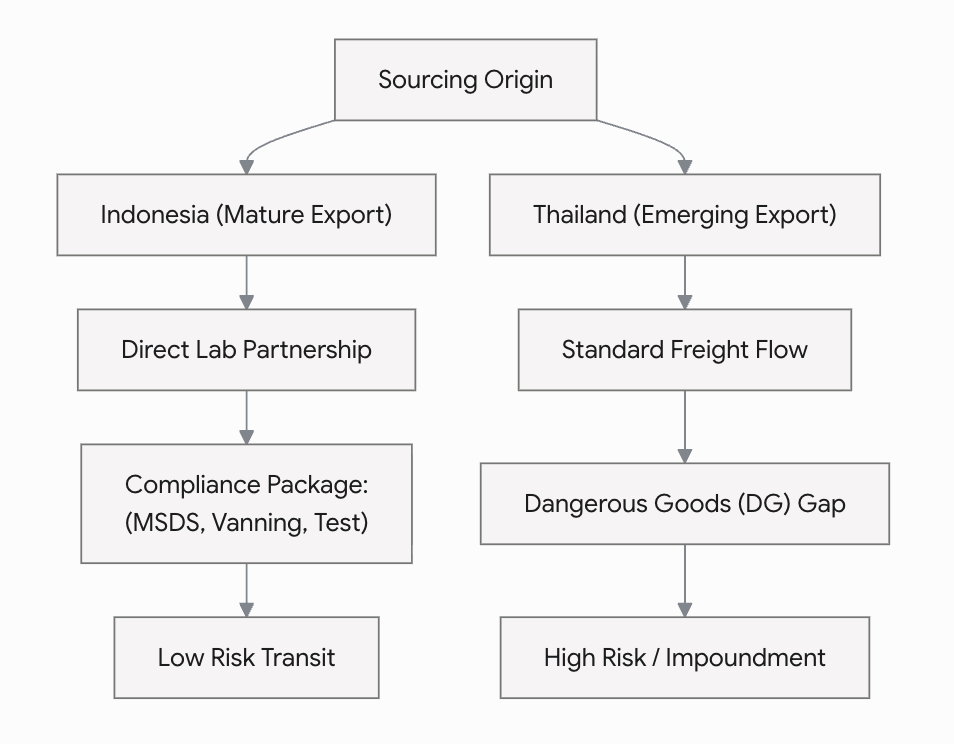
From a sourcing perspective, getting the charcoal out of the factory door is only half the battle. Shipping charcoal across international ocean routes involves strict maritime safety protocols. Because charcoal is classified under international maritime law as a Dangerous Goods (DG) Class 4.2 self-heating substance (UN 1361), the export infrastructure of the country of origin is critical.
Indonesian Export Sophistication
Because coconut charcoal is a multi-million dollar national export driver for Indonesia, the local logistics ecosystem is highly developed. Legitimate Indonesian manufacturers maintain direct, permanent partnerships with international shipping lines and accredited third-party laboratory surveyors.
They provide a standard, mandatory compliance package with every container shipment:
- A valid, up-to-date Material Safety Data Sheet (MSDS).
- An official Self-Heating Test Report.
- A certified Vanning Certificate proving the container was loaded under controlled temperatures to eliminate spontaneous combustion risks.
Thai Logistics Realities
Thailand is highly proficient in standard containerized freight (such as rice, rubber, and electronics). However, because coconut charcoal is a niche export product for them rather than a primary industrial focus, finding local freight forwarders and shipping lines in Bangkok or Laem Chabang that are fully set up for regular DG Class 4.2 vanning can be significantly more difficult.
In practice, a common mistake among first-time importers is working with Thai suppliers who attempt to ship charcoal under non-hazardous declarations. If a port authority detects an undocumented charcoal container, the shipment can be impounded immediately, resulting in catastrophic demurrage fees and blacklisting by major ocean carriers.
Read: Indonesia vs Philippines Coconut Charcoal: Why Year-Round Supply Wins
Aligning Supply with Strategy
Ultimately, the choice in the Indonesia vs. thailand charcoal comparison depends entirely on your market destination.
If your primary business lies in high-volume restaurant grilling, premium charcoal briquette retail for barbecue enthusiasts, or specialty wood-blended fuel matrices, Thai manufacturers offer an excellent product with a rich culinary heritage.
However, if your business requires high fixed carbon metrics, total structural stability under extreme heat, a neutral odor profile, and a reliable pipeline of standardized container shipments for the premium shisha sector, Indonesia remains the undisputed global center of gravity.
The Omnicoco Commitment
At Omnicoco Charcoal, we focus exclusively on executing this high-specification Indonesian model at scale. By managing our raw material networks directly at the agricultural sourcing hubs of Sulawesi and Sumatra, we ensure that only dense, mature shells enter our carbonization loop.
Our facility pairs this traditional material selection with modern quality control—utilizing precise screening, uniform extrusion, and extended industrial baking cycles to deliver a reliable, export-ready product that protects your brand’s reputation in the global marketplace.
FAQ Section
Why does the ash color differ so significantly between Indonesian and Thai charcoal?
Ash color is determined almost entirely by the mineral content of the raw material and how it was harvested. Indonesian factories typically purchase shells that have been separated cleanly from the nut during copra processing, minimizing ground contact. If shells are collected loosely from muddy agricultural floors—a common practice in unspecialized farming zones—sand and soil minerals fuse into the charcoal during carbonization, creating a dark grey or yellowish ash residue.
Can Thai coconut charcoal be used for premium shisha lounges?
It can be used, but it introduces operational risks. Due to the higher potential for volatile matter and different wood blends used in common Thai briquetting, the charcoal may emit a slight aroma that interferes with the shisha flavor profile. Additionally, the lower fixed carbon means the coals will burn out faster, increasing labor costs for lounge staff who must perform mid-session swaps.
What is the risk of shipping charcoal without a Dangerous Goods (DG) declaration?
The risks are severe. Charcoal can undergo spontaneous combustion if it contains high moisture and is packed into a hot, unventilated steel container for weeks at sea. Shipping lines require strict DG Class 4.2 testing to ensure the cargo is chemically stable. Attempting to ship without this documentation is illegal and can lead to massive financial liabilities, carrier fines, and seized cargo at destination ports.
How does the thickness of the coconut shell impact final briquette quality?
Thicker shells from mature coconuts contain high concentrations of natural lignin, which acts as a dense structural binder when carbonized. When these shells are ground and pressed, they form a highly compact briquette with an excellent specific gravity. Thin shells from younger nuts lack this dense structural core, resulting in a lighter briquette that crumbles easily under thermal stress.