
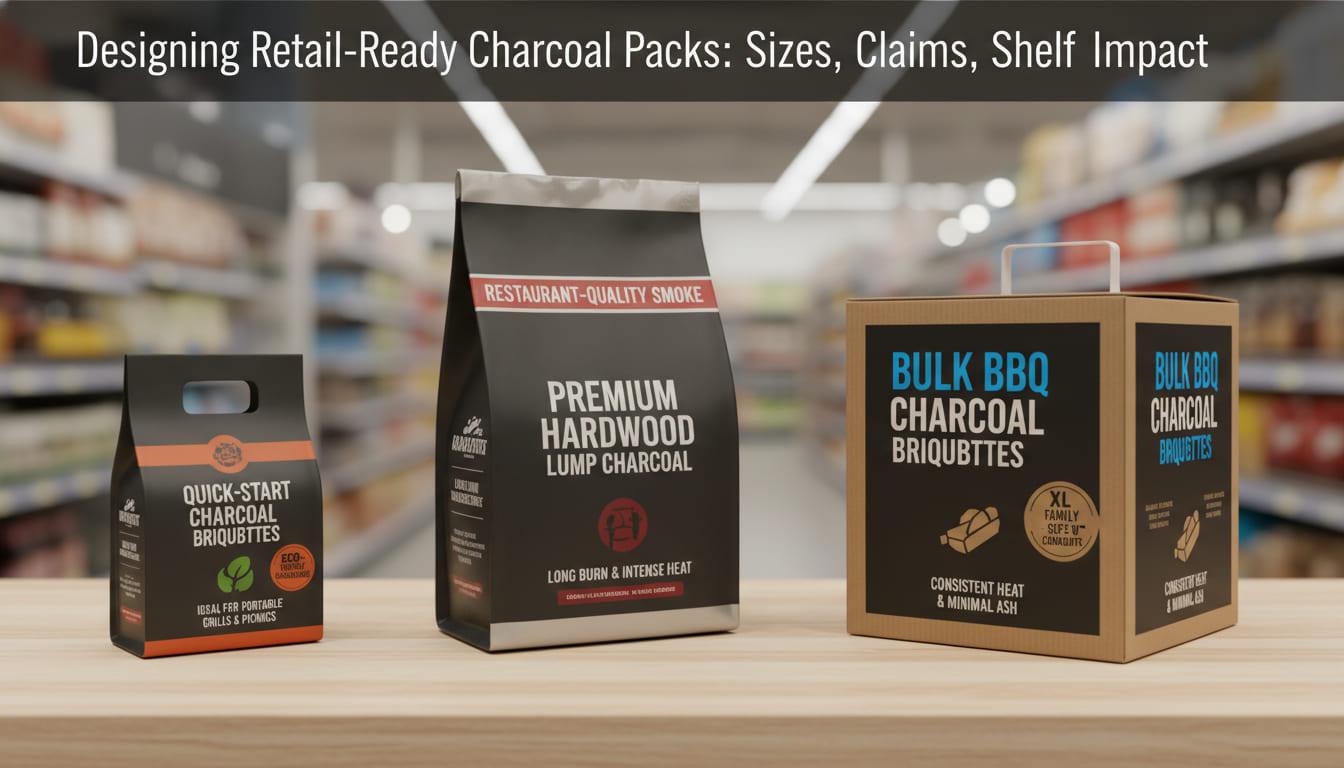
Retail charcoal packaging drives 68-73% of consumer purchase decisions through shelf visibility, product claims communication, and perceived value demonstration within 3-7 second consideration windows. Strategic package design combining optimal sizing (1-4kg weight ranges), compelling benefit statements (120+ minute burn time, <2% ash content), and visual differentiation increases sales velocity 40-85% versus generic kraft box packaging.
Understanding Retail Packaging Requirements
Retail charcoal packaging serves multiple functions beyond simple product containment, creating marketing communication, brand differentiation, and purchase justification within highly competitive shelf environments.
Primary Packaging Objectives:
- Shelf Visibility: Stand out among 15-25 competing products within 2-3 meter shelf sections
- Benefit Communication: Convey performance advantages (burn time, heat output, low ash) instantly
- Usage Guidance: Communicate quantity needed per grilling session or hookah bowl
- Quality Signaling: Premium materials and design justify higher pricing versus commodity products
- Handling Durability: Withstand retail shelf stocking, customer handling, and checkout processing
Retail Environment Challenges:
Charcoal competes for attention in crowded retail spaces:
- BBQ/grilling sections: 8-15 charcoal brands on 4-6 shelf facings
- Hookah shops: 10-20 charcoal options on counter displays and wall fixtures
- Hardware stores: Seasonal outdoor living sections with 100+ SKUs competing for attention
- Convenience stores: Limited shelf space requiring maximum impact per facing
Effective packaging must communicate value proposition within 3-7 seconds before consumers shift attention to competing products or abandon category entirely.
Optimal Package Sizing Strategy
Package size selection balances consumer usage patterns, price point psychology, shelf space efficiency, and retail margin requirements.
Consumer Package Size Options
1kg Packages (Small Consumer Format):
Target Applications:
- Single-use occasions (1-2 BBQ sessions, 2-3 hookah bowls)
- Trial purchases and first-time brand buyers
- Apartment dwellers with limited storage space
- Convenience store impulse purchases
Pricing Strategy:
- Retail price: $3.99-5.99 per kg ($3.99-5.99 per 1kg package)
- Price per kg: Highest among size options but acceptable for convenience
- Comparison: 15-25% price premium versus bulk 5kg packages
Retail Advantages:
- Lower price point reduces purchase risk for trial buyers
- Multiple facings possible with small package footprint
- Easy shelf restocking without special handling
- Attractive impulse purchase price under $6
Packaging Recommendations:
- Compact dimensions: 18-22cm height × 12-15cm width × 8-10cm depth
- Resealable closure maintaining freshness after opening
- Clear usage quantity: “Enough for 2-3 BBQ sessions”
- Prominent price per package (not per kg) for psychological pricing
2kg Packages (Standard Consumer Format):
Target Applications:
- Regular household use (3-4 BBQ sessions, 4-6 hookah bowls)
- Weekend warrior consumers using monthly or bi-weekly
- Balanced value and convenience positioning
Pricing Strategy:
- Retail price: $7.49-10.99 per package ($3.75-5.50 per kg)
- Price per kg: 8-12% savings versus 1kg format
- Sweet spot pricing: Under $11 maintains impulse purchase potential
Retail Advantages:
- Most popular consumer size (45-55% of retail sales volume)
- Optimal shelf space efficiency balancing facings and inventory
- Appropriate weight for customer carrying and checkout handling
- Retailer margin friendly with moderate wholesale cost
Packaging Recommendations:
- Standard dimensions: 24-28cm height × 16-20cm width × 10-12cm depth
- Carrying handle for customer convenience
- Value communication: “20% more versus 1kg size”
- Usage guidance: “Fuel for 4-5 grilling sessions”
3kg Packages (Value Consumer Format):
Target Applications:
- Frequent users consuming 1-2 packages monthly
- Value-conscious consumers comparing price per kg
- Restaurant and catering small-scale purchasing
Pricing Strategy:
- Retail price: $10.49-14.99 per package ($3.50-5.00 per kg)
- Price per kg: 12-18% savings versus 1kg format
- Positioned as “best value” option in consumer range
Retail Considerations:
- Moderate popularity (25-35% of retail sales volume)
- Requires adequate shelf depth (12-14cm minimum)
- Weight may deter some consumers (3kg = 6.6 lbs handling)
- Strong performer in ethnic grocery stores and specialty retailers
Packaging Recommendations:
- Dimensions: 28-32cm height × 18-22cm width × 12-14cm depth
- Reinforced handle design supporting weight
- Value messaging: “Save $2-3 versus buying multiple 1kg packs”
- Bulk quantity indicator: “15-18 pieces of charcoal”
4-5kg Packages (Bulk Consumer/Small Commercial):
Target Applications:
- Heavy users consuming weekly or multiple times weekly
- Small restaurants and hookah lounges supplementing wholesale orders
- Event caterers and party hosts
- Rural consumers with infrequent shopping trips
Pricing Strategy:
- Retail price: $13.99-19.99 per package ($2.80-4.00 per kg)
- Price per kg: 25-35% savings versus 1kg format
- Approaches wholesale pricing territory
Retail Challenges:
- Limited sales volume (10-20% of retail sales)
- Requires 15-18cm shelf depth often unavailable in retail
- Weight (5kg = 11 lbs) requires two-hand carrying
- Takes valuable shelf space from faster-moving SKUs
Packaging Recommendations:
- Heavy-duty construction: Double-wall corrugated, reinforced corners
- Prominent “Bulk Size – Best Value” messaging
- Commercial usage suggestion: “Great for restaurants and caterers”
- Clearly marked weight in both metric and imperial units
Package Size Portfolio Strategy
Multi-Size Offering Benefits:
Retailers carrying 2-3 package sizes capture broader consumer segments:
- Budget-conscious: Gravitate to 3-4kg “best value” sizes
- Convenience-focused: Choose 1kg “easy to handle” formats
- Mainstream consumers: Select 2kg “just right” standard size
Recommended Retail SKU Strategy:
Specialty Retailers (Hookah Shops, BBQ Specialty):
- Offer all 4 sizes (1kg, 2kg, 3kg, 5kg)
- Heavy inventory emphasis on 2kg (50%) and 3kg (30%)
- 1kg for trial, 5kg for commercial customers
Mass Market Retailers (Hardware, Grocery):
- Limit to 2-3 sizes for inventory simplicity
- Focus on 1kg and 2kg for maximum turnover
- Optional 3kg where demographics support bulk purchasing
Convenience Stores:
- Single SKU strategy: 1kg only
- Maximize impulse purchase potential
- Limited shelf space requires focused offering
Read: How to Choose the Right Size and Shape of Shisha Charcoal
Strategic Claims and Benefit Communication
Package claims communicate product superiority and purchase justification within seconds of consumer consideration.
Performance Claims Structure
Primary Benefit Statement (Front Panel):
Lead with single most compelling advantage in large, bold typography:
Burn Time Claims:
- “Burns 2+ Hours Per Load” (BBQ applications)
- “120-Minute Consistent Heat” (specific duration)
- “Outlasts Standard Charcoal by 40%” (comparative advantage)
Heat Output Claims:
- “Restaurant-Grade Heat Output”
- “Professional Performance, Backyard Convenience”
- “High BTU for Perfect Searing”
Cleanliness Claims:
- “Minimal Ash – Easy Cleanup”
- “98% Pure Coconut Charcoal”
- “Less Than 2% Ash Residue”
Natural/Sustainability Claims:
- “100% Natural Coconut Shell Charcoal”
- “No Chemicals, No Additives”
- “Sustainably Sourced, Eco-Friendly“
Secondary Benefits (Side/Back Panels):
Support primary claim with 3-5 specific advantages:
Example BBQ product:
- Extended Burn Time: 120-150 minutes continuous heat
- Consistent Temperature: 550-650°F maintained throughout burn
- Minimal Ash Production: Less than 2% residue for easy cleanup
- Quick Ignition: Ready to cook in 12-15 minutes
- No Chemical Taste: Pure coconut shell preserves natural food flavors
Example Hookah product:
- Long Session Duration: 90-120 minutes per bowl
- Clean Burning: No smoke or odor interference with tobacco
- Stable Heat Output: Consistent temperature prevents harsh hits
- Low Ash Content: Reduces cleaning frequency
- Natural Composition: Food-grade quality for safety
Claim Substantiation and Legal Compliance
Verifiable Performance Data:
Support all claims with documented testing results:
- Burn time: Standardized ASTM testing or controlled in-house protocols
- Ash content: Laboratory proximate analysis certificates
- Heat output: Calorific value testing from accredited laboratories
- Ignition time: Documented testing under specified conditions
Required Disclaimers:
Include appropriate qualifying language:
- “Results based on standard testing conditions”
- “Actual performance may vary based on usage”
- “Burn time depends on airflow, quantity used, and application”
Prohibited Claims:
Avoid unsubstantiated or misleading statements:
- “Best charcoal in the world” (subjective, unverifiable)
- “Burns forever” (obviously false, credibility-damaging)
- “No ash production” (impossible, creates customer disappointment)
- “Replaces gas grills” (overreaching comparison)
Comparative Claims Requirements:
When comparing to competitors:
- Specify comparison basis: “versus standard briquettes” not “versus other brands”
- Use measurable differences: “40% longer burn time” not “much better”
- Maintain supporting documentation for regulatory compliance
Environmental and Sustainability Messaging
Eco-Conscious Consumer Appeal:
Environmental claims resonate with premium market segments:
Sustainable Sourcing:
- “Made from Renewable Coconut Shells”
- “Agricultural Waste Valorization”
- “Supports Circular Economy Principles”
Carbon Impact:
- “Lower Carbon Footprint than Wood Charcoal”
- “Deforestation-Free Fuel Source”
- “Carbon-Neutral Production Process”
Packaging Sustainability:
- “Recyclable Packaging Materials”
- “Minimal Plastic Use”
- “FSC-Certified Cardboard”
Certification Badges:
Display relevant third-party certifications:
- Organic certifications (USDA Organic, EU Organic)
- Sustainability certifications (Rainforest Alliance, Fair Trade)
- Food safety certifications (FSSC 22000, HALAL)
- Quality standards (ISO 9001)
Certification logos add credibility and justify premium pricing through independent verification.
Visual Design for Shelf Impact
Packaging aesthetics drive initial attention capture and brand perception formation within 1-2 seconds of shelf scanning.
Color Strategy and Psychology
Primary Color Selection:
Different colors communicate distinct brand positioning:
Black Packaging:
- Perception: Premium, sophisticated, professional-grade
- Best for: High-end BBQ products, specialty hookah charcoal
- Risk: May blend with competitors using similar approach
- Mitigation: Bold accent colors and distinctive graphics
Natural Kraft Brown:
- Perception: Natural, eco-friendly, artisanal quality
- Best for: Organic/sustainable positioning, farmers market retailers
- Risk: May appear generic or budget-quality without design investment
- Mitigation: Premium printing, embossing, and unique structural elements
Vibrant Colors (Red, Orange, Yellow):
- Perception: Energy, excitement, action-oriented
- Best for: Mass-market BBQ products, impulse purchase targeting
- Risk: May appear cheap if color saturation and printing quality insufficient
- Mitigation: Professional color management and high-quality printing
Green Packaging:
- Perception: Natural, eco-friendly, healthy living
- Best for: Organic products, environmentally-conscious consumers
- Risk: Overused in natural products category creating differentiation challenges
- Mitigation: Unique green shades and complementary color combinations
Accent Color Strategy:
Use contrasting accent colors for critical elements:
- Product name: 70-80% contrast versus background color
- Primary benefit claim: High-visibility orange, yellow, or white
- Call-to-action elements: Red or orange for “New,” “Premium,” “Value”
Typography and Readability
Brand Name Legibility:
Product name must be readable from 2-3 meters (retail aisle distance):
- Minimum letter height: 40-50mm for primary brand name
- Font weight: Bold or extra-bold for visibility
- Font style: Sans-serif for clean, modern appearance; serif for traditional/premium
- Color contrast: Minimum 70% contrast ratio versus background
Benefit Statement Sizing:
Primary benefit claim requires prominent display:
- Letter height: 25-35mm for main benefit statement
- Positioning: Upper third of front panel (eye-level scanning zone)
- Treatment: Color background, outline, or shadow for emphasis
Secondary Information Hierarchy:
Organize supporting information by importance:
- Product specifications: 12-18mm letter height
- Usage instructions: 8-12mm letter height
- Legal requirements: 6-8mm minimum (regulatory compliance)
Imagery and Graphics
Product Photography:
Show finished briquettes communicating quality:
- Close-up shots: Reveal uniform surface, consistent shape
- In-use imagery: BBQ grill with glowing charcoal or hookah setup
- Lifestyle photography: Happy families, social gatherings, outdoor cooking
Professional photography investment ($500-1,500 per shoot) delivers significant returns through improved shelf appeal versus stock images or no product photos.
Icon and Symbol Usage:
Communicate benefits quickly through visual symbols:
- Flame icon + “120 min” = Extended burn time
- Leaf icon = Natural/eco-friendly composition
- Clock icon = Quick ignition time
- Checkmark + “Low Ash” = Cleanliness benefit
Texture and Finish Effects:
Premium finishes elevate perceived quality:
- Matte lamination: Sophisticated, modern appearance
- Spot UV coating: Highlight logo and key elements
- Metallic inks: Premium positioning for specialty products
- Embossing/debossing: Tactile quality signaling
Read: Indonesia vs Philippines Coconut Charcoal: Why Year-Round Supply Wins
Structural Design and Functionality
Package structure impacts handling, display efficiency, and customer experience beyond visual design.
Box Construction Options
Folding Carton (Most Common):
Standard kraft or white-lined chipboard construction:
- Material: 300-400 GSM cardboard
- Construction: Glued or tucked closure
- Cost: $0.15-0.35 per box depending on size and printing
- Benefits: Easy assembly, good printing surface, recyclable
Variations:
- Tuck-top boxes: Self-locking without glue (faster packing)
- Window boxes: Clear film window showing product inside
- Display-ready boxes: Tear-away front panel converting box to shelf display
Shrink-Wrapped Bundles:
Polyethylene film wrapping around cardboard tray:
- Material: PE shrink film + chipboard base
- Cost: $0.08-0.18 per package
- Benefits: Product visibility, dust protection, tamper evidence
- Drawbacks: Less premium appearance, limited graphics space
Woven Polypropylene Bags:
Heavy-duty woven bags for larger formats:
- Material: PP woven fabric with PE liner
- Cost: $0.25-0.45 per bag
- Benefits: Moisture resistance, durability, reusable by customer
- Best for: 3-5kg bulk sizes, commercial/restaurant sales
Premium Rigid Boxes:
Set-up boxes for ultra-premium positioning:
- Material: 2mm greyboard with printed wrapping
- Cost: $1.50-3.50 per box
- Benefits: Luxury appearance, giftable presentation, reusable
- Best for: Premium hookah charcoal, specialty BBQ products
Handling Features
Carrying Handles:
Essential for packages above 2kg weight:
Die-Cut Handles:
- Cut directly from carton top panel
- Cost: No additional material cost
- Limitation: Reduces structural integrity, limited to lighter weights
Rope/Cord Handles:
- Cotton or PP cord through punched holes
- Cost: $0.05-0.12 per handle
- Benefits: Comfortable carrying, supports heavier weights (4-5kg)
Plastic Strap Handles:
- Integrated plastic handle attached to carton
- Cost: $0.08-0.15 per handle
- Benefits: Durable, professional appearance, customer convenience
Resealable Closures:
Maintain product freshness after opening:
- Zip-lock mechanisms: $0.15-0.25 per closure
- Adhesive reseal strips: $0.03-0.08 per strip
- Magnetic closures: $0.25-0.40 per closure (premium only)
Resealability creates customer value for multi-use packages (2kg and larger) where entire package may not be consumed in single session.
Retail Display Optimization
Shelf Stability:
Package design must prevent tipping and shifting:
- Base dimensions: Minimum 12cm × 8cm footprint for stability
- Center of gravity: Low positioning (charcoal weight concentrated in bottom half)
- Anti-slip features: Textured bottom surface or rubber pads
Stacking Capability:
Vertical stacking maximizes shelf efficiency:
- Top panel strength: Support 3-4 packages stacked weight
- Alignment features: Recessed top matching base footprint
- Stack height indicators: Maximum 3-4 units high marking
Shelf Talker Integration:
Design allows shelf tag attachment:
- Front panel space: 3-5cm clear zone at bottom for price tags
- Hanging holes: Pre-punched holes for peg-board display systems
- Flat surfaces: Smooth areas accepting adhesive promotional labels
Regulatory Compliance and Labeling Requirements
Retail packaging must meet legal requirements varying by market and product category.
Mandatory Information Elements
Product Identification:
- Product name and description: “Coconut Shell Charcoal Briquettes”
- Net weight declaration: Both metric (kg, g) and imperial (lbs, oz) for US markets
- Piece count (optional but recommended): “Approximately 40 pieces”
Manufacturer Information:
- Company name and address
- Country of origin: “Made in Indonesia” or “Product of Indonesia”
- Manufacturing date or batch code (recommended for traceability)
Safety Warnings:
Required hazard communication:
- Carbon monoxide warning: “Produces carbon monoxide when burning – use only in well-ventilated areas”
- Fire safety: “Keep away from children and flammable materials”
- Disposal instructions: “Allow ashes to cool completely before disposal”
- Storage recommendations: “Store in cool, dry place away from moisture”
Usage Instructions:
Basic lighting and application guidance:
- Ignition method: Electric starter, lighter fluid compatibility, or natural ignition
- Quantity recommendations: “Use 15-20 pieces for standard BBQ grill”
- Readiness indicators: “Coals ready when covered with light ash (12-15 minutes)”
Market-Specific Requirements
United States:
- CPSC compliance for consumer products
- California Proposition 65 warnings (if applicable based on trace elements)
- English language primary with Spanish optional
- UPC barcode for retail scanning
European Union:
- CE marking (if applicable to product category)
- Recycling symbols and material codes
- Multi-language labeling (minimum 2-3 languages)
- EAN-13 barcode standard
Middle East (GCC Countries):
- Arabic language requirements (bilingual Arabic/English)
- HALAL certification display (for food-contact applications)
- Country of origin prominence
- Importer/distributor contact information
Australia/New Zealand:
- Biosecurity compliance declarations
- ACCC labeling standards
- Origin country statement prominence
- Metric measurements (imperial optional)
Certification and Quality Marks
Third-Party Certifications:
Display relevant approved certifications:
- Food safety: FSSC 22000, HALAL, Kosher
- Environmental: FSC, Rainforest Alliance, Carbon Neutral
- Quality: ISO 9001, GMP certification
- Organic: USDA Organic, EU Organic standards
Quality Seal Design:
Integrate certification logos without cluttering design:
- Bottom corner positioning (5-8% of panel area)
- Consistent sizing across multiple certifications
- Official logo artwork from certifying bodies
- Verification numbers or QR codes for authentication
Cost Management and Pricing Strategy
Packaging represents 8-15% of retail product cost, requiring balance between visual impact and profitability.
Packaging Cost Structure
Material Costs:
Component pricing for 2kg standard package:
- Printed folding carton: $0.18-0.28
- Inner poly bag moisture barrier: $0.03-0.06
- Carrying handle (if included): $0.05-0.12
- Shrink wrap or outer seal: $0.02-0.04
- Total materials: $0.28-0.50 per package
Printing Costs:
Quality-dependent pricing:
- 2-color flexographic: $0.05-0.08 per carton
- 4-color offset lithography: $0.12-0.18 per carton
- Premium finishes (UV coating, embossing): +$0.08-0.15 per carton
Minimum Order Quantities:
Printing setup costs require minimum runs:
- Flexographic printing: 5,000-10,000 cartons minimum
- Offset printing: 10,000-20,000 cartons minimum
- Digital printing: 500-1,000 cartons (higher per-unit cost but lower minimum)
Total Package Cost Examples:
Budget/Economy Package (2kg):
- Simple 2-color kraft box: $0.25-0.35 total cost
- Retail price: $7.49-8.99
- Packaging as % of retail: 3-5%
Standard/Commercial Package (2kg):
- 4-color printed carton with handle: $0.45-0.65 total cost
- Retail price: $9.49-11.99
- Packaging as % of retail: 5-7%
Premium Package (2kg):
- Full-color offset with UV coating and premium materials: $0.75-1.20 total cost
- Retail price: $12.99-15.99
- Packaging as % of retail: 6-9%
Price-Value Perception Management
Packaging Quality Signals Price Tier:
Consumer expectations align with packaging presentation:
- Budget packaging: Justifies $3.50-4.50/kg pricing
- Standard packaging: Supports $4.50-6.00/kg pricing
- Premium packaging: Enables $6.00-8.00/kg pricing
Under-packaging premium products (excellent charcoal in cheap packaging) leaves revenue uncaptured. Over-packaging economy products (mediocre charcoal in premium packaging) creates customer disappointment and return problems.
Value Communication Strategy:
Justify premium pricing through package messaging:
- “Professional restaurant-grade quality”
- “Imported from Indonesia – world’s finest coconut charcoal”
- “Third-party laboratory tested and certified”
- Specific performance advantages versus competitors
Read: Valorizing Fines: Turning Briquette Waste into Value
Testing and Optimization Process
Successful package design requires iterative testing and refinement before final production.
Pre-Launch Testing Methods
Mock-Up Evaluation:
Create physical prototypes for assessment:
- 3D rendering review: Digital visualization of design
- Printed mock-ups: Full-size printouts assembled as packages
- Competitive comparison: Display alongside competitor products
- Stakeholder review: Internal team and select customer feedback
Cost: $200-500 for professional mock-ups covering 3-5 design variations.
Shelf Simulation Testing:
Evaluate shelf presence in realistic retail environment:
- Set up mock retail shelf with competitor products
- Test visibility from 2-3 meter viewing distance
- Assess legibility of claims and brand name
- Photograph from multiple angles and lighting conditions
Consumer Focus Groups:
Gather target customer feedback before launch:
- Show 3-5 package design options
- Collect preference rankings and reasoning
- Test comprehension of claims and messaging
- Assess willingness to pay at different price points
Focus group investment: $2,000-5,000 for professional moderation and analysis.
Post-Launch Performance Tracking
Sales Velocity Analysis:
Monitor package design impact on sales performance:
- Unit sales per store per week (baseline vs new packaging)
- Market share changes within category
- Price elasticity testing (sales response to pricing changes)
- SKU rationalization (which sizes perform best)
Packaging Damage Assessment:
Track retail handling durability:
- Damage rate during shipping and distribution
- Shelf damage from customer handling
- Structural failure points requiring reinforcement
- Moisture intrusion or product degradation issues
Customer Feedback Collection:
Systematic review gathering:
- Online review analysis for packaging comments
- Retailer feedback on handling and display
- Direct customer surveys at point of purchase
- Social media sentiment monitoring
Continuous Improvement Cycle
Annual Packaging Refresh:
Plan regular design updates maintaining contemporary appeal:
- Minor updates: Claim refinement, color adjustments (every 12-18 months)
- Major redesign: Complete visual overhaul (every 3-5 years)
- Seasonal variations: Holiday themes, promotional editions
Competitor Response Strategy:
Monitor competitive packaging changes:
- Quarterly competitive shelf audits
- Track new entrant packaging approaches
- Identify emerging design trends in category
- Maintain differentiation advantage
Case Study: Retail Package Redesign Impact
A coconut charcoal producer selling through USA hardware stores redesigned packaging in 2023, demonstrating measurable impact.
Original Packaging (2020-2023):
- Simple kraft boxes with 2-color printing
- Minimal claims: “Coconut Charcoal” product name only
- No handles on 2kg and 3kg sizes
- Generic design similar to competitors
Sales Performance:
- Average weekly sales: 45 units per store (2kg size)
- Retail price: $8.99 per 2kg package
- Market share: 12% within coconut charcoal segment
Redesign Implementation:
Design Changes:
- Full 4-color offset printing with professional photography
- Prominent benefit claims: “Burns 2+ Hours,” “Minimal Ash,” “100% Natural”
- Added rope handle on 2kg size
- Premium matte lamination finish
- Certification badges (USDA Organic, FSSC 22000)
Cost Impact:
- Original packaging cost: $0.28 per 2kg carton
- New packaging cost: $0.58 per 2kg carton
- Cost increase: $0.30 per package (+107%)
Post-Redesign Results (6 months):
Sales Performance:
- Average weekly sales: 68 units per store (+51% increase)
- Retail price: $10.99 per 2kg package (+22% price increase)
- Market share: 19% within coconut charcoal segment (+58% share growth)
Financial Impact:
- Revenue per store weekly: $404 (original) vs $747 (new) = +85% revenue increase
- Gross profit per package: $3.20 (original) vs $4.80 (new) = +50% profit increase
- Annual incremental profit: $186,000 across 50 retail locations
The $0.30 packaging cost increase delivered $1.60 additional profit per package, generating 533% ROI on packaging investment while strengthening brand positioning and enabling premium pricing.
Read: Benefits of Stable OEM Partnerships: Why Long-Term Collaboration Matters
Retail-Ready Packaging Drives Sales Performance
Strategic retail charcoal packaging combining optimal sizing (1-4kg formats), compelling claims communication (specific burn time, ash content, natural composition), and professional visual design increases sales velocity 40-85% versus generic packaging approaches. Package design investment of $0.30-0.70 per unit enables 15-30% retail price premiums while improving shelf visibility and consumer purchase conversion.
Successful retail packaging requires testing across mock-ups, focus groups, and shelf simulations before production commitment of 10,000-20,000 unit minimum orders for offset printing. Post-launch performance tracking through sales velocity analysis, damage assessment, and customer feedback enables continuous optimization maintaining competitive differentiation.
Our retail packaging serves 200+ specialty retailers and hardware chains across North America and Europe through optimized 1kg, 2kg, and 3kg size offerings. We provide packaging design consultation, supplier coordination, and regulatory compliance support for brands developing retail-ready product lines.
Contact us to discuss your retail packaging requirements and review our current design portfolio.