
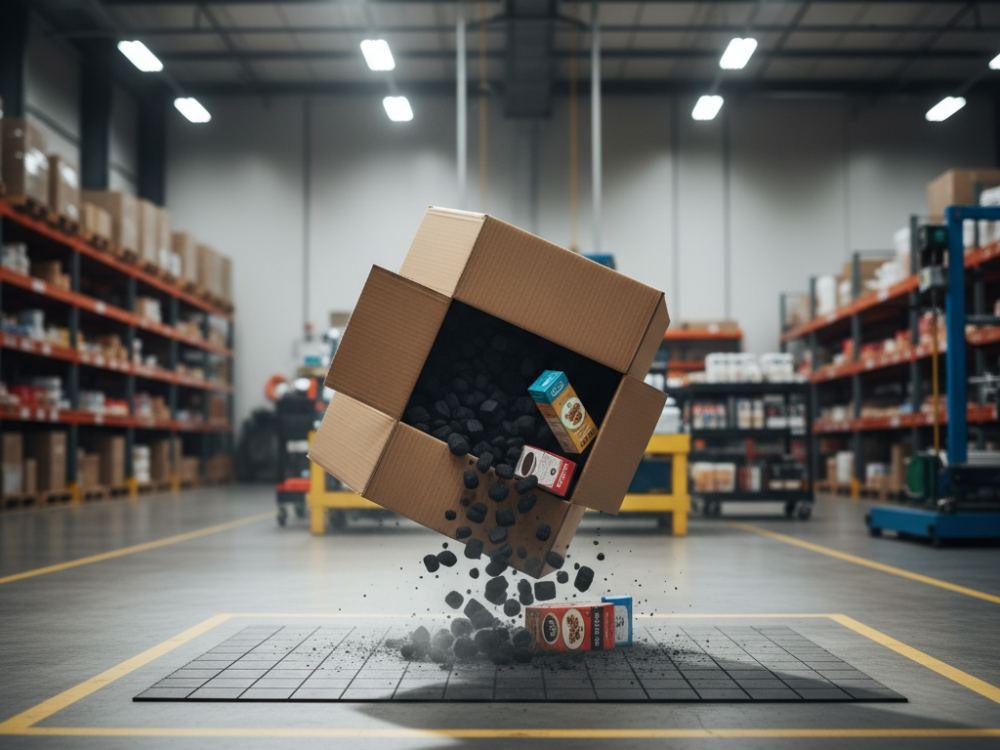
Broken briquettes cost exporters money twice—first through product value loss, then again through customer dissatisfaction and potential claims. After tracking breakage rates across thousands of shipments since 2010, we’ve learned that systematic strength testing and transit protection engineering reduce damage from industry-average 8-12% down to under 2%.
The difference between acceptable and excessive breakage often determines whether buyers reorder or switch suppliers. One European distributor rejected our competitor after receiving a container with 15% broken pieces. That single quality failure cost the supplier a €180,000 annual account that we gained by demonstrating consistent sub-3% breakage rates.
Why Breakage Prevention Matters
Broken charcoal creates multiple problems beyond obvious product loss. Small fragments and dust complicate handling for warehouse staff and end users. Excessive breakage suggests quality control deficiencies that damage supplier reputation even when the broken pieces remain functionally usable.
Commercial buyers often specify maximum allowable breakage rates in purchase contracts. Common specifications require 95% of pieces to arrive intact with fragments under 20% of original briquette volume. Shipments exceeding these limits face rejection, price deductions, or replacement requirements.
The economic impact extends beyond direct product loss. Insurance claims, replacement shipment costs, and customer relationship damage from quality failures far exceed the 8-12% direct material loss that breakage represents. One rejected container cost us $4,200 in material value but generated $11,000 in total costs including replacement shipping, customs reprocessing, and expedited handling to maintain delivery commitments.
Understanding Breakage Mechanisms
Briquette failure occurs through multiple stress mechanisms during production, storage, handling, and transportation. Preventing breakage requires addressing each failure mode systematically.
Compression failure:
Vertical stacking pressure crushes briquettes when carton stacking heights exceed material strength limits. Container loading often involves 5-6 pallet layers creating bottom-layer pressures exceeding 200 kg per square meter.
Inadequate compressive strength allows carton contents to crush under this load. The failure typically occurs in bottom cartons where accumulated weight reaches maximum. Crushed briquettes in lower cartons create tell-tale evidence of compression problems.
Impact failure:
Dropping, throwing, or rough handling creates impact forces that exceed tensile strength of briquette materials. Forklifts dropping pallets, warehouse workers tossing cartons, or truck loading impacts all generate damaging forces.
Impact failures produce characteristic fracture patterns. Clean breaks through briquette centers indicate sudden force application. Multiple small cracks radiating from impact points show repeated moderate impacts.
Vibration failure:
Extended transportation vibration causes abrasion between adjacent briquettes and gradual material fatigue. Ocean container shipments lasting 25-35 days experience millions of vibration cycles from vessel engines, wave action, and road transport.
Vibration damage appears as rounded edges, surface abrasion, and accumulated dust in carton bottoms. Severe vibration creates complete failures along weak points in briquette structure.
Moisture-induced failure:
Water absorption softens binder materials and reduces structural integrity. Containers experiencing condensation during temperature transitions or packages with inadequate moisture barriers suffer strength degradation.
Moisture damage shows as soft spots, surface flaking, and easy crumbling when pressure is applied. Advanced moisture exposure causes visible mold growth and characteristic musty odors.
Read: Charcoal Shape Engineering: Cube vs Finger vs Tablet vs Hexagonal
Compression Strength Testing
Compressive strength measurement provides the primary indicator of briquette structural capability and stacking survivability.
Testing methodology:
Place individual briquettes between compression plates of universal testing machine or simplified compression fixture. Apply gradually increasing force perpendicular to largest face until failure occurs. Record maximum force at failure point.
Simplified field testing uses calibrated spring scales or hydraulic gauges. Position briquette on solid base, apply gauge to top surface, and increase pressure gradually while monitoring force reading. The briquette fails when cracks appear or structure collapses.
Test minimum 10 samples from each production batch, selecting pieces randomly from different carton positions. Calculate average failure force and standard deviation to assess consistency.
Performance specifications:
Export-quality coconut charcoal briquettes should withstand 25-35 kg force before failure for standard 25mm cubes. This strength level ensures survival under typical stacking conditions with adequate safety margin.
Premium products targeting demanding applications specify 35-45 kg minimum compressive strength. This higher specification supports heavier stacking or rougher handling environments.
Below 20 kg failure force indicates serious production problems requiring immediate correction. Briquettes this weak rarely survive container loading, much less international shipping and distribution handling.
Factors affecting compressive strength:
Binder content and type directly determine strength characteristics. Tapioca starch at 6-8% usage provides 28-32 kg average compressive strength. Reducing binder to 4-5% drops strength to 18-22 kg. Increasing beyond 8% provides minimal additional strength while raising ash content unnecessarily.
Compression pressure during molding significantly impacts final strength. Our standard 12 tons per square inch compression creates 30-33 kg strength products. Reducing pressure to 8 tons drops strength to 22-26 kg. Increasing beyond 15 tons provides diminishing returns while accelerating die wear.
Moisture content during testing affects results considerably. Test briquettes at final moisture content (6-8%) rather than immediately after drying when residual heat may inflate strength readings. Moisture absorption above 10% reduces strength by 30-40% compared to properly dried products.
Carbonization quality influences structural integrity. Well-carbonized material with 75-80% fixed carbon creates stronger matrix than under-carbonized material with high volatile content. Over-carbonization producing excessive ash also weakens structure.
Corrective actions for low strength:
Increase binder content by 1-2 percentage points if strength consistently falls below specifications. Monitor ash content increases to ensure combustion performance remains acceptable.
Raise compression pressure in 2-ton increments until strength targets are achieved. Verify die wear rates don’t increase excessively with higher pressures.
Review carbonization parameters to ensure complete pyrolysis without over-carbonization. Adjust kiln temperatures or residence times if carbonization quality appears inconsistent.
Verify moisture content remains in specification during testing. Moisture creep during storage indicates inadequate packaging moisture barriers requiring improvement.
Read: Carbonization Tech Compared: Drum, Retort, and Continuous Systems
Drop Impact Testing
Drop testing simulates handling impacts during loading, transportation, and warehousing operations.
Standard test protocol:
Drop individual briquettes from 1 meters onto concrete surface. Observe failure patterns and classify results into categories: no damage, minor edge chipping (fragments less than 10% of original volume), moderate cracking (10-20% fragmentation), or complete failure (breakage into multiple pieces or greater than 20% fragmentation).
Test 20 samples per production batch for statistical significance. Calculate percentage of samples surviving each damage category.
Repeat tests from 1.0 meter to establish damage threshold ranges. Most specifications assume 1.5 meter drops represent typical worst-case handling heights.
Acceptance criteria:
Quality products show 85% or higher survival rate (no damage or minor edge chipping only) at 1.5 meter drop height. Premium specifications require 90% survival rates.
Products showing more than 25% complete failures at 1.5 meters indicate inadequate impact resistance requiring production process improvements.
Carton drop testing:
Test packaged products by dropping sealed 10kg cartons from 30cm, 60cm, and 90cm heights onto concrete. These represent typical handling impacts during warehouse operations and truck loading.
Open cartons after drops and inspect contents. Count broken pieces and weigh fragments. Calculate breakage percentage by weight.
Acceptable performance shows less than 3% breakage at 60cm drops and less than 8% breakage at 90cm drops. Higher breakage rates indicate either product weakness or inadequate packaging cushioning.
Multi-drop protocol:
Conduct sequential drop testing where same briquettes undergo multiple 1.0 meter drops to simulate repeated handling impacts during distribution. Drop each sample 5 times, inspecting after each drop.
Products maintaining integrity through 3+ drops demonstrate good fatigue resistance. Failure on first or second drops suggests brittleness or internal flaws.
Improving drop performance:
Higher binder content improves impact resistance but shows diminishing returns above 8% usage. The strength gain doesn’t justify ash content increases for most applications.
Proper drying prevents internal moisture gradients that create weak planes susceptible to impact fracture. Ensure slow initial drying temperatures (80-90°C) before increasing to final drying temperatures (100-110°C).
Uniform particle size distribution in charcoal powder creates consistent internal structure. Excessive fines (particles under 0.5mm) or large chunks (over 3mm) create weak points. Screen carbonized material to remove oversized and undersized particles before mixing.
Adequate compression pressure activates binder completely and eliminates internal voids. Insufficient pressure leaves air pockets that concentrate stress during impact.
Read: Export Packaging Engineering: Cartons, Inner Bags, Pallets, Straps
Vibration and Abrasion Testing
Extended transportation exposes briquettes to continuous vibration causing edge wear and gradual structural degradation.
Tumble drum testing:
Place 50-100 briquettes in rotating drum (30-40cm diameter) with internal baffles. Rotate at 25-30 RPM for 30 minutes. This simulates approximately 1,000 kilometers of truck transport or 7-10 days of ocean vessel transit.
Remove briquettes and screen to separate dust and fragments. Weigh remaining intact pieces and calculate material loss percentage. Inspect surviving pieces for edge rounding and surface wear.
Quality products lose less than 4% material weight through 30-minute tumbling. Loss exceeding 8% indicates poor abrasion resistance requiring formulation adjustments.
Vibration table testing:
More sophisticated testing uses vibration tables programmed with transport frequency and amplitude profiles. Place packaged cartons on vibration table and apply typical transport vibration patterns for extended periods.
Ocean transport simulation typically uses 5-15 Hz frequency range at 2-4mm amplitude for 4-8 hours representing 25-35 day transit. Truck transport simulation uses 10-30 Hz at 1-3mm amplitude for 2-4 hours representing 500-1,000 kilometer journeys.
After vibration exposure, open packages and assess contents. Measure dust accumulation, count broken pieces, and calculate breakage percentage.
Acceptable performance shows less than 5% breakage after combined ocean and truck transport simulation. Excessive breakage indicates either product weakness or packaging inadequacy.
Abrasion resistance improvements:
Higher compression pressure creates denser surface structure more resistant to abrasion. Increasing pressure from 10 to 14 tons per square inch typically reduces tumble losses by 20-30%.
Modified starch binders provide superior abrasion resistance compared to standard starches. The enhanced bonding strength maintains surface integrity better during friction exposure.
Proper moisture control prevents surface softening that accelerates abrasion. Maintain final product moisture at 6-8% and use adequate moisture barrier packaging to prevent absorption during storage and transit.
Packaging Protection Engineering
Packaging design contributes equally to product survival as intrinsic briquette strength. Even strong products break without adequate packaging protection.
Inner bag cushioning:
HDPE inner bags provide minimal cushioning. Some producers add crumpled paper or bubble wrap inside bags before sealing to create cushioning layers between briquettes and carton walls.
This additional cushioning reduces breakage by 30-40% in drop tests while adding only $0.03-0.05 per carton cost. The investment pays for itself through reduced damage claims.
Carton strength specifications:
Five-layer corrugated cardboard with BC-flute provides adequate protection for most coconut charcoal applications. Bursting strength should exceed 200 kPa to prevent carton failure under stacking loads.
Edge crush test (ECT) values above 32 ensure cartons maintain structural integrity under compression. Lower ECT values create carton collapse risks that expose contents to crushing.
Pallet configuration optimization:
Distribute weight evenly across pallet surfaces to prevent load concentration. Use 4-per-layer carton arrangements on 1200mm x 1000mm pallets rather than 2-per-layer that concentrates weight on fewer cartons.
Limit pallet heights to 5-6 carton layers maximum. Higher stacking increases bottom carton compression beyond safe limits even with strong cartons and products.
Stretch wrap application:
Apply 8-10 layers of 500mm stretch wrap with 200% elongation to secure palletized loads. Start wrapping 10cm below pallet top surface to secure bottom carton layer effectively.
Proper stretch wrap prevents carton shifting during transit that causes impact damage when boxes collide. Inadequate wrapping allows movement that accumulates into significant damage over long shipments.
Container loading techniques:
Position pallets tightly together to minimize movement during transit. Use dunnage bags or void fillers between pallet rows to prevent shifting.
Avoid loading pallets tight against container doors. Leave 10-15cm clearance to prevent crushing when doors open forcefully or fork entry causes door contact with cargo.
Secure loads with strapping to container anchor points. This prevents entire load shifting during sudden braking or vessel rolling in rough seas.
Quality Control and Monitoring Systems
Systematic testing and monitoring prevent breakage problems before they affect customer shipments.
Production testing frequency:
Test compression strength daily from each production shift. This frequent testing catches process variations early before large quantities of substandard product accumulate.
Conduct drop testing weekly or when production parameters change. Less frequent testing reflects the relative stability of impact resistance compared to compression strength.
Perform tumble testing monthly and after any formulation changes. The time-intensive nature of abrasion testing limits practical frequency.
Batch tracking systems:
Assign unique batch identifiers to each production run. Mark cartons with batch codes to enable tracing customer complaints back to specific production conditions.
We maintain testing records linked to batch codes showing compression strength, drop test results, and moisture content. When customers report breakage issues, we can verify production quality and identify whether problems originate in manufacturing or handling.
Shipping damage monitoring:
Request customers photograph damaged shipments before disposal. These images help distinguish production problems from handling damage and guide corrective actions.
Track breakage claims by shipping route, carrier, and season. Patterns in damage reports often reveal specific handling problems or vulnerable supply chain points requiring attention.
Our records show 3.2% average breakage across all shipments but 8.5% for one specific route involving three intermodal transfers. This data drove packaging improvements specifically for that route, reducing breakage to 4.1%.
Read: OmniCo’s Production Quality: The Secret Behind Premium Export-Grade Charcoal
Statistical Process Control
Advanced operations implement statistical process control to maintain consistent strength performance.
Control charts:
Plot compression strength measurements over time with control limits set at ±3 standard deviations from target means. This visualization quickly reveals process drift before specifications are violated.
When measurements approach control limits, investigate for root causes like binder batch variations, compression pressure changes, or moisture content drift.
Capability analysis:
Calculate process capability indices (Cpk) comparing specification ranges to actual process variation. Cpk values above 1.33 indicate capable processes with low defect risks. Values below 1.0 show processes incapable of meeting specifications consistently.
Our compression strength Cpk of 1.65 demonstrates high capability with minimal risk of producing weak briquettes. This statistical confidence allows reducing inspection frequency while maintaining quality assurance.
Correlation analysis:
Analyze relationships between process variables and strength outcomes. Statistical correlation identifies which factors most significantly influence final product strength.
Our analysis revealed compression pressure explains 67% of strength variation while binder content contributes 28%. This knowledge guides optimization efforts toward highest-impact variables.
Real-World Performance Data
Systematic strength testing and packaging optimization reduced our customer breakage claims from 7.3% in 2015 to 1.8% in 2024. This improvement saved approximately $28,000 annually in replacement costs while strengthening customer relationships through consistent quality delivery.
One major Middle Eastern distributor increased order frequency from monthly to semi-monthly after we demonstrated consistent sub-2% breakage rates over 12 consecutive shipments. The reliability improvement gave them confidence to reduce safety stock levels and improve inventory turnover.
Ready to discuss strength specifications and breakage prevention for your coconut charcoal requirements? Our systematic testing protocols and packaging engineering ensure product arrives in excellent condition. Contact us today.