
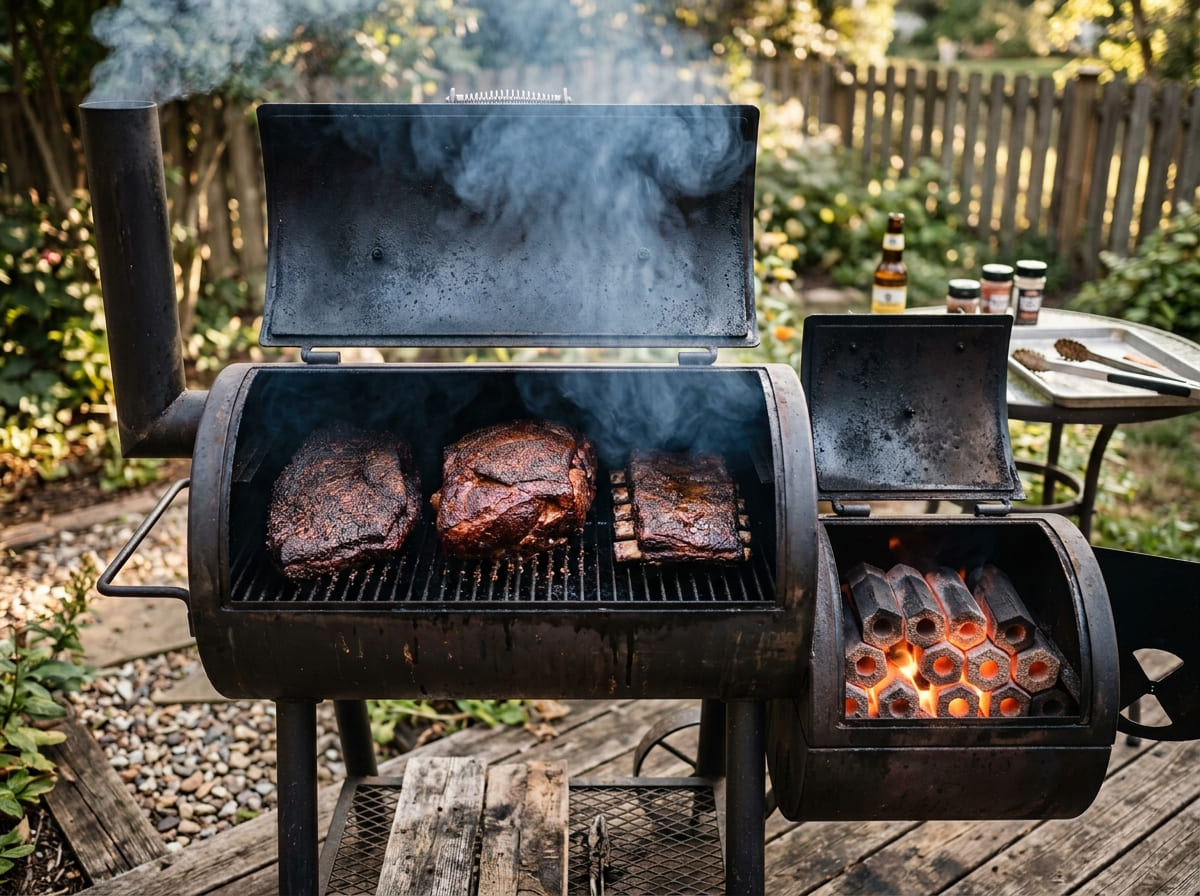
Low and slow cooking is unforgiving of fuel inconsistency. A brisket that cooks at 225°F for 12 hours requires a fuel source that maintains temperature within a narrow band for the entire duration. A temperature spike at hour seven overcooks the exterior. A temperature drop at hour nine extends the cook unpredictably and disrupts the stall management that separates competent smoke cooking from exceptional results.
Most charcoal is not built for this. Standard wood briquettes and lump charcoal deliver adequate performance for 45-minute direct grilling. They were not engineered for 10-14 hour indirect smoking sessions where temperature consistency is the only variable that matters.
Coconut charcoal’s physical properties align with low and slow cooking requirements in ways that other fuel types do not. This article explains why, and how to use it effectively for extended smoking sessions.
Why Low and Slow Cooking Demands Different Fuel
Direct grilling operates at 350-500°C at the grate level. Fuel inconsistency at this temperature range is manageable — the cook time is short enough that minor temperature variation does not accumulate into a significant outcome difference.
Low and slow smoking operates at 100-135°C at the cooking chamber level, maintained for 4-16 hours depending on the cut. At this temperature range, fuel inconsistency compounds over time. A fuel source that cycles between 95°C and 155°C across a 12-hour session produces meat with uneven texture, inconsistent bark development, and unpredictable timing that makes service planning impossible in a restaurant context.
Three fuel properties determine suitability for low and slow cooking:
Burn duration. Longer burn time per unit of charcoal reduces the frequency of fuel additions. Every fuel addition introduces a temperature disturbance — the new charcoal heats up, produces a temporary temperature spike, then settles. Fewer additions mean fewer disturbances and more consistent temperature across the session.
Heat output stability. A fuel that delivers consistent heat output from the first hour to the final hour maintains steady cooking chamber temperature without continuous intervention. Fuels that burn intensely early and fade significantly after peak combustion require compensating adjustments throughout the session.
Ash production. In a long session, ash accumulation restricts airflow to the fuel bed progressively. Low ash content charcoal maintains consistent airflow and therefore consistent combustion rate across the full session duration. High ash content charcoal requires periodic cleaning interventions that disturb temperature stability.
Coconut charcoal addresses all three requirements simultaneously. Its high fixed carbon content of 75-85% delivers longer burn duration and more stable heat output than wood alternatives. Its ash content below 5% reduces the airflow restriction that disrupts temperature consistency over extended sessions.
Coconut Charcoal vs. Wood Alternatives for Smoking
The standard fuel choices for low and slow smoking are wood lump charcoal, wood briquettes with binders, and hardwood chunks used alone or combined with charcoal. Each has specific characteristics that affect smoking performance.
Wood lump charcoal burns irregularly. Pieces vary in size, density, and wood species composition within a single bag. This variation produces inconsistent burn rates between pieces and makes temperature prediction difficult across a long session. Experienced pit operators compensate through frequent adjustment, but the compensation requires continuous attention that eliminates the hands-off advantage of a well-built low and slow setup.
Wood briquettes with chemical binders offer more consistency than lump wood but introduce off-flavors during the early combustion phase as chemical binders burn off. In a short grilling session, this phase passes before food enters the cooking chamber. In a low and slow setup where food enters the smoker early and stays for hours, the binder burnoff phase affects flavor development during the initial cooking period.
Hardwood chunks provide the smoke flavor that defines regional BBQ traditions. They do not provide consistent heat. Operators who use hardwood exclusively for fuel manage constant temperature swings as individual chunks ignite, peak, and decline at different rates.
Coconut charcoal versus hardwood charcoal performance comparison covers the specification differences in detail. The practical conclusion for low and slow applications is that coconut charcoal serves as the heat source and wood chunks serve as the flavor source. Using each material for what it does best produces better results than asking either material to perform both roles.
Smoke Flavor and Coconut Charcoal
The most common concern operators and serious home cooks raise about coconut charcoal for smoking is smoke flavor. Traditional BBQ culture associates specific wood species — post oak for Texas brisket, hickory for Memphis ribs, applewood for Pacific Northwest salmon — with specific regional flavor profiles. Coconut charcoal does not belong to any regional wood tradition.
This concern reflects a misunderstanding of how smoke flavor develops in low and slow cooking.
Coconut shell charcoal produces a neutral combustion profile. It does not impart wood-derived flavor compounds during combustion because the carbonization process has converted the original organic coconut shell material into carbon. The volatile organic compounds that create wood smoke flavor are no longer present after proper carbonization.
In low and slow cooking, this neutrality is an advantage. The coconut charcoal provides consistent heat. The wood chunks or chips the operator adds separately provide smoke flavor. Because the base fuel contributes no competing flavor compounds, the wood smoke flavor develops clearly and without interference.
An operator using hickory-smoke hardwood briquettes for both fuel and flavor gets hickory flavor whether they want it or not. An operator using coconut charcoal as the heat base can choose any smoke wood — or no smoke wood — without the base fuel constraining that decision. This flexibility suits restaurants that offer multiple regional BBQ styles or that customize smoke profiles for different menu items.
Why coconut charcoal delivers BBQ performance advantages covers the flavor neutrality point alongside heat performance specifications. For low and slow applications specifically, flavor neutrality is not a limitation. It is a feature.
Setting Up a Low and Slow Session with Coconut Charcoal
The Minion Method and the Snake Method are the two most widely used charcoal management techniques for extended low and slow sessions. Both work effectively with coconut charcoal, with specific adjustments that account for coconut charcoal’s longer burn time and slower ignition characteristics.
The Minion Method fills the fuel chamber with unlit charcoal and places a small quantity of fully lit charcoal on top. The lit charcoal ignites the unlit charcoal beneath it gradually, creating a slow front of combustion that moves through the fuel bed over several hours. This method suits offset smokers, kettle grills, and ceramic kamado-style cookers.
With coconut charcoal, the Minion Method requires full ignition of the starter quantity before placing it on the unlit bed. Coconut charcoal’s denser structure takes longer to reach the ignition temperature required to light adjacent pieces than wood lump charcoal does. A starter quantity that is partially lit rather than fully combusting may not propagate through the unlit bed reliably, which produces a temperature drop 30-40 minutes into the session when the partially lit pieces extinguish.
Practical setup: light 8-12 coconut charcoal pieces fully using a chimney starter — all surfaces glowing orange with no black patches — before placing them on the unlit bed. The fully lit pieces provide enough sustained heat to propagate combustion reliably through the adjacent unlit charcoal.
The Snake Method arranges charcoal in a C-shaped or spiral configuration around the perimeter of a kettle grill. A small quantity of lit charcoal placed at one end of the snake ignites adjacent pieces sequentially, creating a slow-moving combustion front that maintains consistent temperature for 6-10 hours without fuel additions.
Coconut charcoal’s consistent piece density makes it well-suited for the Snake Method. Irregular lump charcoal creates gaps in the snake where the combustion front may stall. Uniform briquettes — hexagonal or pillow format — pack consistently and maintain contact between adjacent pieces that allows the combustion front to propagate without interruption.
Wood chunks for smoke flavor sit on top of the snake at regular intervals rather than mixed throughout. As the combustion front reaches each chunk, it ignites and contributes smoke for 20-30 minutes before burning through. This spacing produces consistent smoke contribution across the session rather than heavy smoke early that tapers off as the wood depletes.
Temperature Management Across a Long Session
Maintaining 110-135°C in a cooking chamber for 8-12 hours requires understanding how coconut charcoal’s combustion characteristics interact with the cooking equipment’s airflow controls.
Initial temperature establishment. Coconut charcoal reaches peak combustion temperature more slowly than wood lump charcoal. Allow 20-30 minutes after the Minion or Snake setup is complete before placing food in the cooking chamber. The temperature will climb through the 150-180°C range as initial combustion establishes, then settle toward the target range as the combustion front stabilizes. Placing food before this stabilization period creates an inconsistent temperature environment during the first hour of cooking.
Airflow as the primary temperature control. Once steady-state combustion establishes, cooking chamber temperature responds primarily to airflow rather than fuel quantity. Opening intake vents increases oxygen supply to the fuel bed, which raises combustion rate and cooking chamber temperature. Closing vents reduces oxygen supply and lowers temperature. In a well-sealed cooker using quality coconut charcoal, temperature adjustments of ±15°C require only minor vent adjustments rather than fuel manipulation.
Resisting the urge to add fuel early. Operators transitioning from wood lump charcoal to coconut charcoal sometimes add fuel at the intervals their wood charcoal required — typically every 2-3 hours. Coconut charcoal’s extended burn duration does not require this frequency. Unnecessary fuel additions disturb temperature stability and waste charcoal. Monitor temperature and fuel bed visual indicators rather than adding charcoal on a fixed time schedule.
Recognizing the fuel bed transition. As coconut charcoal nears the end of its burn cycle, the characteristic orange glow fades and the pieces show increasing ash coverage. This visual transition precedes temperature drop by approximately 30-45 minutes — enough time to add fresh charcoal at the edge of the fuel bed where it can begin igniting from the residual heat before the existing fuel depletes completely.
Specific Applications: Cut-by-Cut Considerations
Different cuts and proteins have different temperature requirements and session durations that interact with coconut charcoal’s properties in specific ways.
Beef brisket (10-14 hours at 110-125°C). This is the most demanding low and slow application for fuel consistency. The extended session duration and the critical stall phase — where internal meat temperature plateaus at approximately 70°C for several hours as collagen converts to gelatin — require absolutely consistent cooking chamber temperature. Coconut charcoal’s extended burn duration reduces fuel additions to one or two events across a full brisket cook on a well-insulated smoker. Each addition disturbs the stall phase minimally compared to the more frequent additions that wood charcoal requires.
Pork shoulder and Boston butt (8-12 hours at 120-135°C). More forgiving of temperature variation than brisket. Coconut charcoal’s heat output stability suits this application well. The higher fat content in pork shoulder provides a buffer against minor temperature variation that leaner cuts do not have. Operators new to low and slow cooking with coconut charcoal often start with pork shoulder because the margin for error is wider.
Beef ribs and pork spare ribs (5-7 hours at 120-135°C). Shorter session duration than brisket but still benefits from coconut charcoal’s burn stability. A single properly loaded fuel bed handles the full rib cook on most kettle and offset smoker configurations without additions. The reduced session management suits restaurant operations where staff cannot monitor the smoker continuously.
Whole poultry (3-5 hours at 120-150°C). The shortest common low and slow application. Coconut charcoal’s longer burn duration means the entire cook completes well within a single fuel load. Temperature control at the higher end of the poultry smoking range — 135-150°C — is straightforward on coconut charcoal because the fuel responds predictably to vent adjustment at these temperatures.
Fish (1-3 hours at 80-110°C). The lowest temperature application in smoking. Coconut charcoal’s neutral smoke profile particularly suits fish smoking, where the delicate flavor of the protein is easily overwhelmed by strong wood smoke compounds. The operator controls smoke intensity entirely through wood chunk selection and quantity without the base fuel contributing competing flavors.
Commercial Smoking Operations: Volume and Consistency
Restaurants that operate dedicated smoking programs — whether a primary BBQ concept or a smoked component within a broader menu — face scaling considerations that home smoking setups do not encounter.
Fuel volume planning. A commercial offset smoker handling 40 kilograms of brisket across a 12-hour overnight cook consumes significantly more charcoal than a kettle grill handling a single brisket. Calculate fuel requirements based on cooking chamber volume, insulation quality, and ambient temperature rather than extrapolating from home setup experience. Well-insulated commercial smokers consume less fuel per hour than poorly insulated equipment at equivalent cooking chamber temperatures.
Consistency across multiple cooks. Commercial operations running the same smoker program daily need charcoal that performs identically across shipments. Batch-to-batch consistency in fixed carbon content, ash content, and moisture content determines whether the pitmaster’s established protocols produce consistent results or require recalibration with each new delivery. Request proximate analysis certificates for each incoming shipment and compare figures against the specification baseline established during initial testing.
Staff training for coconut charcoal transitions. Pitmasters and kitchen staff experienced with wood lump charcoal need specific guidance when transitioning to coconut charcoal. The longer ignition time, different combustion front propagation behavior, and extended burn duration all require adjusted protocols. Staff who apply wood charcoal timing and management instincts to coconut charcoal produce suboptimal results that they attribute to the new fuel rather than to the protocol mismatch.
Managing lead times and production schedules applies directly to commercial smoking operations that run continuous programs and cannot tolerate supply gaps. Establishing reliable delivery schedules prevents the improvised fuel substitutions that disrupt smoking consistency.
Pairing Wood Chunks with Coconut Charcoal
Since coconut charcoal contributes no flavor compounds to the smoke, wood selection becomes the primary flavor variable in the cooking setup. A few practical guidelines:
Use dry, seasoned hardwood chunks rather than green wood. Green wood produces excessive moisture vapor and acrid smoke compounds that overpower the clean smoke profile that coconut charcoal enables. Seasoned wood produces cleaner combustion and more refined smoke flavor.
Match wood species intensity to the protein. Strong smoke woods — hickory, mesquite, pecan — suit fatty, robust cuts like brisket and pork shoulder. Milder woods — apple, cherry, maple — suit poultry, fish, and leaner cuts where the meat flavor should remain primary.
Start with less wood than you expect to need. Coconut charcoal’s neutral base means wood smoke flavor develops more clearly than it does when competing with the base fuel’s own flavor compounds. Operators transitioning from flavored hardwood briquettes to coconut charcoal often find that half their previous wood chunk quantity produces equivalent smoke intensity.
Getting Started
Operators evaluating coconut charcoal for low and slow applications benefit from a structured testing approach before committing to full volume orders. Run a side-by-side session — current fuel source versus coconut charcoal — on the same cut at the same target temperature. Track fuel consumption per hour, temperature stability across the session, and ash accumulation rate. The results provide a direct operational comparison rather than a specification comparison.
Our BBQ briquettes in both hexagonal and pillow formats meet the specification requirements for low and slow applications: fixed carbon content of 75-85%, ash content below 5%, moisture content below 8%, and burn times exceeding 3 hours at standard cooking temperatures. Request samples for kitchen testing before placing a first order. We include proximate analysis documentation with every sample shipment. For commercial volume purchasing, our wholesale coconut charcoal page covers minimum order quantities and logistics details.