
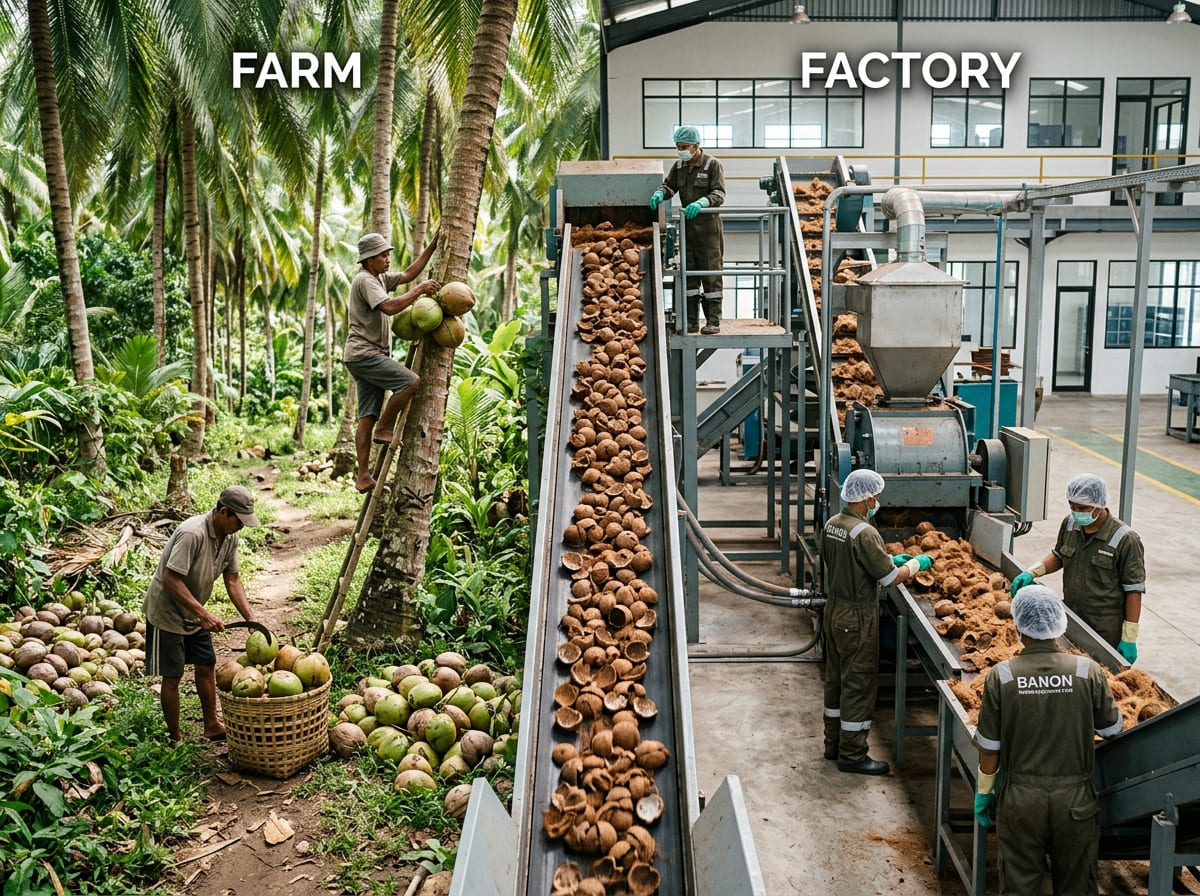
The coconut shell charcoal industry faces growing scrutiny from international buyers who want to know exactly where their product comes from. Restaurant chains, hookah lounge operators, and distributors increasingly ask: Which farms supplied these shells? How were they collected? Can you prove sustainable sourcing?
We’ve seen this shift accelerate over the past five years. European buyers now commonly request farm-level documentation. Middle Eastern distributors want proof that shells come from legitimate agricultural sources, not endangered forest areas. North American importers need traceability data to satisfy corporate sustainability commitments.
Supply chain transparency isn’t just a compliance requirement anymore. It’s become a competitive advantage that separates professional exporters from commodity suppliers who can’t document their sourcing practices.
Why Traceability Matters for Coconut Shell Charcoal
Coconut shells are agricultural waste products, but not all shells are equivalent. Quality, sustainability credentials, and legal compliance depend entirely on where shells originate and how they reach the carbonization facility.
Quality Consistency Starts at the Source
Shell quality varies based on coconut variety, growing conditions, harvesting timing, and post-harvest handling. Shells from copra production (where coconuts are opened for meat extraction) differ from shells from coconut water processing. Mature coconuts produce denser shells with higher fixed carbon content than young coconuts harvested primarily for water.
When you know which farms supplied shells for a specific production batch, you can correlate charcoal performance with source characteristics. One of our restaurant clients in Dubai noticed their charcoal burn time varied between shipments. After we implemented farm-level tracking, we identified that shells from coastal farms produced slightly different carbonization results than shells from inland plantations. This insight let us optimize shell sourcing for consistent product performance.
Sustainability Claims Need Documentation
Many buyers market their businesses as eco-friendly or sustainable. These claims only work if you can prove your charcoal comes from genuine agricultural waste, not from cutting down forests or purchasing from questionable sources.
European Union regulations increasingly require sustainability documentation for imported biomass products. While current requirements focus mainly on energy applications, the regulatory trend points toward broader coverage. Buyers in Germany and Netherlands already request documentation showing shells came from productive coconut farms, not from land clearing activities.
Preventing Illegal Sourcing
Indonesia has strict regulations about forest protection and land use. Coconut shells from legitimate agricultural operations are legal and sustainable. Shells harvested from protected forest areas or from illegal land clearing activities violate environmental laws.
Traceability systems protect both suppliers and buyers from unknowingly participating in illegal supply chains. Law enforcement and customs officials in several countries now spot-check charcoal shipments for sourcing documentation. Exporters who can’t prove legitimate agricultural sourcing face detention, fines, or import bans.
Read: Coconut Shell Charcoal vs Sawdust Charcoal Briquettes: Premium vs Budget Breakdown
How Farm-to-Factory Traceability Works
Effective traceability requires systematic documentation at each supply chain stage: farm collection, aggregation, transportation, and factory processing.
Farm-Level Documentation
The process starts when coconut processors (copra mills, desiccated coconut factories, or coconut oil facilities) separate shells from other coconut components. These processors should maintain records showing which farms supplied coconuts for each production batch.
Basic farm documentation includes the farm name and location, farmer identification number or business registration, approximate land area under coconut cultivation, and coconut variety planted. More sophisticated systems add GPS coordinates, land ownership documentation, and sustainability certifications.
Many Indonesian coconut farms are small operations, often 2-5 hectares managed by individual families. These farmers typically don’t maintain extensive records. The responsibility for documentation usually falls on the aggregator or processor who purchases coconuts from multiple small farms.
Aggregation and Collection Points
Most coconut shells move through aggregation points before reaching charcoal manufacturers. A village-level collector might gather shells from 20-30 small farms. A regional processor might consolidate shells from multiple collectors.
Each aggregation point should document the volume received, source locations, collection dates, and moisture content. This documentation links shells back to farm origins while creating batches large enough for efficient transportation to carbonization facilities.
We work with collection networks across East Java where aggregators maintain simple ledgers recording which villages supplied shells each week. These records aren’t sophisticated, but they provide the chain of custody needed to verify legitimate agricultural sourcing.
Transportation Records
Shells move from collection points to carbonization facilities by truck, typically in loads of 3-8 tons. Transportation records document the pickup location, delivery location, weight, and transport date.
These records serve two purposes: they verify the physical movement of materials and they help identify contamination sources if quality issues arise. If a particular truck load produces poor carbonization results, transportation records help trace the problem back to specific collection areas.
Factory Intake Documentation
When shells arrive at the carbonization facility, intake documentation records the source, quantity received, moisture content, and physical inspection results. Most facilities assign batch numbers at intake that follow materials through the entire production process.
Quality control testing at intake measures moisture content, shell size distribution, contamination levels, and general condition. Shells with excessive moisture (above 15%) require additional drying before carbonization. Shells contaminated with dirt, metal, or plastic need cleaning. Documentation of these intake conditions helps optimize processing parameters and troubleshoot quality variations.
Production Batch Tracking
During carbonization, shells from specific sources are processed in trackable batches. A modern carbonization facility might process 10-15 tons per batch over 6-8 hours. Each batch should be tagged with source information, carbonization parameters, and quality test results.
This batch-level tracking creates the link between finished charcoal and original shell sources. When you order coconut charcoal from a facility with robust traceability, they can tell you which farms supplied the shells for your specific containers.
Technology Solutions for Enhanced Traceability
Traditional paper-based record keeping works but has limitations. Information gets lost, handwriting becomes illegible, and consolidating data across multiple collection points is time-consuming.
Digital Tracking Systems
Some Indonesian charcoal producers now use smartphone-based systems where collectors photograph documentation and log quantities digitally. These systems sync data to cloud databases accessible by quality control teams and export departments.
Digital systems reduce errors and make data retrieval much faster. When a buyer asks about sourcing for a specific shipment, export staff can pull complete supply chain documentation in minutes rather than searching through paper files for hours.
The technology doesn’t need to be complex. Simple spreadsheet systems with standardized data entry forms work well for small to medium operations. Larger facilities handling shells from hundreds of source locations benefit from purpose-built traceability software.
QR Codes and Batch Identification
Advanced operations now mark packaging with QR codes linking to complete batch traceability data. Buyers scan the code to access information about farm sources, carbonization parameters, quality testing results, and shipping documentation.
This transparency builds trust and differentiates suppliers in competitive markets. A hookah lounge owner in Berlin can show customers exactly where their charcoal originated and how it was produced. A restaurant chain can verify that all locations use charcoal from verified sustainable sources.
Blockchain Experiments
A few Indonesian agricultural exporters are testing blockchain-based traceability systems that create immutable records of supply chain transactions. Each transfer of custody—from farm to collector to factory to exporter—generates a blockchain entry that can’t be altered retroactively.
These systems are still experimental and add significant cost and complexity. For most charcoal buyers, simpler digital documentation systems provide adequate traceability without blockchain’s overhead. The technology might become more relevant as regulatory requirements increase and international standards emerge.
Read: Two-Zone Grilling with Coconut Briquettes
Challenges in Implementing Traceability
Building effective traceability systems in Indonesian coconut supply chains faces several practical obstacles.
Fragmented Supply Chains
Indonesia’s coconut industry involves thousands of small farms, hundreds of local collectors, and dozens of processing facilities. Shells often pass through 3-4 intermediaries before reaching carbonization facilities. Each transition creates documentation challenges and information loss risks.
Exporters who want complete traceability need to work closely with their shell suppliers to implement consistent documentation practices. This often means providing training, supplying standardized forms, and creating incentives for accurate record keeping.
Limited Farmer Literacy and Technology Access
Many coconut farmers have limited formal education and minimal experience with documentation systems. Asking elderly farmers to maintain detailed records about coconut sales isn’t realistic in many rural areas.
Practical solutions focus on aggregator-level documentation rather than farm-level records. A village collector who purchases from 30 farms can maintain one record covering all sources. This approach sacrifices some granularity but remains practical given ground-level realities.
Cost and Time Investment
Implementing traceability systems requires investment in staff training, documentation materials, and potentially technology infrastructure. Small operations struggle to justify these costs when many buyers don’t yet require traceability documentation.
The business case strengthens as premium buyers willing to pay higher prices for traceable product enter the market. European buyers often accept 5-10% price premiums for charcoal with complete supply chain documentation. This premium helps offset traceability system costs.
Verification and Auditing
Documentation only creates value if it’s accurate. Some suppliers create false traceability records to satisfy buyer requirements without actually implementing real tracking systems.
Independent verification through third-party audits helps ensure traceability system integrity. Organizations like Rainforest Alliance or Fair Trade conduct on-site audits that verify documentation matches physical realities. These audits cost USD 2,000-5,000 annually but provide credible evidence of legitimate traceability practices.
Read: What is Shisha Coconut Charcoal and Why is it Preferred?
What Buyers Should Look For
When evaluating charcoal suppliers’ traceability capabilities, focus on specific documentation and verification methods rather than general sustainability claims.
Request Sample Documentation
Ask suppliers to provide traceability documentation for a sample shipment. Complete documentation should show the origin of shells (specific districts or villages at minimum), collection dates, transportation records, factory intake documentation, carbonization batch records, and quality control test results.
Review this documentation for internal consistency. Do the quantities add up correctly? Are dates logical and sequential? Does the documentation reference specific locations and individuals rather than vague general descriptions?
Verify with Third-Party Inspections
Independent inspection firms like SGS can verify traceability documentation accuracy as part of pre-shipment inspections. Inspectors visit collection sites and factories to confirm that documented processes actually occur and that records match physical operations.
This verification costs USD 300-600 per inspection but provides strong evidence of legitimate traceability systems. For large orders or new supplier relationships, the cost is modest insurance against fraudulent documentation.
Look for Certification Programs
Several certification programs incorporate traceability requirements. Organic certifications require documented supply chains showing shells came from certified organic coconut farms. Fair Trade certifications mandate transparent sourcing with verified farmer payments.
These certifications don’t guarantee perfect traceability, but they indicate a supplier has invested in systematic documentation practices and submits to regular third-party audits.
Assess Supplier Scale and Integration
Vertically integrated suppliers who own or directly manage collection networks typically have better traceability than exporters who purchase shells through multiple layers of intermediaries. A supplier who works with 20 village-level collectors in a specific region can implement consistent documentation more easily than an exporter buying from commodity markets.
Smaller, specialized operations often have better traceability than large commodity exporters handling shells from diverse sources. A producer focused on premium markets has stronger incentives to invest in traceability systems than a volume-oriented exporter serving price-sensitive markets.
Future Trends in Charcoal Traceability
Traceability requirements will likely strengthen as sustainability regulations expand and corporate environmental commitments intensify.
Regulatory Development
The European Union’s deforestation regulations already require extensive traceability for commodities linked to forest clearing. While coconut shells currently fall outside these regulations, future iterations might expand coverage. Buyers serving EU markets should prepare for stricter documentation requirements over the next 3-5 years.
Similar regulatory discussions are occurring in North America and some Asian markets. The trend clearly points toward mandatory traceability for agricultural commodities, even those considered waste products.
Consumer Demand for Transparency
Restaurant customers increasingly ask about ingredient and supply sourcing. Shisha lounge patrons want to know their experience doesn’t harm the environment. This consumer interest creates business incentives for traceability that go beyond regulatory compliance.
Suppliers who can provide compelling sustainability stories backed by verifiable traceability data will capture premium market segments. A restaurant can advertise “charcoal from verified sustainable Indonesian farms” as a point of pride and differentiation.
Integration with Quality Management
Forward-thinking suppliers are integrating traceability with quality management systems. By correlating charcoal performance characteristics with specific source farms and processing batches, they can optimize sourcing and production parameters for consistent quality.
This integration transforms traceability from a compliance burden into a quality improvement tool. The documentation required for sustainability verification simultaneously enables better production management and product consistency.
How Omnico Approaches Traceability
We maintain direct relationships with coconut processors and collection networks across East Java. Our shell sourcing focuses on established agricultural areas with documented coconut cultivation, not recently cleared land or questionable sources.
Our aggregation partners maintain records showing which districts supplied shells for each delivery to our facilities. We track shells through intake documentation that records source information, delivery dates, moisture content, and physical condition. Each carbonization batch receives identification numbers that link finished charcoal back to source documentation.
For buyers who need enhanced traceability, we can provide detailed documentation packages showing shell origins, collection dates, transportation records, carbonization parameters, and quality testing results. We work with independent inspection firms who verify our documentation accuracy and conduct periodic audits of our collection networks.
Our facility locations in established coconut-growing regions give us direct access to legitimate agricultural waste streams. We don’t purchase shells from unknown sources or through long intermediary chains where traceability becomes difficult to verify.
We’re currently upgrading our systems to include GPS documentation of collection points and digital record keeping that makes information retrieval faster and more reliable. These improvements help us meet increasing buyer expectations for supply chain transparency while strengthening our internal quality management.
Ready to discuss traceability documentation for your charcoal orders? Our team can explain our sourcing practices in detail and provide the documentation your business needs to verify sustainable supply chains. Contact us to learn more about our farm-to-factory tracking systems.