
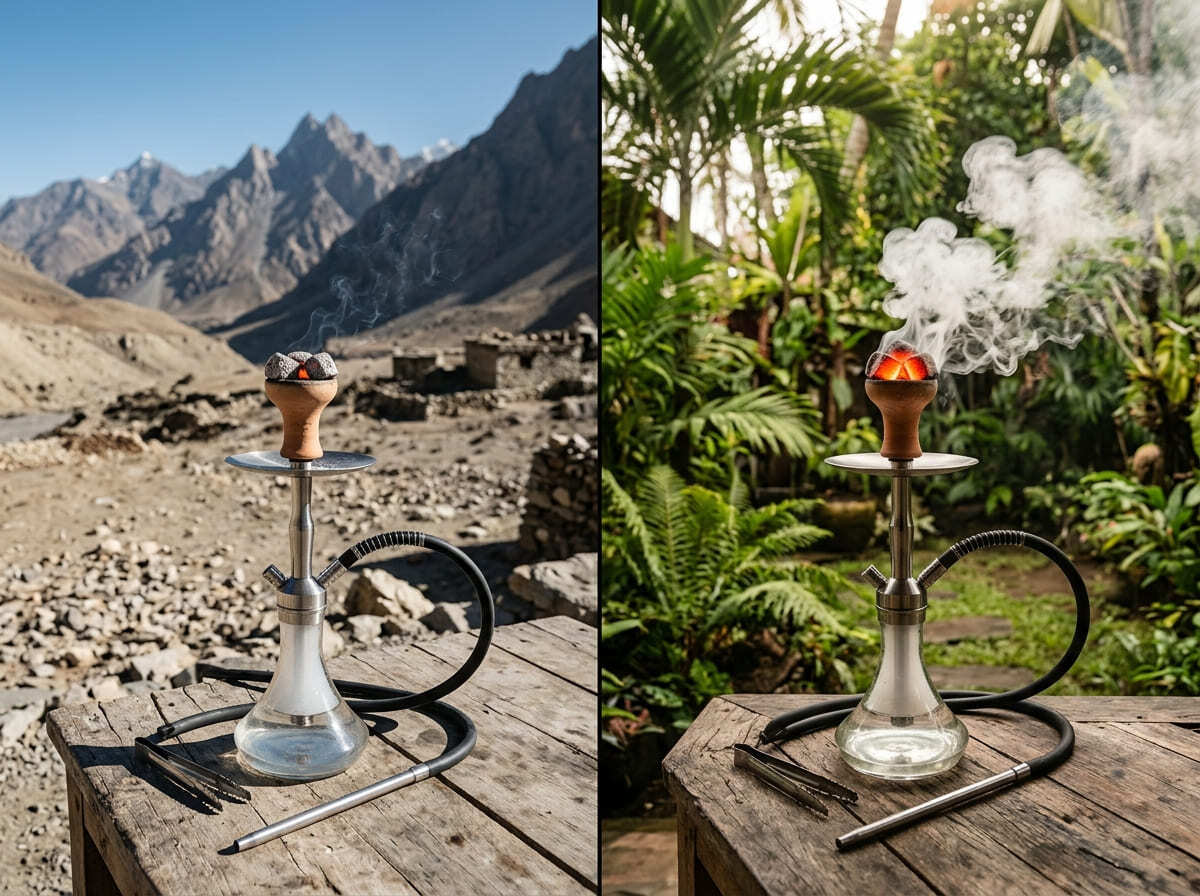
A distributor supplying shisha lounges across multiple cities occasionally receives contradictory feedback about the same product. Lounges at sea level report consistent 85-minute burn times. A lounge in a highland city reports the same charcoal burning out at 60 minutes. Another customer in a coastal humid climate reports sparking and uneven combustion on product that performs flawlessly elsewhere.
Same charcoal. Same specification. Different environments. Different results.
Altitude and humidity are the two environmental variables that most significantly affect charcoal burning time and combustion behavior. Neither appears on a proximate analysis certificate. Both require understanding to manage customer expectations and prevent misdirected quality complaints.
The Chemistry Behind Environmental Effects
Charcoal combustion is an oxidation reaction. Carbon combines with oxygen to produce heat, carbon dioxide, and carbon monoxide. The rate of this reaction — and therefore the heat output and burn duration — depends on how much oxygen reaches the combustion zone per unit of time.
Two environmental variables control oxygen availability at the combustion surface: atmospheric pressure, which determines oxygen density in the air, and relative humidity, which determines how much of that air is water vapor rather than oxygen. Altitude reduces atmospheric pressure. High humidity displaces oxygen with water vapor. Both effects reduce the oxygen supply to the burning charcoal.
Understanding what drives charcoal combustion at the molecular level connects proximate analysis specifications to real-world environmental performance. Fixed carbon content, volatile matter, and moisture content all interact with these environmental variables in ways that matter for end-user experience.
How Altitude Affects Burning Time
Atmospheric pressure decreases as altitude increases. At sea level, atmospheric pressure is approximately 101.3 kPa. At 1,500 meters above sea level, it drops to approximately 84.5 kPa — a 17% reduction. At 2,500 meters, pressure reaches approximately 74.7 kPa, a 26% reduction from sea level.
Lower pressure means lower oxygen density. A given volume of air at 2,500 meters contains 26% less oxygen than the same volume at sea level. Charcoal burning at altitude receives less oxygen per breath of airflow, which slows the oxidation rate and reduces heat output.
The practical effects for shisha sessions at altitude:
Burn time increases, not decreases. This is counterintuitive and frequently misunderstood. Lower oxygen availability slows the combustion rate. The charcoal oxidizes more slowly, which means each gram of carbon lasts longer. A cube that burns for 80 minutes at sea level may burn for 95-110 minutes at 2,000 meters under identical session conditions.
Heat output per unit time decreases. The cube lasts longer but delivers less heat intensity at any given moment. For shisha, this means the tobacco bowl receives less heat per minute. Users who do not compensate for this produce thin, cool smoke. The session lasts longer, but the experience quality drops.
Ignition takes longer. Getting a cube to reach full combustion temperature requires more sustained external heat input at altitude. An electric coil that lights a cube in 8 minutes at sea level may need 11-13 minutes at 2,000 meters. Users who light charcoal for their usual duration and transfer it to the bowl before it is fully lit experience the under-ignition problems that produce mid-session blackening and inconsistent performance.
The altitude threshold that matters. Below 800 meters, altitude effects on shisha charcoal performance are negligible for practical purposes. Between 800 and 1,500 meters, effects are noticeable for experienced users but manageable with minor session adjustments. Above 1,500 meters, altitude requires deliberate compensation in charcoal selection, lighting protocol, and session setup.
Markets Where Altitude Matters
Many significant shisha markets include high-altitude cities where these effects apply directly.
Addis Ababa, Ethiopia sits at approximately 2,355 meters. Amman, Jordan ranges from 700 to 1,100 meters depending on the district. Bogotá, Colombia sits at 2,640 meters. Nairobi, Kenya sits at approximately 1,795 meters. Mexico City sits at 2,240 meters. Riyadh, Saudi Arabia sits at approximately 612 meters — close enough to negligible, but highland districts reach higher.
Distributors supplying these markets and receiving burn time complaints longer than the specification should consider altitude as the explanation before investigating product quality. A customer in Addis Ababa reporting 100-minute burn times from a product specified at 80-85 minutes is experiencing the physics of high-altitude combustion, not a product anomaly.
Conversely, a customer in the same city reporting insufficient heat for a satisfying session is experiencing the reduced heat output per unit time that accompanies longer burn duration at altitude. The solution is not different charcoal. It is adjusted session management — more cubes, different HMD vent settings, or a different bowl configuration.
Optimizing the heat curve for long hookah sessions provides the session management framework that applies to altitude compensation as much as to standard setup optimization.
Charcoal Specifications That Perform Best at Altitude
Not all charcoal handles altitude equally. Two specification variables determine altitude resilience:
Fixed carbon content. Higher fixed carbon content — 80-85% rather than the lower end of the 75-85% range — provides more combustible material per gram. At altitude, where each gram burns more slowly due to oxygen restriction, higher fixed carbon content maintains adequate heat output per unit time. Charcoal at the lower end of the fixed carbon range struggles to deliver sufficient heat at altitude even with extended burn time.
Cube size. Larger cubes perform better at altitude for shisha sessions. A 27mm cube provides more thermal mass than a 25mm cube. Greater thermal mass sustains combustion temperature better under conditions of reduced oxygen supply. Distributors supplying high-altitude markets should evaluate 27mm cube performance alongside standard 25mm and 26mm formats.
Ash content. Low ash content — below 5% — matters more at altitude than at sea level. Ash accumulation insulates the cube surface and restricts already-limited oxygen access. At sea level, adequate airflow manages ash accumulation reasonably well. At altitude, where airflow carries less oxygen per volume, ash insulation has a proportionally larger effect. Ash content below 3% represents a meaningful performance advantage specifically for high-altitude markets.
How Humidity Affects Burning Time
Humidity operates through two distinct mechanisms that affect charcoal at different stages: ambient humidity during the session, and absorbed moisture within the briquette itself.
Ambient humidity during the session. Water vapor in the air displaces oxygen. At 80% relative humidity, approximately 3-4% of the air volume is water vapor rather than oxygen. This reduces the effective oxygen concentration reaching the combustion zone. The effect is smaller than altitude — high ambient humidity does not reduce oxygen availability as dramatically as significant elevation — but it compounds with other variables.
In very high humidity environments above 85% RH, ambient humidity contributes measurably to reduced combustion intensity. Sessions in outdoor coastal setups during humid season in tropical markets — Southeast Asia, West Africa, the Caribbean during wet season — produce slightly shorter effective burn times and reduced heat intensity compared to the same setup in dry conditions. The difference is typically 8-12 minutes on a standard 80-minute cube.
Absorbed moisture within the briquette. This mechanism is far more significant than ambient humidity during the session. Charcoal that has reabsorbed moisture during storage carries that water into the combustion zone. As the briquette heats, water converts to steam, which absorbs heat from the surrounding carbon. This heat absorption drops local combustion temperature and reduces burn rate.
The interaction is not linear. A briquette at 10% moisture content does not simply burn 25% longer than one at 8% moisture. The moisture actively suppresses combustion temperature, which reduces heat output while simultaneously reducing the sustained burn time in some zones and causing sparking and mid-session blackening in others. The overall effect is degraded performance across multiple dimensions simultaneously.
Proper storage to prevent moisture reabsorption is the only effective control for this mechanism. Charcoal that arrives correctly specified and gets stored poorly performs as if it were poorly specified.
The Compound Effect: High Altitude Combined with High Humidity
Some markets experience both high altitude and high humidity simultaneously. Highland cities in tropical regions — parts of Ethiopia, Colombia, East Africa, and highland Southeast Asia — sit above 1,500 meters while experiencing significant ambient humidity during certain seasons.
In these environments, the two effects compound. Reduced atmospheric pressure limits oxygen density. High ambient humidity further displaces available oxygen with water vapor. The net result is a more significant reduction in combustion intensity than either variable produces independently.
Distributors supplying markets with this compound condition need to address both variables in their product recommendation:
Higher fixed carbon content — targeting the 82-85% end of the specification range rather than 75-78% — provides more combustible material per gram to compensate for reduced oxygen availability. Lower ash content — targeting below 3% rather than the standard below 5% threshold — reduces the insulation effect that compounds under restricted airflow. Larger cube format — 26mm or 27mm rather than 25mm — provides the thermal mass to sustain combustion temperature under compound oxygen restriction.
These are specification choices, not product category changes. Premium coconut shell charcoal produced under controlled carbonization conditions achieves all three targets within a standard product range.
Seasonal Variation and Its Effect on Customer Feedback
A pattern many distributors encounter without understanding its cause: customer feedback about burn time and heat performance fluctuates seasonally without any change in the product.
A distributor supplying a humid tropical market receives consistent positive feedback during the dry season months. As the wet season arrives, complaints about reduced heat output and shorter effective burn time increase. The distributor investigates the supplier. The proximate analysis shows no change in specification. The product has not changed. The environment has.
Seasonal humidity shifts change both the ambient combustion conditions and the rate at which stored charcoal reabsorbs moisture from the air. Both effects degrade performance. The degradation is predictable, seasonal, and manageable — but only if the distributor understands the mechanism.
The practical response has two components: adjust storage protocols during high-humidity season as covered in bulk storage guidelines, and set customer expectations proactively. Lounge operators who understand that session management requires minor adjustment during humid season — slightly longer lighting time, one additional cube for long sessions, more frequent ash rotation in HMDs — experience the seasonal shift as a manageable variable rather than a quality failure.
Session Adjustments for Different Environments
Communicating environmental compensation techniques to end customers is part of effective distribution in markets where altitude or humidity is a significant variable. These are the adjustments that work:
At altitude above 1,500 meters: Extend initial lighting time by 2-4 minutes beyond standard protocol to ensure full ignition before transferring to the bowl. Use 26mm or 27mm cubes rather than 25mm for longer thermal mass. Open HMD vents wider than standard settings to compensate for lower ambient oxygen density. Add one additional cube for sessions intended to exceed 75 minutes.
In high ambient humidity above 75% RH: Verify inner packaging seal integrity before every session. Light charcoal for the full standard protocol duration — do not shorten lighting time in humid conditions. Rotate cubes in the HMD at 45-minute intervals rather than 60-minute intervals to clear ash buildup that compounds under reduced oxygen conditions.
In compound high-altitude and high-humidity environments: Apply both sets of adjustments simultaneously. Prioritize charcoal specifications at the higher end of the fixed carbon range and lower end of the ash content range when placing orders for these markets.
What This Means for Distributors
The practical implication for distributors operating across multiple markets is that one specification does not produce identical performance everywhere. The same charcoal burns differently in Nairobi than in Dubai, and differently in coastal Lagos than in highland Bogotá.
This does not require stocking different products for different cities. It requires understanding which environmental variables apply to each market and translating that understanding into customer communication, storage protocol guidance, and appropriate specification selection.
Our client base spans 15 countries across varying altitude and humidity conditions. We have observed these patterns across markets and factor them into the specification guidance we provide with each order. Distributors who want market-specific recommendations can discuss their destination conditions when placing orders or requesting samples.Contact us to discuss which specification best suits your market’s environmental conditions. We can also connect you with our first-time buyer process if you are evaluating suppliers for a new market.