
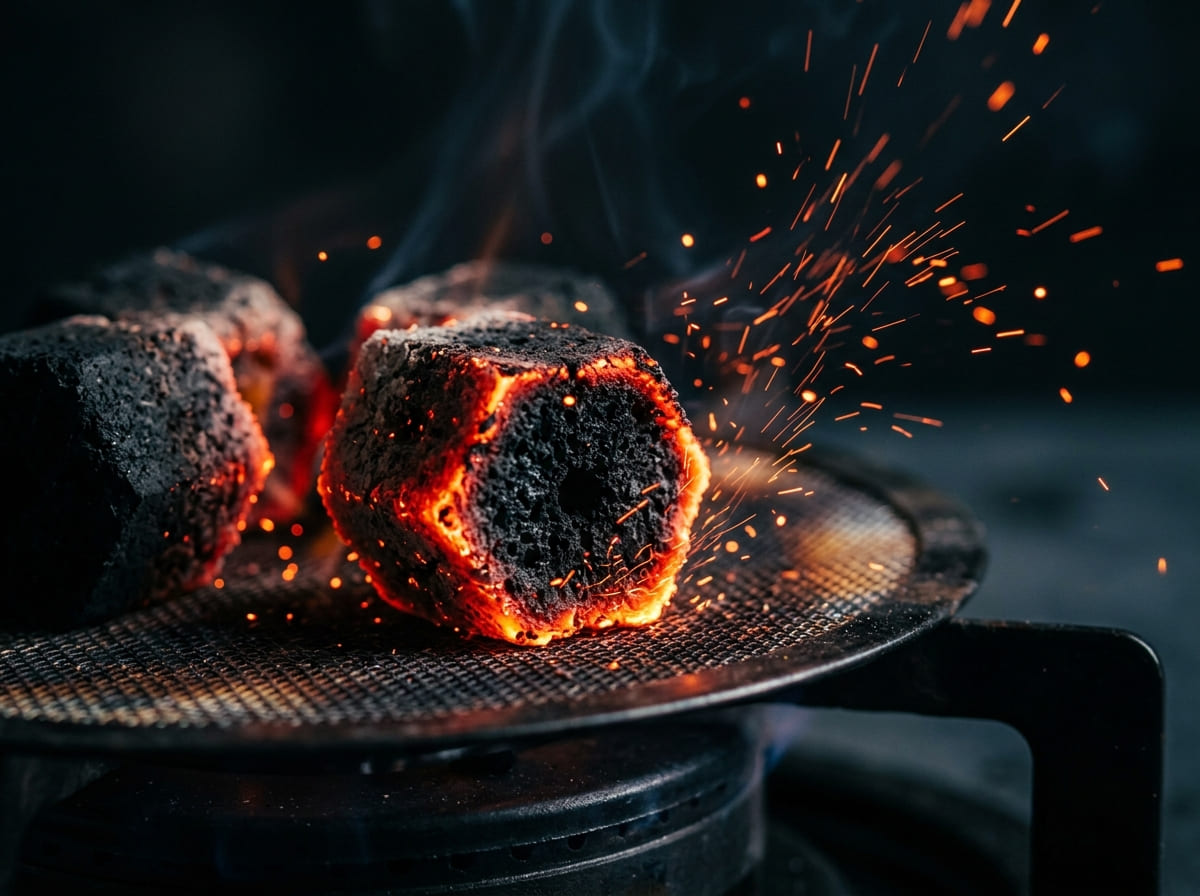
Sparking during lighting is one of the most common complaints shisha charcoal buyers pass back to their distributors. Customers blame the product. Distributors question the supplier. The root cause, in most cases, is traceable to specific production variables that quality-controlled charcoal avoids entirely.
This article explains what causes sparking, which variables contribute most, and what specifications to verify before purchasing.
What Sparking Actually Is
When a charcoal cube sparks during lighting, it ejects small particles of burning material. These particles travel outward from the cube surface and land on the tray, the table, or the user.
The mechanism behind sparking is rapid, localized pressure release. Moisture or volatile compounds trapped inside the charcoal vaporize faster than the surrounding material can allow them to escape. The pressure builds in a small pocket and releases suddenly, ejecting a fragment of the outer surface.
Understanding volatile matter in charcoal is the starting point for understanding sparking. Volatile matter percentage and moisture content are the two proximate analysis readings most directly connected to spark behavior.
Cause 1: High Moisture Content
Moisture is the most common cause of sparking in shisha charcoal.
Water trapped inside a briquette does not evaporate gradually and calmly during lighting. When a cube reaches 100°C internally, the moisture converts to steam. If the charcoal is dense and the steam has no efficient path to the surface, pressure builds. The release produces a crack, a pop, or an ejected fragment — what users describe as sparking.
The threshold matters. Charcoal with moisture content below 8% lights with predictable, controlled behavior. Moisture content between 10% and 15% produces occasional sparking. Above 15%, sparking becomes consistent and severe enough to damage the product’s reputation in the market.
Premium shisha charcoal specifies moisture content below 8%. This figure appears in the proximate analysis certificate that reputable suppliers include with every shipment. Buyers who do not request this document cannot verify what they are importing.
Drying methods affect final moisture content significantly. Sun-dried charcoal absorbs ambient humidity during storage and transport. Oven-dried charcoal reaches a consistent moisture level that remains stable inside sealed packaging. Buyers importing to humid climates — Southeast Asia, West Africa, parts of the Caribbean — should specify oven-dried product and verify packaging integrity on arrival.
Cause 2: High Residual Volatile Matter
Volatile matter refers to the gases and compounds that escape charcoal when it is heated, excluding moisture. In well-carbonized coconut shell charcoal, volatile matter content sits between 10% and 20%. Above 25%, the charcoal has not completed the carbonization process.
Under-carbonized charcoal sparks for the same reason as wet charcoal: pressure builds as trapped compounds vaporize. The difference is that volatile matter burns as it escapes. Users see small flames or flares coming off the cube surface in addition to ejected particles.
The carbonization process drives this variable. Different carbonization systems produce different volatile matter outcomes. Drum kilns process material inconsistently — outer shells carbonize fully while the interior remains under-processed. Retort and continuous systems deliver uniform temperature across the entire batch, which produces consistent volatile matter readings.
A proximate analysis showing fixed carbon content of 75-85% and volatile matter below 20% confirms adequate carbonization. Suppliers who cannot provide this data cannot confirm their product meets the specification.
Cause 3: Inconsistent Binder Composition
Charcoal briquettes require a binder to hold the compressed powder together. The binder choice and its percentage in the formula affect how the cube behaves during lighting.
Starch-based binders — cassava starch and corn starch are the most common in coconut charcoal production — burn cleanly and do not contribute to sparking when used at the correct ratio. Binder content typically runs between 5% and 12% of total briquette weight. Below 5%, the briquette lacks structural integrity and crumbles. Above 12%, the excess starch burns unevenly during lighting and produces the small flares that users mistake for sparking.
Some lower-quality producers substitute cheaper binders, including sawdust or chemical accelerants. Sawdust binders produce visible smoke and contribute to off-flavors in the session. Chemical accelerants cause aggressive sparking during lighting and are the primary ingredient in quick-light charcoal — a product category that shisha users increasingly reject for health reasons.
Binder science in briquette production is not complicated, but it requires consistent sourcing and measurement. Production facilities that weigh binder additions per batch rather than estimating by volume produce more consistent results.
Cause 4: Incomplete Curing After Pressing
After pressing, briquettes need time to cure. Curing allows the binder to set fully and the residual moisture from the pressing process to escape.
Charcoal shipped before adequate curing is complete behaves like wet charcoal during lighting. The moisture introduced during pressing has not left the briquette. The result is sparking that buyers attribute to the raw material, when the actual cause is a production timeline cut short.
Curing time depends on ambient temperature, humidity, and drying method. Properly cured briquettes measure below 8% moisture before packaging. Facilities that skip or shorten curing to meet shipping schedules produce product that performs poorly in the destination market.
This cause is difficult to detect from a specification sheet alone. It shows up in briquette defect inspections and in the field, when customer complaints arrive 60 to 90 days after the shipment clears customs.
Cause 5: Physical Damage and Micro-Fractures
A structurally intact cube lights evenly. A cube with internal fractures or surface damage creates uneven pressure zones during lighting, and sparking occurs at fracture points.
Physical damage enters the product at two stages: during production and during shipping.
During production, briquettes fracture when the compression force is inconsistent, when the binder ratio is too low, or when the product moves through drying and packaging equipment that generates excessive impact. Strength drop tests measure a briquette’s resistance to impact. Products that fail drop tests at the factory produce higher sparking rates in the market.
During shipping, vibration from ocean freight causes briquette-to-briquette impact inside the carton. Inner packaging that does not cushion the product allows this to accumulate across a 30-35 day voyage. On arrival, cubes that appear intact externally may have developed micro-fractures that cause sparking during lighting.
Export packaging engineering addresses this. Properly designed cartons with appropriate inner packaging reduce in-transit damage to negligible levels. Buyers who receive product with elevated sparking rates should inspect packaging integrity before concluding the issue is with the charcoal itself.
Cause 6: Storage Conditions After Arrival
Even correctly produced and shipped charcoal sparks if it absorbs moisture after arrival.
Coconut shell charcoal is hygroscopic. It absorbs moisture from the surrounding air, and it does so faster in humid environments. A shipment that arrives at 7% moisture content can reach 12% or higher within weeks if stored in an unsealed warehouse in a coastal or tropical location.
Post-arrival quality checks should include a moisture reading on arrival and a second reading 30 days later if the product enters humid storage. Distributors who skip these checks cannot distinguish between a supplier quality problem and a storage problem — and that distinction matters when filing a claim with the supplier.
Sealed inner packaging, ideally foil-lined or moisture-barrier poly, protects the product through storage. Buyers who repack product into unlined bags or open-top containers after arrival create the moisture problem themselves.
What Buyers Should Verify
Sparking-free performance comes from verifiable specifications, not supplier promises. Before placing an order, request:
- Proximate analysis certificate showing moisture content below 8%, volatile matter below 20%, and fixed carbon content of 75-85%
- Binder composition and percentage
- Curing and drying method documentation
- Drop test or breakage resistance results
- Packaging specification for the inner bag and outer carton
Suppliers who cannot provide these documents cannot guarantee consistent spark-free performance. Suppliers who can provide them have built the production controls that make consistent performance possible.
Our Standards
Our shisha cubes measure below 8% moisture content and below 20% volatile matter across all formats. We use food-grade cassava starch binders at controlled ratios, dry in oven systems, and cure before packaging. Every shipment includes a proximate analysis certificate.
Request samples to test performance before committing to a full order. We can also arrange a first-time buyer walkthrough of our documentation and quality process.